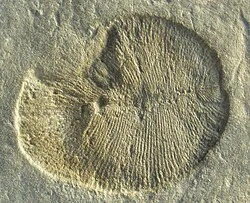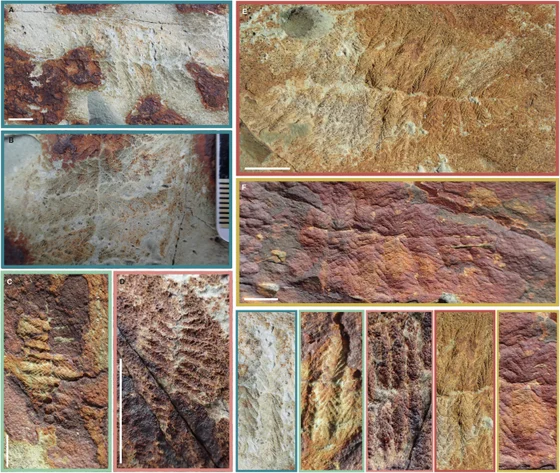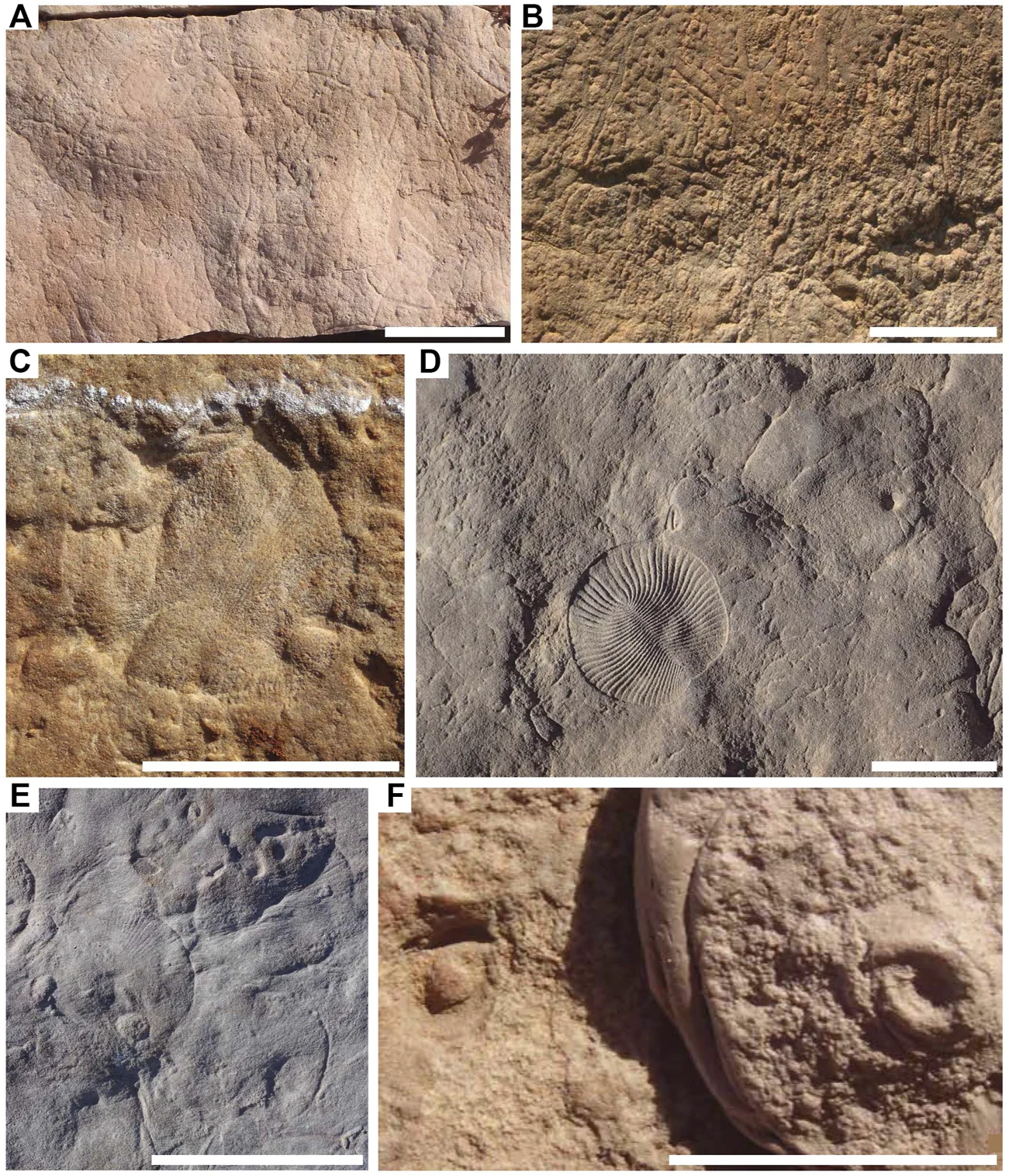
Six fossil-surface photographs; panel B shows dense Funisia impressions, with comparative Plexus, Dickinsonia and Obamus fossils in other panels.
Funisia dorothea appears in panel B on WS-MAB annex surfaces. A shows Plexus; C–E show Dickinsonia and mat surfaces; F shows Obamus and its putty mould. All scale bars are 5 cm.
Overview
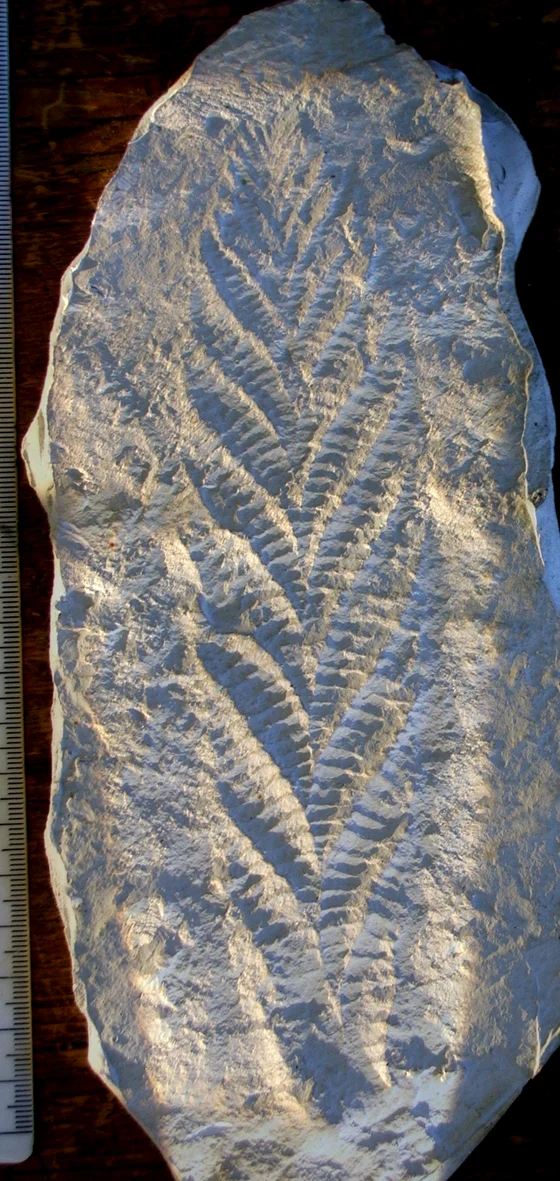
Funisia dorothea is reconstructed as an upright, hollow tube anchored to the seafloor by a small ring-shaped holdfast. Repeated barrel-like modules formed its nonmineralized body. Fossils occur in the Ediacara Member of South Australia’s Rawnsley Quartzite, particularly at Nilpena. Surprenant and Droser describe it as an inferred animal-grade organism rather than assign it confidently to a living phylum. Its form is relatively simple, but its abundant populations record how a tubular body occupied and grew above an ancient microbial mat.
Dense patches commonly contain individuals of similar size. This pattern has been interpreted as settlement of a cohort of waterborne young, consistent with sexual reproduction through spawning and subsequent settlement. It is population evidence, not preserved eggs or an observed mating event. The early establishment stage in the 2025 growth model is explicitly hypothetical because very small individuals cannot yet be distinguished reliably from mat textures. The proposed suspension-feeding habit likewise belongs to a biological reconstruction.
The 2025 study screened thousands of fossils but selected 51 specimens with sufficiently distinct and minimally distorted modules, measuring 237 modules altogether. Their widths ranged from 2.2 to 13.8 mm. The modules generally retained similar dimensions along an individual, while both width and length increased between smaller and larger specimens. Growth therefore involved enlargement of existing modules and the addition of new ones. The authors propose that newly inserted modules briefly enlarged more rapidly until they matched their neighbors, helping maintain an approximately cylindrical body instead of a strongly tapering tube.
Preservation is essential to this interpretation. Burial could collapse, flatten or fill a hollow organism with sediment; apparent diagonal or spiral module boundaries can therefore result from deformation. Complete body ends are rare, so researchers cannot usually determine the full original length or locate the growth zone directly. A single branching specimen suggests growth near an upper end but could instead reflect old injury. Differences in size also need not measure chronological age alone, because local resources could influence growth.
The study compares Funisia with Wutubus annularis, another modular Ediacaran tube. Similar gross construction does not establish a close relationship: their growth timing, body shape, holdfasts and population densities differ. Funisia’s closely packed cohorts could exclude other settlers over substantial areas, whereas Wutubus is typically more sparsely distributed. The authors favor convergence in their shared tubular architecture, while acknowledging that a resolved evolutionary framework is still needed to test homology directly.
Origins & earliest records
Droser and Gehling described and named Funisia dorothea in 2008. The 2025 study places its South Australian occurrences in the Ediacara Member at approximately 555–550 million years. The displayed 552.5 Ma is the midpoint of that interval, not a measured age of a particular specimen.
Evidence & interpretation
Surprenant and Droser (2025), Geologic background, Materials and methods, Results and Discussion, document fossils on excavated Nilpena bedding planes and slabs in the South Australia Museum. They state that examined type material is held in SAM collections; the original 2008 type designation was not independently inspected for this profile. Figure 2 illustrates measured material SAM P41508; Figure 7 illustrates holdfasts SAM P55236. Measurement selection excludes visibly stretched, torn, bent or folded modules.
Selected bibliography
Documented works and useful reading. This is not a list of every appearance.
- 01
A growth model for the highly abundant Ediacaran tubular organism Funisia dorothea
Journal of Paleontology 99(2), 262–274; online publication 18 June 2025. Complete primary article read. Original summary adapted from article licensed CC BY 4.0; https://creativecommons.org/licenses/by/4.0/.
- 02
Synchronous Aggregate Growth in an Abundant New Ediacaran Tubular Organism
Science 319, 1660–1662, 21 March 2008; DOI10.1126/science.1152595
Family, evolution & connections
Taxonomic classification
A hierarchy of classified groups, not a chain of direct ancestors.
- GenusFunisia
- SpeciesFunisia dorothea
Located primary passages
Specific passages supporting details in this entry, grouped by their published witness.
Primary source witness
Science 319, 1660–1662, 21 March 2008; DOI10.1126/science.1152595
- Excavated South Australian fossil beds preserve modular tubes and attachment structures. Similar-sized groups support recruitment in cohorts; branching and successive tube units support multiple growth modes. The authors suggest stem cnidarian or sponge affinities, while acknowledging missing diagnostic openings and pores. Sexual reproduction is an inference from living analogues, not directly observed fossil gametes.
1660–1662; Fig.1 holotype SAM P40725; affinities/reproduction1661
No whole corpus or uninspected supplementary materials claimed; research hypotheses distinguished from observation. No quotation or image reuse.
References
Sources supporting this profile. Linked pages have their own scope and editorial standards.
- ResearchSurprenant and Droser (2025), Funisia growth analysisResearch access: 2026-10-05
Image credits
Whole comparative fossil-photograph figure, exact Funisia population in panel BSix fossil-surface photographs; panel B shows dense Funisia impressions, with comparative Plexus, Dickinsonia and Obamus fossils in other panels.
Funisia dorothea appears in panel B on WS-MAB annex surfaces. A shows Plexus; C–E show Dickinsonia and mat surfaces; F shows Obamus and its putty mould. All scale bars are 5 cm.