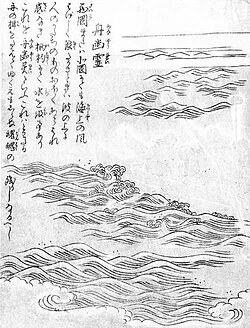
Funayūrei
Image associated with the exact linked encyclopedia article; consult credited file description for its interpretation.
Overview
Funayūrei are ghosts associated with water travel, often imagined as people who died at sea and now threaten passing vessels. Their appearance is not limited to human figures: traditions can involve ghost boats, eerie lights or larger apparitions. A widespread narrative motif has them ask for a ladle and use it to fill a boat with water, turning an ordinary act of assistance into danger.
Some accounts give sailors a bottomless ladle as a defence, but this should remain a reported storytelling device rather than practical maritime guidance. Regional names and relationships with other water beings vary. Sekien's illustration belongs to the visual record, while collected local tales give different circumstances of encounter. The entry emphasizes the persistence of the drowned dead and the uncertain exchange between traveller and apparition, without combining every coastal account into one standard event.
Griffis’s Little Silver’s Dream of the Shoji supplies a distinct literary version of the ladle encounter. Within the girl’s dream, pale men and women stand or move on the sea, and the vessel passes through their figures without displacing them. They ask for dippers and cling to the gunwale, trying to bail seawater into the boat. The sailors have a supply of bottomless dippers ready, so the attempts fail. The whole company vanishes at daylight. The passage calls them ghosts without using the name Funayūrei; its connection here is the matching sea-ghost and ladle motif, not a supplied Japanese identification.
The dream frame matters to the ending. Little Silver eventually wakes when her imagined ship strikes a rock, calls on a dream-eating tapir and then laughs at the failed ghosts and her nurse’s confidence in a protective picture. No tapir appears. The reteller’s playful doubt and the dream setting are therefore part of this witness, rather than evidence of a waking encounter or the automatic success of an actual protective practice.
Hearn’s “By the Japanese Sea” (1894) records a coastal belief with a particular seasonal setting. On the sixteenth day of the seventh month in the old calendar, after the Bon observances, the sea becomes the route by which the dead return. He describes reported gliding lights and indistinct voices, then a danger to ships delayed offshore: tall dead figures reach towards the vessel and demand a bucket. The bottom must be removed before it is given, since an intact bucket would let them fill and sink the ship. Hearn does not use the name Funayūrei here; the passage is a closely matching sea-ghost witness rather than an explicit identification under that label.
The same chapter preserves a different account of the drowned as remaining in currents, tides and surf instead of travelling to the realm of the dead. Sailors call them O-bake and keep cats aboard to ward them off, especially three-coloured cats; Hearn admits that he has not learned the reason for this supposed power. These accounts should remain distinguishable from the soul-boats he actually describes: small ritual model vessels, with practices varying by locality. His Hamamura informant’s repeated memories and dreams of a husband drowning are a bereaved woman’s testimony, not another independently observed apparition.
Origins & earliest records
Selected historical witness: Konjaku Gazu Zoku Hyakki (1779) by Toriyama Sekien. The linked library record identifies a surviving printed edition; it does not establish when the belief first arose.
Records & interpretation
The historical illustration and individual contextual reference support this profile. Named motifs, local narratives and later explanations are distinguished; image-to-plate matching still needs review.
Selected bibliography
Documented works and useful reading. This is not a list of every appearance.
- 01
Konjaku Gazu Zoku Hyakki
Selected historical witness; individual illustration now checked in the separately linked primary scan. This edition is not a claim of the earliest oral attestation.
- 02
Japanese Fairy World: Stories from the Wonder-Lore of Japan
XIII, Little Silver’s Dream of the Shoji, pp.102–111; sea ghosts104–105; complete dream and ending read. Name Funayūrei not supplied by this text.
- 03
Glimpses of Unfamiliar Japan, Second Series — By the Japanese Sea
Hosted chapterVI, complete sections1–12 and all7notes; original two-volume chapterXXI. Sea ghosts§§1–6; Tottori futon§§8–9.
Family & connections
A source-supported family tree or inspiration record has not yet been compiled for this profile. Related reading below indicates a connection in subject matter, not a proven lineage or creative influence.
Primary records and illustrations
Konjaku Gazu Zoku Hyakki
Volume 2; Smithsonian Libraries digitized copy. IIIF canvas index 15 (zero-based); Konjakuzokuhyak2Tori_0016.jp2
Printed label 船幽霊; disembodied heads and faces appear among waves. Label and composition directly inspected; no transcription of cursive explanatory text is claimed. Additional complete narrative comparison: Griffis1887 XIII pp102–111, sea ghosts104–105, source https://www.gutenberg.org/cache/epub/29337/pg29337-images.html#LITTLE_SILVERS_DREAM_OF_THE_SHOJI. Bottomless ladle motif matched, but Japanese name not supplied; entire voyage dream-framed, no tapir appears. Original Sekien visual evidence retained. Complete Hearn1894 By the Japanese Sea§§1–12/all7notes read; seasonal bucket motif and separate permanent-drowned beliefs compared, no literal Funayurei name in text. https://www.gutenberg.org/cache/epub/8133/pg8133.html#id00494
Encyclopedia background
An additional attributed reference, separate from the editorial profile above.
Read the open encyclopedia overview
Funayūrei (船幽霊 or 舟幽霊; literally "boat spirit") are spirits (yūrei) that have become vengeful ghosts (onryō) at sea. They have been passed down in the folklore of various areas of Japan. They frequently appear in ghost stories and miscellaneous writings from the Edo Period as well as in modern folk customs. In Yamaguchi Prefecture and Saga Prefecture, they are called Ayakashi.
Text from Wikipedia contributors, “Funayūrei”. CC BY-SA 4.0. Extracted introduction; formatting changed. Retrieved 5 October 2026. The source article may have changed since retrieval.
References
Sources supporting this profile. Linked pages have their own scope and editorial standards.
- Primary illustration / library recordKonjaku Gazu Zoku Hyakki — historical library editionResearch access: 2026-10-05
- Secondary referenceFunayūrei — contextual overview and bibliographyResearch access: 2026-10-05
- Primary illustrated plate / institutional digitizationKonjaku Gazu Zoku Hyakki — directly inspected IIIF canvas index 15 (zero-based); Konjakuzokuhyak2Tori_0016.jp2Research access: 2026-10-05
- Historical English literary retellingGriffis, Japanese Fairy World, Little Silver’s Dream of the ShojiResearch access: 2026-10-05
- Historical literary travel account and mediated oral narrativesHearn, complete By the Japanese SeaResearch access: 2026-10-05
Image credits
Historical illustrationFunayūrei
Image associated with the exact linked encyclopedia article; consult credited file description for its interpretation.