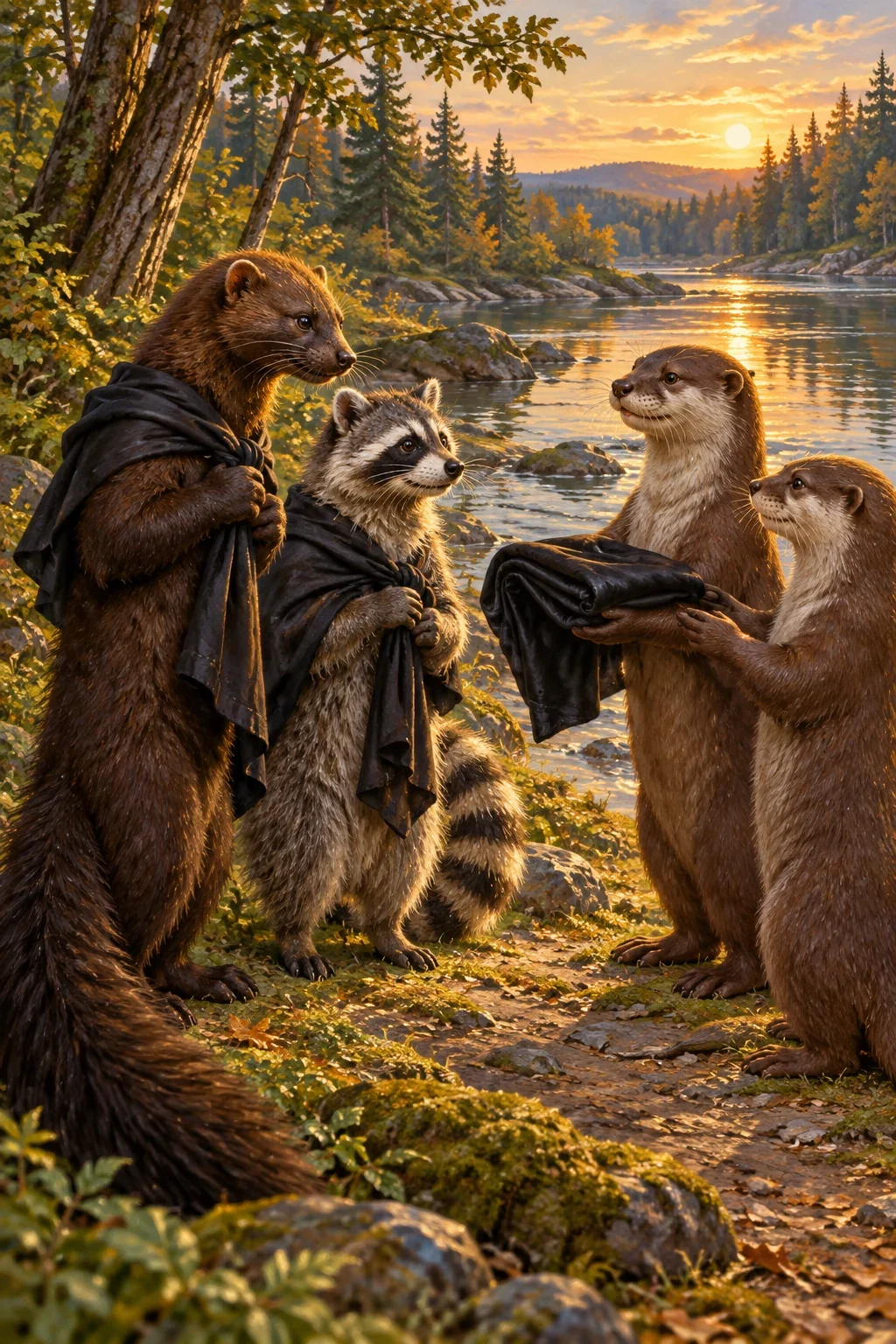
AI-generated interpretation of the Otters’ parting clothing gift to Fisher and Raccoon in Nancy Jeddore’s account. The soft glossy black clothing and animal-person roles follow the narrative. Upright animal forms, exact fur, faces, cloak design, host number, setting and light are artistic choices, not modern clan, costume or natural-history evidence.
AI-generated interpretation of the Otters’ parting clothing gift to Fisher and Raccoon in Nancy Jeddore’s account. The soft glossy black clothing and animal-person roles follow the narrative. Upright animal forms, exact fur, faces, cloak design, host number, setting and light are artistic choices, not modern clan, costume or natural-history evidence.
Overview
A young Fisher lives with his parents, brother and two sisters. Asking his mother how easily their family could be killed, he learns that one attacker could destroy them, but that Porcupines are not a danger to them. He leaves home and meets Raccoon. They agree to travel and hunt together. A stone dwelling they find is associated with Porcupines, before their journey brings them to a riverside town of Otters, described as people in rich black clothing. The visitors are welcomed and offer work in exchange for their living.
The partnership assigns different tasks. Fisher does not undertake the hunting, but is skilled at preparing game and skinning eels, so he becomes the housekeeper and cook. The Otters enter the river and bring back fish. Raccoon goes elsewhere and adds poultry stolen from neighbouring farmers. The narrator contrasts the Otters’ honesty with Raccoon’s conduct. That comparison belongs to the story’s animal-person society, not an ethical rule governing real species or human communities with similar animal names.
After seven years Fisher proposes returning home with his companion. Pleased with their service, the Otters give them abundant soft, glossy black clothing. At the place where Fisher and Raccoon first met, Fisher tells the other not to accompany him farther. He continues alone and finds his mother living, but learns that his siblings have all been killed by a hostile group. His mother welcomes him, and he remains to care for her. The long stay away and final household loss are part of the complete ending; the narrative gives neither revenge nor a later reunion with Raccoon.
Nancy Jeddore told the account on10October1871. Rand’s attached notes explain rocky Porcupine dwellings, different hunting roles and Fisher’s preparation of prey as animal allegory. Those collector explanations help show how human work and animal capacities are combined in the English telling. They do not independently verify its seven-year stay or bereavement. The names identify characters in this historical narrative, without authorising their assignment to a present-day human clan or importing a separate magical transformation that the story does not describe.
Origins & earliest records
Rand, Legends of the Micmacs, LXXXIV, The Fishers and the Raccoon, pp438–439; Nancy Jeddore,10October1871. English translation edited by Helen L. Webster in1894.
Records & interpretation
Complete animal-person tale and three attached collector notes. It records narrative roles, not contemporary community conduct or independently verified animal morality. No separate power of transformation is stated.
Selected bibliography
Documented works and useful reading. This is not a list of every appearance.
- 01
Legends of the Micmacs, LXXXIV: The Fishers and the Raccoon
Complete pp438–439, three notes and final source attribution; complete editorial prefacev–ix retained.
Family & connections
A source-supported family tree or inspiration record has not yet been compiled for this profile. Related reading below indicates a connection in subject matter, not a proven lineage or creative influence.
References
Sources supporting this profile. Linked pages have their own scope and editorial standards.
- Primary historical translated collectionRand1894, The Fishers and the RaccoonResearch access: 2026-10-27
Image credits
AI-generated illustrationAI-generated interpretation of the Otters’ parting clothing gift to Fisher and Raccoon in Nancy Jeddore’s account. The soft glossy black clothing and animal-person roles follow the narrative. Upright animal forms, exact fur, faces, cloak design, host number, setting and light are artistic choices, not modern clan, costume or natural-history evidence.
AI-generated interpretation of the Otters’ parting clothing gift to Fisher and Raccoon in Nancy Jeddore’s account. The soft glossy black clothing and animal-person roles follow the narrative. Upright animal forms, exact fur, faces, cloak design, host number, setting and light are artistic choices, not modern clan, costume or natural-history evidence.