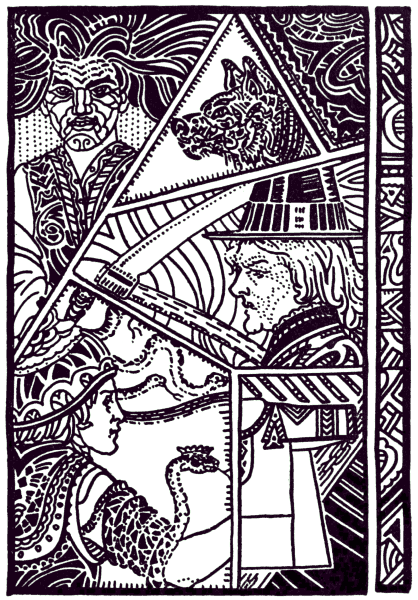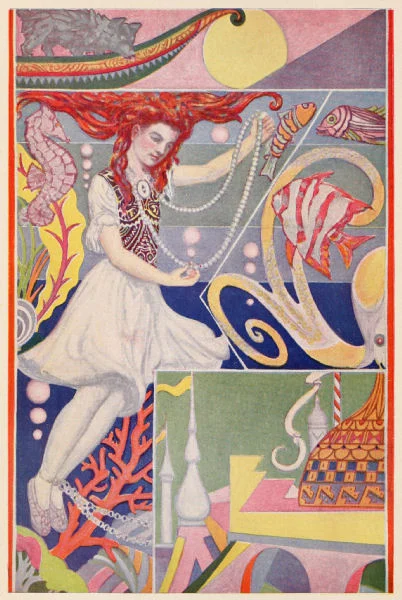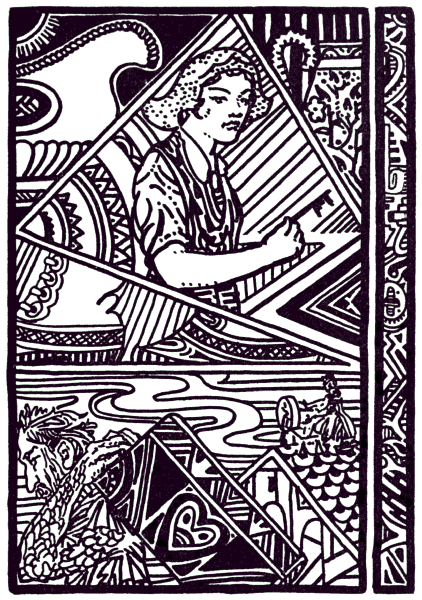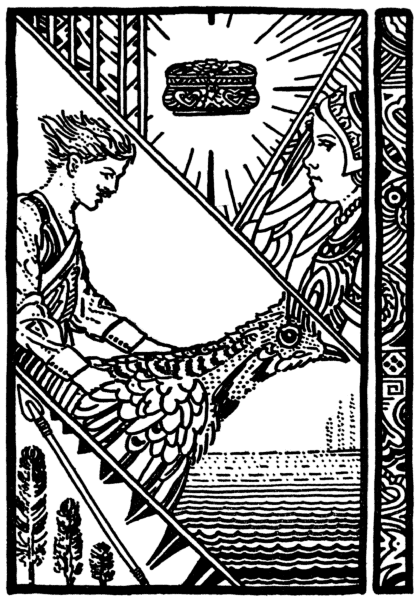
Helli riding the enchanted grouse over the sea, Jay Van Everen, 1922
Van Everen illustrates Helli riding the speaking grouse over the ocean, alongside the locked-box motif in Fillmore’s retelling. The bird’s later release from enchantment is stated in the tale, but its natural shape is not described.
Overview
Helli aims at a grouse after an unsuccessful hunt, but it repeatedly asks him to spare it and take it home alive. He relents at its third appeal and, despite his wife’s protests, agrees to feed it. After the first year it drops a copper tail feather and briefly disappears; the second year produces a silver feather, and the third a golden one. It then invites Helli onto its back and carries him over the ocean. Three times it lets him fall before catching him above the water, explaining that these scares reproduce its fear when he had aimed at it.
The bird takes him to three sisters in succession. The eldest’s home looks like a copper column; the middle sister has a silver castle, and the youngest a golden castle. Each offers a gift in gratitude for the bird’s preservation. On its advice, Helli asks only for a small locked box whose key is lost. The first two refuse, but the youngest parts with hers. The bird carries him home with instructions to drop the box where he wishes permanently to live.
At parting, it explains that the three acts of mercy and three years of feeding have broken the enchantment that compelled it to live as a grouse. It can now resume its natural shape and disappears, but that shape is not described. Helli later drops the box at his family home, where it opens into a castle with servants and riches. The bird’s three sisters are explicit family members, while its initial address of Helli as brother is not accompanied by a genealogical claim.
Origins & earliest records
Parker Fillmore, Mighty Mikko (1922), The Enchanted Grouse, printed pp. 143–153; author’s note vii–xi.
Records & interpretation
Complete English retelling. Speaking bird, metal feathers, carriage across the ocean, three sisters and stated release conditions are explicit; original or restored bodily identity remains unspecified.
Selected bibliography
Documented works and useful reading. This is not a list of every appearance.
- 01
Mighty Mikko: The Enchanted Grouse, pp. 143–153
Complete selected chapter. Three sisters explicitly identified by age; no name for enchanter or description of restored natural shape.
Family & connections
A source-supported family tree or inspiration record has not yet been compiled for this profile. Related reading below indicates a connection in subject matter, not a proven lineage or creative influence.
References
Sources supporting this profile. Linked pages have their own scope and editorial standards.
- Primary historical literary retelling of folkloreFillmore1922: The Enchanted GrouseResearch access: 2026-10-05
Image credits
Historical illustrationHelli riding the enchanted grouse over the sea, Jay Van Everen, 1922
Van Everen illustrates Helli riding the speaking grouse over the ocean, alongside the locked-box motif in Fillmore’s retelling. The bird’s later release from enchantment is stated in the tale, but its natural shape is not described.