A sourced illustration has not yet been added. This gap is included in the coverage record.
Overview
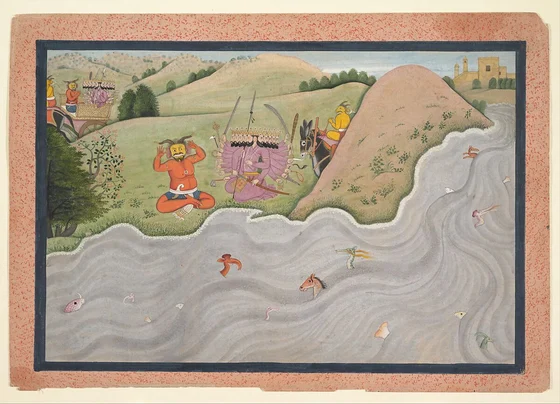
Dundubhi assumes a bull-like form as huge as a mountain and is credited with the strength of a thousand elephants. Looking for an equal opponent, he challenges Ocean and then Himālaya, tearing rocks from the mountain. Neither accepts the fight; Himālaya directs him to Vāli at Kiṣkindhā.
At the city gate he bellows, tears the ground and uproots trees. Vāli seizes his horns and defeats him in a struggle with fists, feet, rocks and trees. The thrown corpse scatters blood near the sage Mataṅga’s retreat, provoking a curse against Vāli entering the area. Thus the slain monster’s body has a continuing effect on the geography of later refuge and rivalry.
Origins & earliest records
South Asian Rāmāyaṇa narrative tradition
Records & interpretation
Primary-text translation directly read by identified book/canto.
Selected bibliography
Documented works and useful reading. This is not a list of every appearance.
- 01
The Rámáyan of Válmíki
Title page gives translation span 1870–1874. Book IV XI, pp. 335–337. Selected historical verse witness.
Family & connections
A source-supported family tree or inspiration record has not yet been compiled for this profile. Related reading below indicates a connection in subject matter, not a proven lineage or creative influence.
Primary records and illustrations
The Rámáyan of Válmíki
Book IV. IV XI, pp. 335–337
Actual translated primary passages directly read. Checked HTML canto anchor. No new image bytes inspected.
References
Sources supporting this profile. Linked pages have their own scope and editorial standards.
- Historical primary-text translationGriffith Rāmāyaṇa — Book IV XI, pp. 335–337Research access: 2026-10-05
Image credits
A sourced illustration has not yet been added. This gap is included in the coverage record.