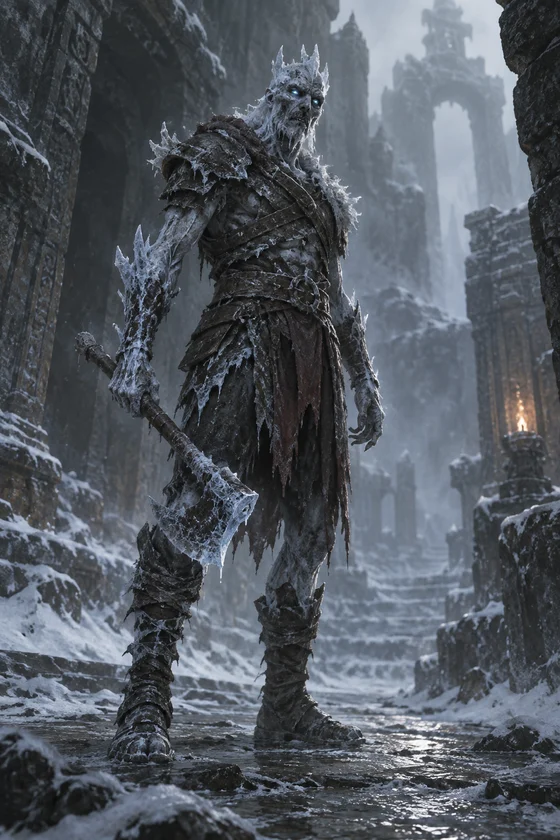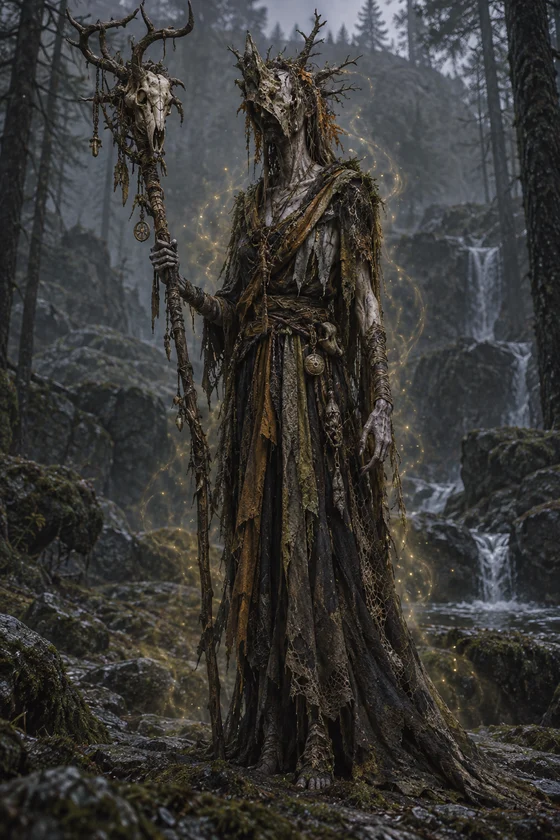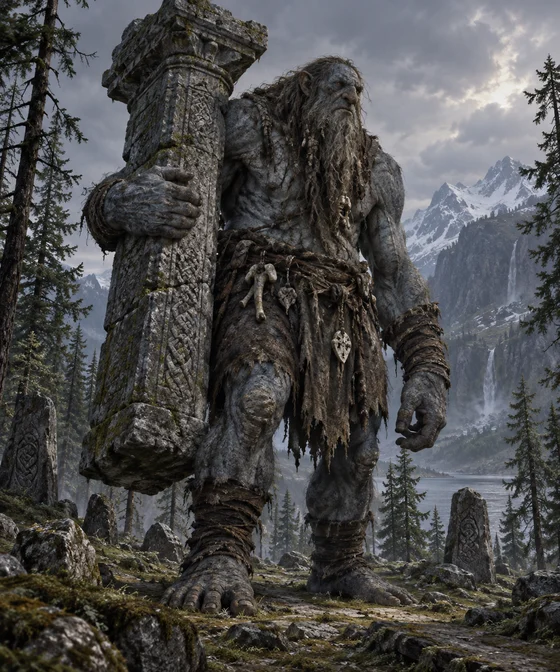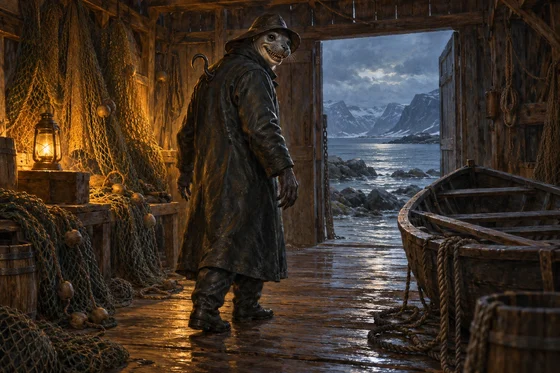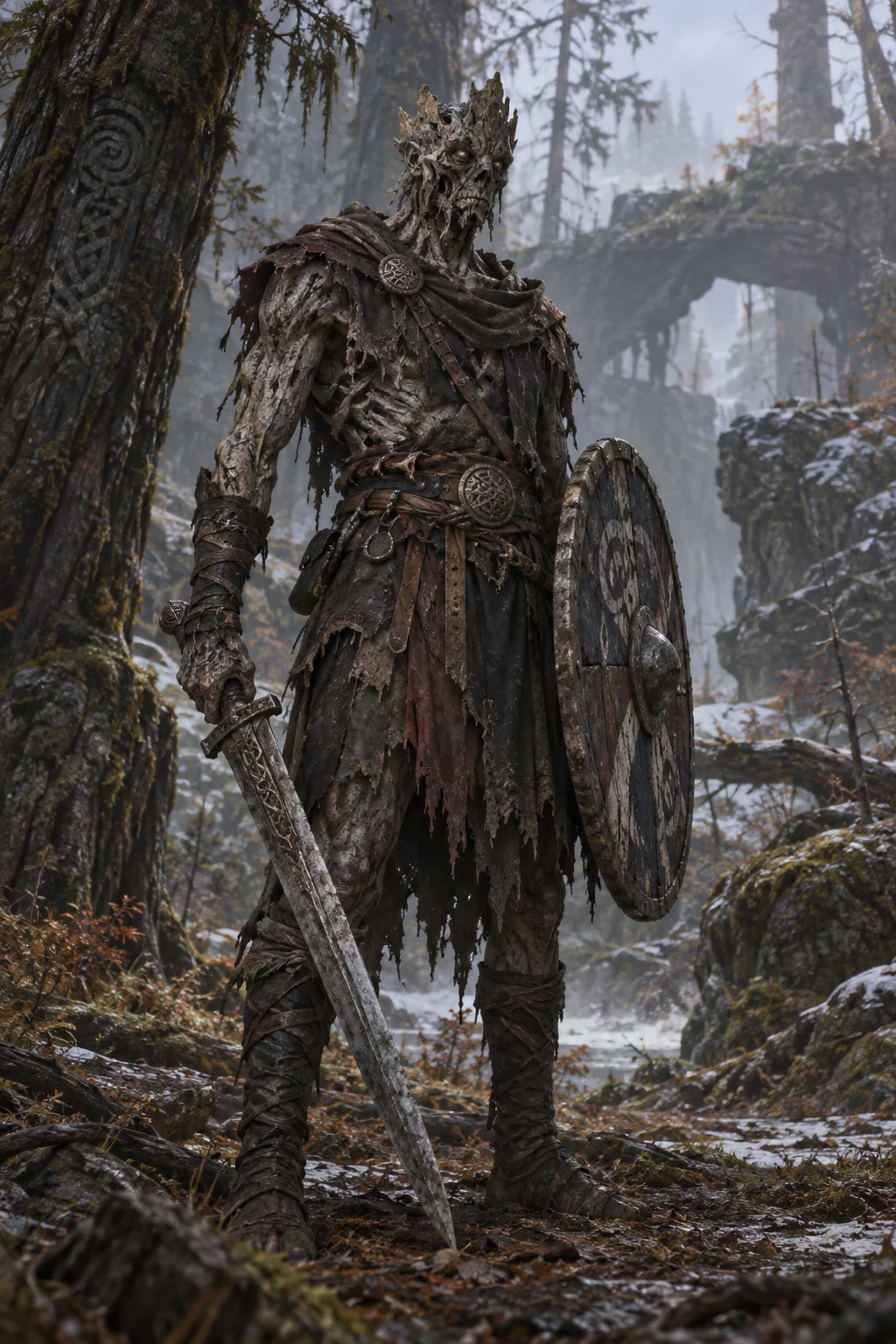
Modern illustration of Draugr (God of War)
AI-generated interpretation of the accepted account; undescribed appearance, colours, clothing, pose and surroundings are imagined. Not historical artwork or ethnographic evidence. Unofficial interpretation.
Overview
Atreus’s account, attributed to his mother, makes the Draugr’s origin an act of resistance after death. Warriors who refuse the Valkyries’ summons struggle against their passage and return in damaged bodies. This explains their restless hostility through the game’s Norse afterlife rather than through a universal rule borrowed from medieval draugr stories. Their recognizable warrior shapes can carry swords, shields or paired weapons, while stronger bodies and supernatural enhancements change how they threaten the travelers. The ordinary dead and these actively fighting revenants are therefore different conditions, not interchangeable names for every corpse in Midgard.
The licensed 2018 guide first places them in the Wildwoods and follows their spread through Midgard. Basic foes can be knocked off balance; heavily built ones withstand those same reactions, and shield-bearers protect themselves from ordinary approaches. Further enhancements produce ranged fire, sudden acceleration, an explosive body or a weapon that sends a burning wave along the ground. Those effects can modify existing encounter types, sometimes in combination. They are game-specific variations within this profile, rather than an invented genealogy of eight undead peoples. The difficulty setting also changes their behavior, so stronger resistance on that setting is not treated as an unchanging anatomical law.
First appearances & development
This treatment selects the 2018 Norse game and its contemporary licensed guide. The traditional name has an older independent history, but the game's Valkyrie-centered explanation and elemental encounter system require their own profile. It does not claim that every earlier franchise undead enemy belonged to this exact category.
Canon & continuity
The dedicated creature reference returns the relevant Atreus account and selected game history. Prima’s actual Draugr chapter independently supplies weapons, heavy forms and combinable enhancements. Its strategy prose is evidence for the 2018 implementation; it is not a source for an otherwise undocumented historical Norse belief.
Selected bibliography
Documented works and useful reading. This is not a list of every appearance.
- 01
God of War
Atreus’s creature account and Midgard encounters.
- 02
God of War official eGuide
Dedicated Draugr encounter chapter.
Family, evolution & connections
Sea-Draug of Elias’s Last Voyage (Lie–Bain)
Bain’s note to Lie’s coastal story expressly compares its draug with Icelandic draugr. This supplies historical naming context beside God of War’s separate fictional Draugr. Lie’s antagonist has seal and human appearances and travels in a half-boat; that coastal literary account does not establish the game’s warrior biography, appearance or rules, or document the developers’ use of Lie.
References
Sources supporting this profile. Linked pages have their own scope and editorial standards.
- Primary workDraugr guideResearch access: 2026-10-05
- ReferenceDraugr accountResearch access: 2026-10-05
Image credits
AI-generated interpretationModern illustration of Draugr (God of War)
AI-generated interpretation of the accepted account; undescribed appearance, colours, clothing, pose and surroundings are imagined. Not historical artwork or ethnographic evidence. Unofficial interpretation.