
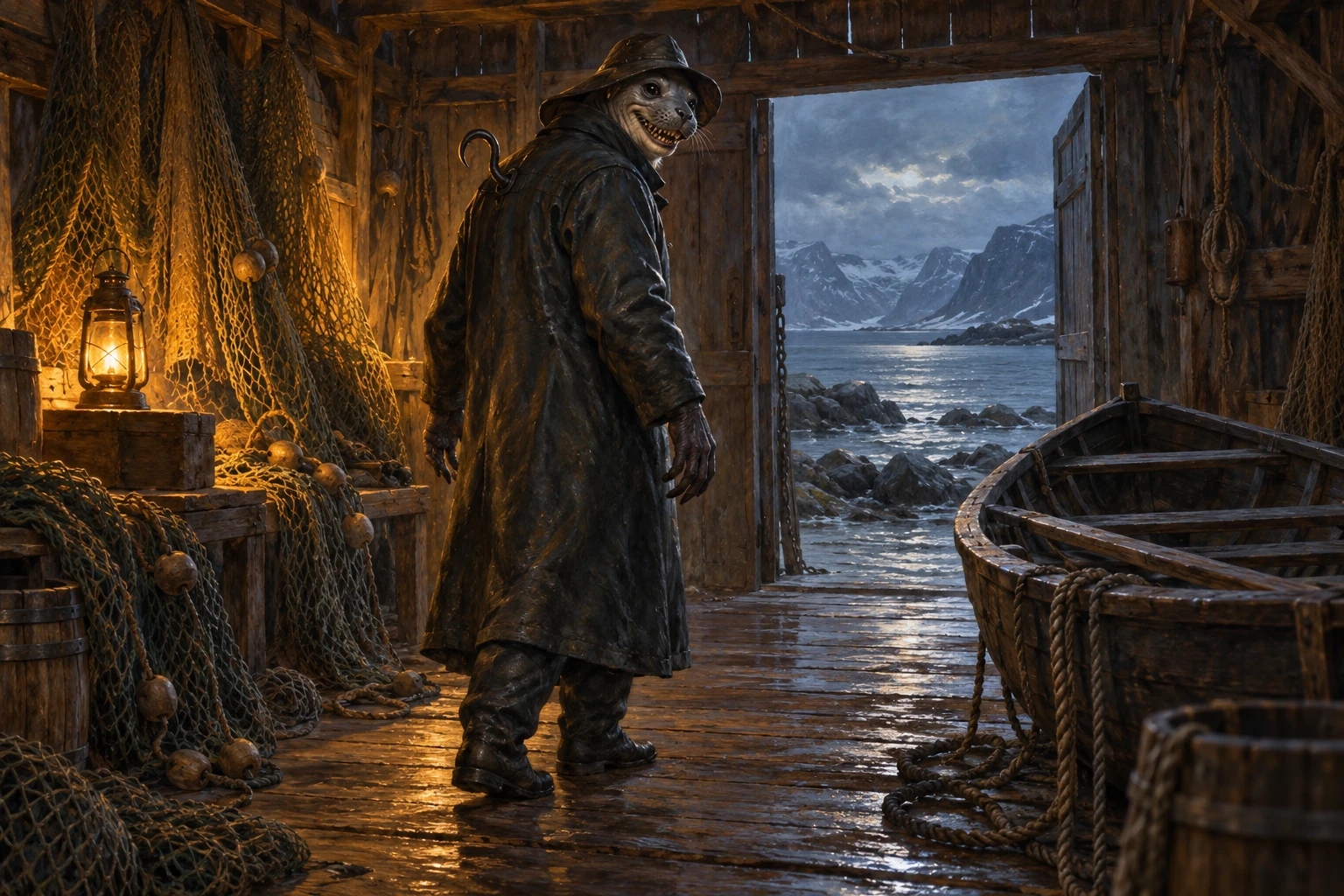
AI-generated interpretation of the boatshed encounter in Lie’s The Fisherman and the Draug, translated by Bain in 1893. The seal-like face and identifying hooked iron follow the account; the exact muzzle, clothing, shed, boat, landscape and lighting are imagined. This is not a historical photograph, community portrait or game draugr design.
This tale’s draug has a visible face and seal/man appearances. The image does not import headlessness or burial armour, and no original book illustration was reused.
Overview
This sea-draug is the antagonist of Jonas Lie’s “The Fisherman and the Draug,” in R. Nisbet Bain’s 1893 English translation. The fisherman Elias lives on Kvalholm in Helgeland with his wife Karen and their children. Strange cries already trouble the island, but the tale’s revenge sequence begins when Elias drives a heavy hooked fishing spike into a monstrous seal. The animal rises unnaturally high and plunges away; the broken pole later washes ashore.
Elias subsequently sees a seal-like face among the nets in his boat-shed. A large man escapes from the doorway, with the hooked iron still projecting from his back. A voice later warns Elias that danger will come when he acquires a larger fishing boat. Years pass before he buys that vessel on the condition that he make no alterations to it. The narrator associates the bargain’s sinister conditions with a devilish helper of the boat-builder; the text does not simply identify every supernatural agent as the draug.
During the family’s return voyage, another boat races alongside. Elias’s pride, the worsening gale and the circulation of brandy form part of the disastrous sequence. His wife and children are lost in successive seas. The other crew’s faces appear corpse-like, and the heavy figure steering their vessel carries the same iron spike. Elias recognises the draug and understands the accompanying craft as its half-boat. The narration presents the encounter as an omen of his death, rather than supplying a universal description of every northern revenant.
After the fishing boat overturns, Elias and two sons briefly survive on its keel. One son dies from exposure; Elias eventually relinquishes his grip after giving his eldest son Bernt his watch. Bernt alone reaches shore, helped by the young servant who had stayed at home. He survives the winter but will not return to the open sea, and later establishes a life inland. The ending gives the revenge a human aftermath rather than treating the draug as an isolated catalogue monster.
Bain’s note 8 calls the being a demon of the north Norwegian coast, describes its half-boat and explicitly invites comparison with Icelandic draugr. That is a historical editor-translator’s comparison, not proof that the tale depicts a corpse raised from a burial mound. This particular creature has a visible face and seal/man appearances; it must not acquire headlessness, armour or other variant attributes by default.
The source is an authored literary tale using coastal supernatural material. Bain’s preface places this opening story in Lie’s first romance Den Fremsynte, associated there with 1870. It is not one of the eight Trold selections in the same English collection, and no original-language or critical-edition collation is claimed here.
Origins & earliest records
The Fisherman and the Draug, opening tale of Weird Tales from Northern Seas, translated by R. Nisbet Bain from Jonas Lie, 1893. Bain’s preface attributes this story to Den Fremsynte rather than Trold. The complete tale, ten notes and preface are the selected historical witness.
Records & interpretation
The complete historical English tale and all ten translator notes were read. Note 8 explicitly compares the coastal draug with Icelandic draugr. No original-language collation, direct community field record or modern creator consultation is claimed.
Selected bibliography
Documented works and useful reading. This is not a list of every appearance.
- 01
Den Fremsynte
Original romance identified in Bain’s preface as containing this tale; not independently collated.
- 02
Weird Tales from Northern Seas: The Fisherman and the Draug
Complete opening tale, ten translator notes and preface; source artwork not reused.
Family, evolution & connections
Draugr (The Elder Scrolls)
The fictional Draugr name can be compared with the historical draug/draugr terminology that Bain expressly connects in note8. Lie’s story concerns a coastal revenge encounter with a spiked sea-being and its half-boat, not an identified burial corpse. The link is qualified literary-name context, with no claim that the game shares this narrative or that its creators used this particular work.
Draugr (God of War)
The shared draug/draugr terminology permits comparison with God of War’s fictional Draugr. Bain explicitly makes the historical Icelandic-name comparison in note 8, while Lie’s tale concerns a coastal revenge encounter. The link preserves these different settings and identities rather than treating the sea-being as the game’s undead warrior or claiming direct adaptation.
References
Sources supporting this profile. Linked pages have their own scope and editorial standards.
- Historical English translation of an authored supernatural taleLie/Bain, The Fisherman and the Draug, complete tale, notes1–10 and preface, Translation1893Research access: 2026-10-25
Image credits
Modern interpretation of a historical literary accountAI-generated interpretation of the boatshed encounter in Lie’s The Fisherman and the Draug, translated by Bain in 1893. The seal-like face and identifying hooked iron follow the account; the exact muzzle, clothing, shed, boat, landscape and lighting are imagined. This is not a historical photograph, community portrait or game draugr design.
This tale’s draug has a visible face and seal/man appearances. The image does not import headlessness or burial armour, and no original book illustration was reused.