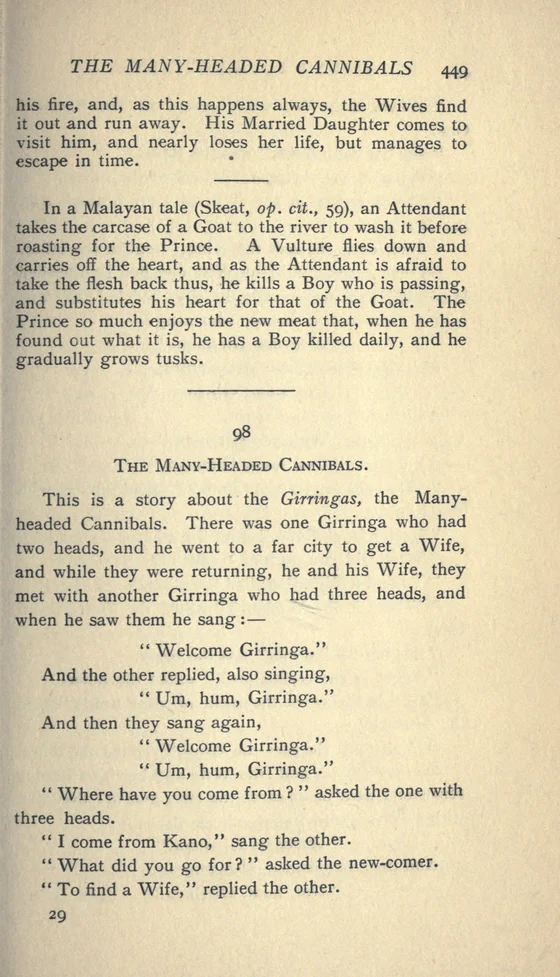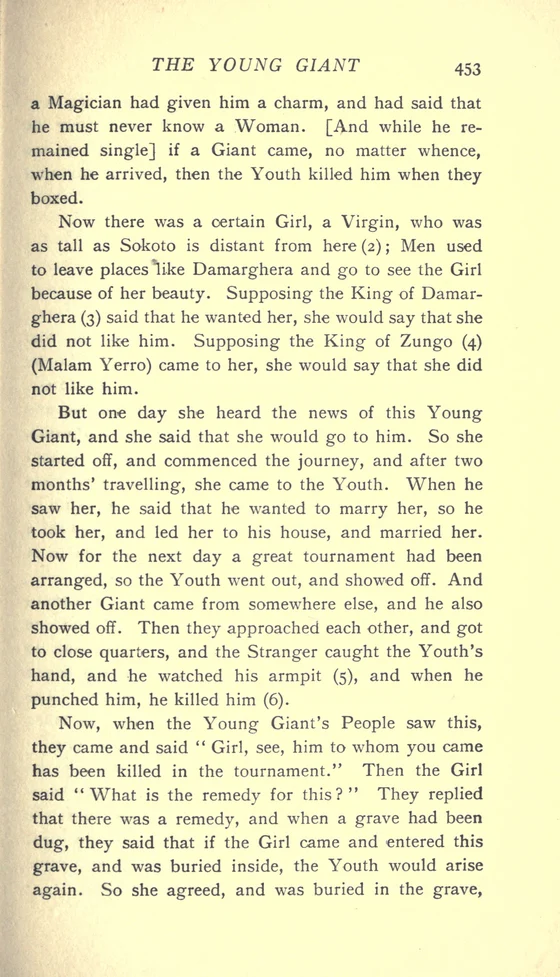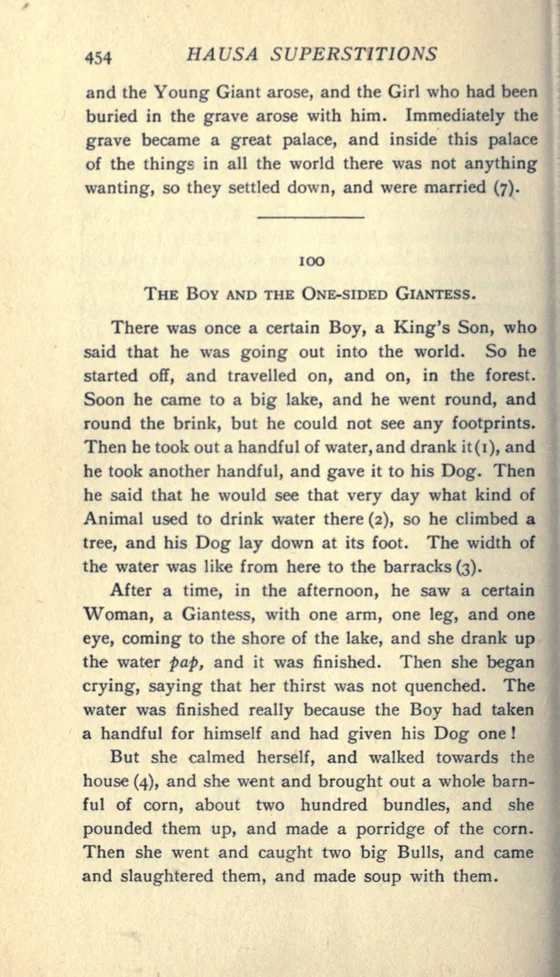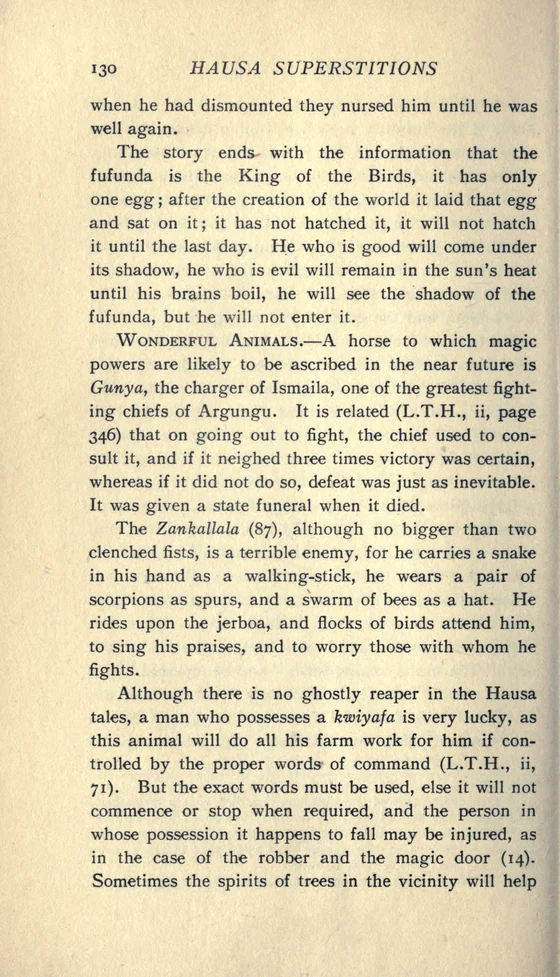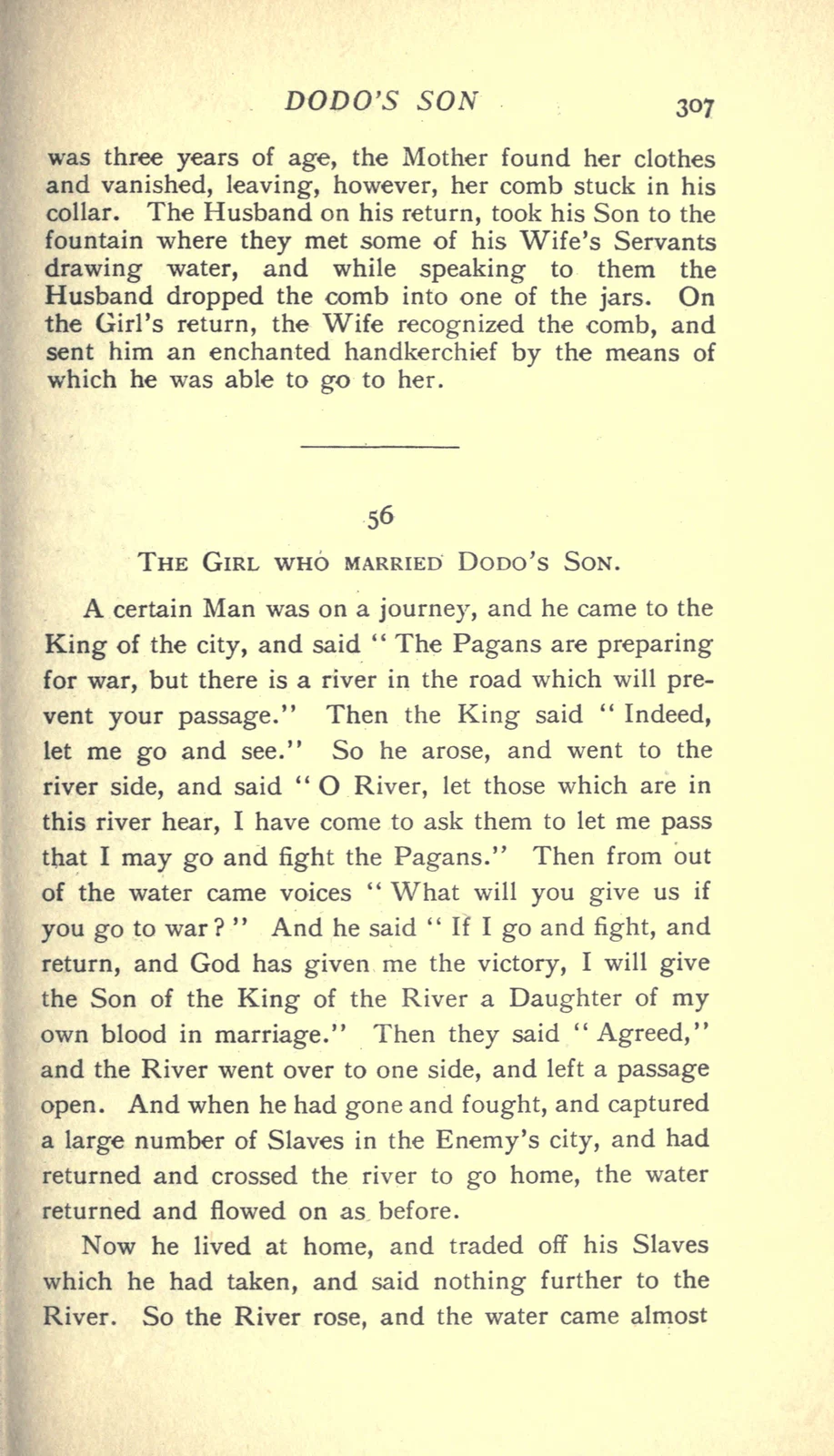
Dodo’s River Household in the Hausa Marriage Tale:1913 documentary text page307; documentary source-page facsimile
Exact named narrative text facsimile, not a creature illustration. Printed page307; actual returned IIIF canvas350. Catalogue identifies1913 edition, author1877–1915, US NOT_IN_COPYRIGHT; historical translated text is life70 expired. Oral narrator attribution retained from profile. Actual scan directly inspected: exact named tale/episode text read, including printed page number and narrative features.
Overview
A human king negotiates passage across a river for his army by promising a daughter to the river king’s son. Voices answer from the water and it moves aside; afterward, an ignored promise brings a threatened flood that recedes when the king requests patience. River-dwellers eventually receive the bride and lead her into Dodo’s underwater house. Their children play with her. Her younger sister later follows a magically growing gourd vine to the submerged home, revealing that the supposed death in the river has instead become a continuing marriage and household life.
The husband detects the visiting mortal by smell despite her hiding beneath an earthen seat. Once introduced, he accepts her as a guest for five days and gives permission for her return. Two small lidded baskets from the corn-bin release livestock, attendants and musicians on the road home. A second visitor refuses instructions, chooses a larger basket and opens it too early, receiving a diminished, impaired party instead. The husband also warns his wife that revealing his name would end their contact. The main story combines coercive marriage obligations with hospitality and unequal gifts.
Origins & earliest records
Tremearne credits Ba Gu(d)du (B.G.) in the contents, with initials resolved by the introduction/preliminary correction. His general 1908–1909 collection dates are not an exact session date for this narrative.
Records & interpretation
Complete main narrative 56, The Girl who Married Dodo’s Son, pp 307–314 directly read. Appended comparative variants are not merged into these events. The title is an editorial locator where the narrative supplies no personal name; classification of spirit or animal forms follows explicit actions rather than modern zoological identification.
Selected bibliography
Documented works and useful reading. This is not a list of every appearance.
- 01
Hausa Superstitions and Customs
Second edition; tale 56, The Girl who Married Dodo’s Son, pp 307–314
Family, evolution & connections
Two family branches in the river marriage tale
Tremearne’s main tale 56, The Girl who Married Dodo’s Son, pp. 307–314.
Scroll sideways to see all branches. With a keyboard, focus the tree and use the arrow keys.
- Two families joined by the elder daughter’s marriage (grouping, not an ancestor)
- Dodo (river king)
- Dodo’s son (elder daughter’s husband)
- Human king’s youngest wife
- Elder daughter (Dodo’s son’s wife)
- Younger daughter (visiting sister)
Keep Dodo’s stated son separate from the human youngest wife’s two explicitly identified daughters. The marriage connects the branches affinally. The root is a diagram grouping, not an ancestor. The human king is husband and bargain-maker but not separately inserted as biological father here. The children playing with the bride are other river-dwellers’ children, not hers. The story’s marriage bargain is coercive; no universal Dodo genealogy is inferred.
Dodo and his son in Tremearne tale 56
Tale 56 explicitly names the underwater householder Dodo and repeatedly identifies the bride’s husband as Dodo’s son. This household belongs to the named tale, not every Dodo narrative.
Dodo’s son and human princess in Tremearne tale 56
The human king delivers his youngest wife’s daughter under a prior river-crossing bargain. She lives as Dodo’s son’s wife; the coercive bargain is part of this story’s marriage context.
Human princess and younger sister in Tremearne tale 56
The bride’s younger sister follows the gourd into the river home, and both identify one another as sisters. Their shared mother is the human king’s youngest wife; neither sister becomes a new water-spirit generation.
Human youngest wife and her two daughters in Tremearne tale 56
The human king’s youngest wife supplies her elder daughter as bride and later answers the younger daughter’s questions about her missing sister. This human maternal branch is separate from Dodo’s father–son branch.
References
Sources supporting this profile. Linked pages have their own scope and editorial standards.
- Collected primary narrative with narrator attributionHausa Superstitions and Customs — tale 56, The Girl who Married Dodo’s Son, pp 307–314Research access: 2026-10-05
Image credits
Historical text facsimileDodo’s River Household in the Hausa Marriage Tale:1913 documentary text page307; documentary source-page facsimile
Exact named narrative text facsimile, not a creature illustration. Printed page307; actual returned IIIF canvas350. Catalogue identifies1913 edition, author1877–1915, US NOT_IN_COPYRIGHT; historical translated text is life70 expired. Oral narrator attribution retained from profile. Actual scan directly inspected: exact named tale/episode text read, including printed page number and narrative features.