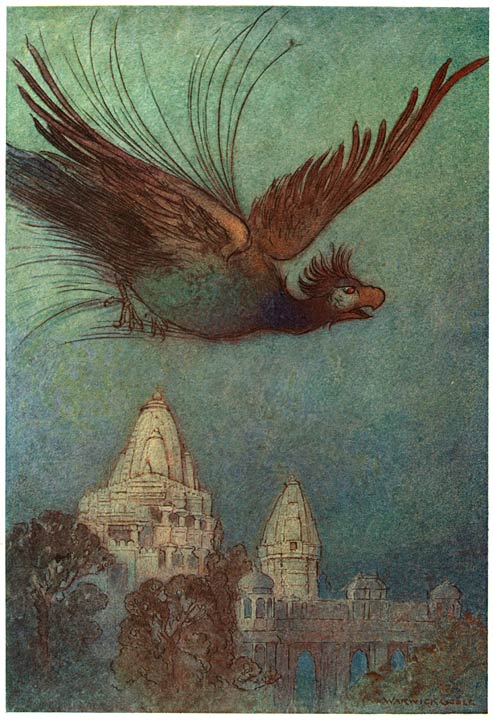
The man-eating queen in her huge bird form above the palace, Warwick Goble, 1912
The vast bird flies above the palace in Goble’s representation of the citizens’ reported predator. Day’s ending identifies the raider as the disguised queen. It is distinct from the small caged bird holding her external life; its plumage and crested head are the artist’s treatment.
Overview
A king marries a beautiful stranger who is secretly a Rakshasi. At her demand he blinds his seven pregnant queens and orders their deaths, though his minister hides them instead. The new queen devours the household and animals by night, then preys on the city. Citizens describe the raider as a monstrous bird emerging from the palace; the ending identifies the queen as this predator.
The surviving son of the youngest queen enters the king’s service and evades the predator by leaving before night. She sends him to her mother across the ocean with a letter ordering his death, ostensibly to obtain a twelve-cubit melon with a thirteen-cubit stone. He destroys the letter and returns with the fruit and, secretly, the caged bird in which her life is held.
In a public confrontation, injury to the small captive bird causes a corresponding loss of the queen’s limb; killing it kills her. The bird containing her life is distinct from the huge bird form reported by the citizens. The tale then restores the blinded queens’ sight and recognizes the boy as heir. It supplies no common personal name for this particular Rakshasi.
Origins & earliest records
Bengali oral storytelling translated by Lal Behari Day
Records & interpretation
Complete relevant tale, attached notes,1883 preface and1912 edition credits directly read.
Selected bibliography
Documented works and useful reading. This is not a list of every appearance.
- 01
Folk-Tales of Bengal
VII, The Boy whom Seven Mothers Suckled, pp.113–118; first edition1883, illustrationsWarwickGoble
Family, evolution & connections
The Rakshasi queen and her mother — Day VII
The Boy whom Seven Mothers Suckled, pp. 113–118.
Scroll sideways to see all branches. With a keyboard, focus the tree and use the arrow keys.
The queen’s direct identification of the older Rakshasi as her mother. The hero pretends to be a grandson, so he is excluded. The caged bird contains the queen’s life and is not a relative. This is one named tale; the mother’s death is not stated.
Primary records and illustrations
Lal Behari Day, Folk-Tales of Bengal (Macmillan,1912; first edition1883)
VII. VII, The Boy whom Seven Mothers Suckled, pp.113–118
Complete tale and footnotes read, pluspreface andeditionhistory. Bengali oral informants described collectively, individual teller of this tale not identified. Original paraphrase; no source-image verification claimed.
References
Sources supporting this profile. Linked pages have their own scope and editorial standards.
- Historical translated oral narrative and collector notesLal Behari Day, Folk-Tales of Bengal (1912), VII, The Boy whom Seven Mothers Suckled, pp.113–118Research access: 2026-10-05
Image credits
Historical illustrationThe man-eating queen in her huge bird form above the palace, Warwick Goble, 1912
The vast bird flies above the palace in Goble’s representation of the citizens’ reported predator. Day’s ending identifies the raider as the disguised queen. It is distinct from the small caged bird holding her external life; its plumage and crested head are the artist’s treatment.