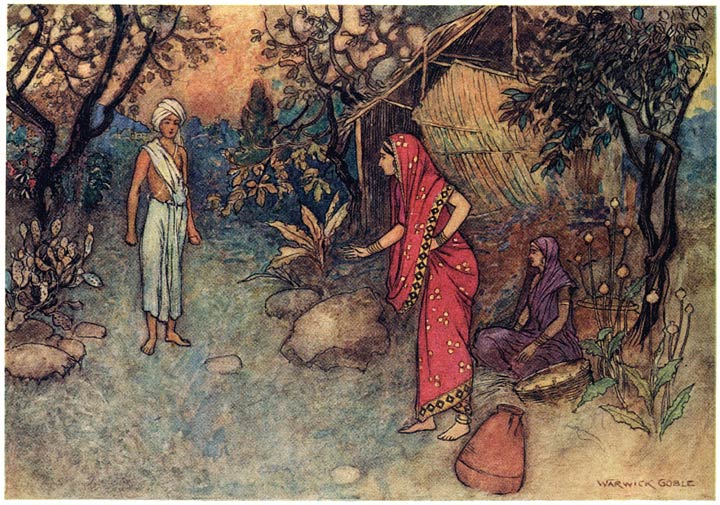
The ghost in the Brahman’s borrowed appearance returns to the household, Warwick Goble, 1912
Goble shows the usurping ghost in the absent husband’s human appearance before his wife and mother. The caption asks why he has returned so soon. Its ordinary human face belongs to the disguise in Day’s tale, rather than a separate portrait of the living Brahman.
Overview
On the evening a poor Brahman leaves home to earn money, a ghost assumes his exact appearance and returns to his mother and newly married wife. It explains that the day was unlucky for travel and that it has already acquired money. For years the household and neighbours accept it as the absent man. When the real husband returns, the ghost drives him away, and the king cannot distinguish the two.
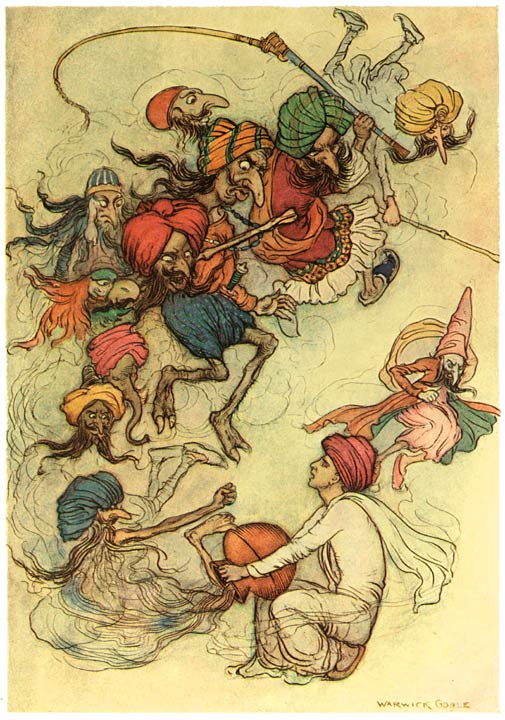
A boy playing king with fellow cowherds proposes a test: whoever can enter a narrow-necked phial will win the dispute. The human protests that this is impossible; the ghost reduces itself to an insectlike creature and enters. The boy seals the bottle, and the Brahman throws it into the sea. The text identifies the intruder as a ghost impersonating a Brahman, not expressly as the ghost of a deceased Brahman.
Origins & earliest records
Bengali oral storytelling translated by Lal Behari Day
Records & interpretation
Complete relevant tale, attached notes,1883 preface and1912 edition credits directly read.
Selected bibliography
Documented works and useful reading. This is not a list of every appearance.
- 01
Folk-Tales of Bengal
XII, The Ghost-Brahman, pp.173–177; first edition1883, illustrationsWarwickGoble
Family & connections
A source-supported family tree or inspiration record has not yet been compiled for this profile. Related reading below indicates a connection in subject matter, not a proven lineage or creative influence.
Primary records and illustrations
Lal Behari Day, Folk-Tales of Bengal (Macmillan,1912; first edition1883)
XII. XII, The Ghost-Brahman, pp.173–177
Complete tale and footnotes read, pluspreface andeditionhistory. Bengali oral informants described collectively, individual teller of this tale not identified. Original paraphrase; no source-image verification claimed.
References
Sources supporting this profile. Linked pages have their own scope and editorial standards.
- Historical translated oral narrative and collector notesLal Behari Day, Folk-Tales of Bengal (1912), XII, The Ghost-Brahman, pp.173–177Research access: 2026-10-05
Image credits
Historical illustrationThe ghost in the Brahman’s borrowed appearance returns to the household, Warwick Goble, 1912
Goble shows the usurping ghost in the absent husband’s human appearance before his wife and mother. The caption asks why he has returned so soon. Its ordinary human face belongs to the disguise in Day’s tale, rather than a separate portrait of the living Brahman.