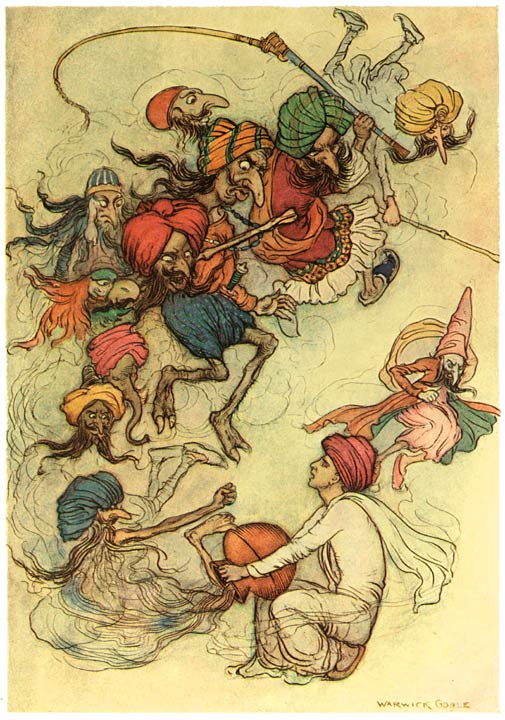
Demons emerge from the punitive pot with whips, Warwick Goble, 1912
The punitive company emerges from the pot around its frightened holder, several figures carrying whips. This is Goble’s 1912 illustration of Day’s Indigent Brahman. The varied faces, headdresses and airborne arrangement belong to this depiction rather than a uniform description of every demon.
Overview
Durga gives a poor Brahman an earthen handi after an innkeeper steals an earlier pot that supplied endless sweetmeats. When the new vessel is inverted and shaken, large, grim-faced demons appear and beat whoever is nearby. Closing or righting the vessel makes them disappear. Their first target is the Brahman himself, so the gift is not automatically safe for its owner.
He uses the demons to force the innkeeper to return the stolen vessel. Later his children accidentally release them against their own household, and he locks the pot away. When a landowner seizes another sweetmeat-producing pot, the Brahman releases the demons at the man’s feast until he begs for mercy. The narration first counts about twenty and later describes a hundred; it gives no individual names or basis for equating them with every rakshasa tradition.
Origins & earliest records
Bengali oral storytelling translated by Lal Behari Day
Records & interpretation
Complete relevant tale, attached notes,1883 preface and1912 edition credits directly read.
Selected bibliography
Documented works and useful reading. This is not a list of every appearance.
- 01
Folk-Tales of Bengal
III, The Indigent Brahman, pp.51–60, notes1–3; first edition1883, illustrationsWarwickGoble
Family & connections
A source-supported family tree or inspiration record has not yet been compiled for this profile. Related reading below indicates a connection in subject matter, not a proven lineage or creative influence.
Primary records and illustrations
Lal Behari Day, Folk-Tales of Bengal (Macmillan,1912; first edition1883)
III. III, The Indigent Brahman, pp.51–60, notes1–3
Complete tale and footnotes read, pluspreface andeditionhistory. Bengali oral informants described collectively, individual teller of this tale not identified. Original paraphrase; no source-image verification claimed.
References
Sources supporting this profile. Linked pages have their own scope and editorial standards.
- Historical translated oral narrative and collector notesLal Behari Day, Folk-Tales of Bengal (1912), III, The Indigent Brahman, pp.51–60, notes1–3Research access: 2026-10-05
Image credits
Historical illustrationDemons emerge from the punitive pot with whips, Warwick Goble, 1912
The punitive company emerges from the pot around its frightened holder, several figures carrying whips. This is Goble’s 1912 illustration of Day’s Indigent Brahman. The varied faces, headdresses and airborne arrangement belong to this depiction rather than a uniform description of every demon.