A sourced illustration has not yet been added. This gap is included in the coverage record.
Overview
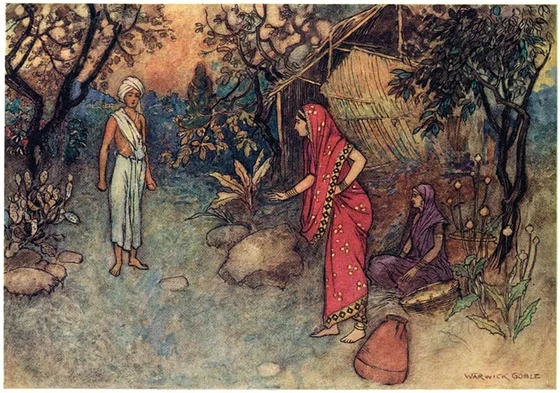
An old Rakshasi lives across the ocean in a country of Rakshasis. Hearing the hero call her grandmother and claim that her daughter is ill, she carries him across and gives him the impossible-sized melon requested by the queen. Believing him her grandchild, she reveals that a caged bird contains her daughter’s life.
She also explains that her club and rope can transport their holder across the sea. While she and the other Rakshasis forage in distant countries, the boy takes those implements and the bird and escapes. The story later kills the daughter through the bird, but does not narrate the mother’s death. Her acceptance of the boy’s kinship claim is mistaken; he is not her biological grandson.
Origins & earliest records
Bengali oral storytelling translated by Lal Behari Day
Records & interpretation
Complete relevant tale, attached notes,1883 preface and1912 edition credits directly read.
Selected bibliography
Documented works and useful reading. This is not a list of every appearance.
- 01
Folk-Tales of Bengal
VII, The Boy whom Seven Mothers Suckled, pp.116–117, within complete tale113–118; first edition1883, illustrationsWarwickGoble
Family, evolution & connections
The Rakshasi queen and her mother — Day VII
The Boy whom Seven Mothers Suckled, pp. 113–118.
Scroll sideways to see all branches. With a keyboard, focus the tree and use the arrow keys.
The queen’s direct identification of the older Rakshasi as her mother. The hero pretends to be a grandson, so he is excluded. The caged bird contains the queen’s life and is not a relative. This is one named tale; the mother’s death is not stated.
Rakshasi queen in the seven-mothers tale
The queen sends the boy across the ocean to her mother. The boy’s address as grandson is a deception; it does not establish biological kinship with either Rakshasi. The older Rakshasi’s death is not narrated.
Primary records and illustrations
Lal Behari Day, Folk-Tales of Bengal (Macmillan,1912; first edition1883)
VII. VII, The Boy whom Seven Mothers Suckled, pp.116–117, within complete tale113–118
Complete tale and footnotes read, pluspreface andeditionhistory. Bengali oral informants described collectively, individual teller of this tale not identified. Original paraphrase; no source-image verification claimed.
References
Sources supporting this profile. Linked pages have their own scope and editorial standards.
- Historical translated oral narrative and collector notesLal Behari Day, Folk-Tales of Bengal (1912), VII, The Boy whom Seven Mothers Suckled, pp.116–117, within complete tale113–118Research access: 2026-10-05
Image credits
A sourced illustration has not yet been added. This gap is included in the coverage record.