A sourced illustration has not yet been added. This gap is included in the coverage record.
Overview
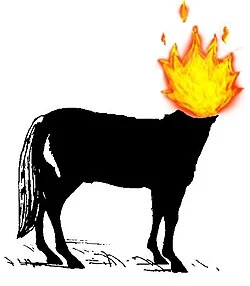
Nery's 1889 French collection spells the name Kumacanga and places the account in Pará, attributing it to Padua-Carvalho. The transformed person's body stays at home, while the detached head flies through the Friday night sky like a ball of fire. His version identifies the afflicted person as a priest's partner or the seventh son of their relationship. Nery groups it among transformations he calls loups-garous, then separately discusses people becoming horses, goats, jaguars and pigs. The fiery head's distinctive separation of body and head should not disappear into that broad European comparison.
A literary collective's 2025 presentation links Cumacanga and Curacanga, describing a cursed woman's detached fiery head and giving the seventh daughter as a common family position. This differs from Nery's priest-partner account. The presentation announces Marcelle Rodrigues Silva's story A Cabeça de Anhanguera, set in Afuá, Pará, where a burning head and the relationship between sisters drive the plot. It supplies a creator's synopsis of an authored reinterpretation; the full story was not inspected. Its etymological claim is not adopted as a verified account of the name's linguistic history.
Mark Harris’s 2008 archival study offers a qualified comparison with accusations against José Cavalcante de Albuquerque at Vila Franca in 1793. Transcribed testimony attributed claims of changing forms, fiery eyes and a wheel of fire to a dispute involving the local priest; Cavalcante sought to clear his name. Harris suggests that the fiery imagery might belong to a Cumacanga-related complex, while acknowledging that the documents leave the other supposed forms unidentified. This is a modern interpretive connection, not an eighteenth-century witness naming Cumacanga. The case also lacks direct Indigenous testimony: colonial officials’ characterizations of Indigenous belief must not be mistaken for the speakers’ own explanations. It preserves evidence about a contested accusation and its social setting, rather than demonstrating that the accused man transformed.
Origins & earliest records
The directly inspected historical passage is Nery's 1889 collection, printed page 31. Padua-Carvalho is explicitly credited but remains an indirect witness. No first oral date follows from that publication. The modern comparison comes from Rafael Caputo's 17 September 2025 presentation of a then-in-editing literary anthology, rather than an independently collected oral episode.
Records & interpretation
Nery's complete paragraph supports the detached head, stationary body and Friday flight. The later creator statement supports its own version and advertised story, not a universal regional genealogy. Its altered family condition is retained as a difference. Spelling Kumacanga is preserved in the bibliographic note; no unsupported equivalence with every fire apparition is imposed.
In the literature
“comme un globe de feu”
ChapterI, printed p.31
The detached flying head’s fiery comparison in the Padua-Carvalho account.
Selected bibliography
Documented works and useful reading. This is not a list of every appearance.
- 01
Folk-lore brésilien
Printed p. 31; directly read Kumacanga paragraph, credited to Padua-Carvalho.
- 02
Curacanga e outros contos de terror — apresentação
17 September creator presentation, including synopsis of Marcelle Rodrigues Silva's A Cabeça de Anhanguera; announced anthology not assumed published or fully read.
- 03
O lobisomem entre índios e brancos: o trabalho da imaginação no Grão-Pará no final do século XVIII
Revista IEB 47, pp. 29–56; archival case pp. 39–45, Cumacanga comparison pp. 46–47.
Family & connections
A source-supported family tree or inspiration record has not yet been compiled for this profile. Related reading below indicates a connection in subject matter, not a proven lineage or creative influence.
Located primary passages
Specific passages supporting details in this entry, grouped by their published witness.
Folk-lore brésilien
F.J.de Santa-Anna Nery, Folk-lore brésilien, Paris: Librairie académique Didier/Perrin et Cie,1889; original French selected scan. Printed31/index52,32/index53,33/index54,69/index90,70/index91 visually inspected; exact image-index mapping verified separately for these pages.
- Nery attributes a Pará account to Padua-Carvalho: the Kumacanga is a priest’s concubine or their seventh son; its body remains at home while the detached head flies on Friday night like a fire globe. The next paragraph separately treats animal-form seventh children of an ordinary couple.
Padua-Carvalho’s underlying account not independently inspected. Cumacanga’s stated origins and the neighbouring generic seventh-child rule are not silently merged into one universal anatomy or inheritance rule; the claim is a historical reported belief.
References
Sources supporting this profile. Linked pages have their own scope and editorial standards.
- ResearchNery 1889: Kumacanga, p. 31Research access: 2026-10-05
- CommunityAspas Duplas 2025: Curacanga anthology creator presentationResearch access: 2026-10-05
- ResearchHarris’s archival studyResearch access: 2026-10-05
Image credits
A sourced illustration has not yet been added. This gap is included in the coverage record.