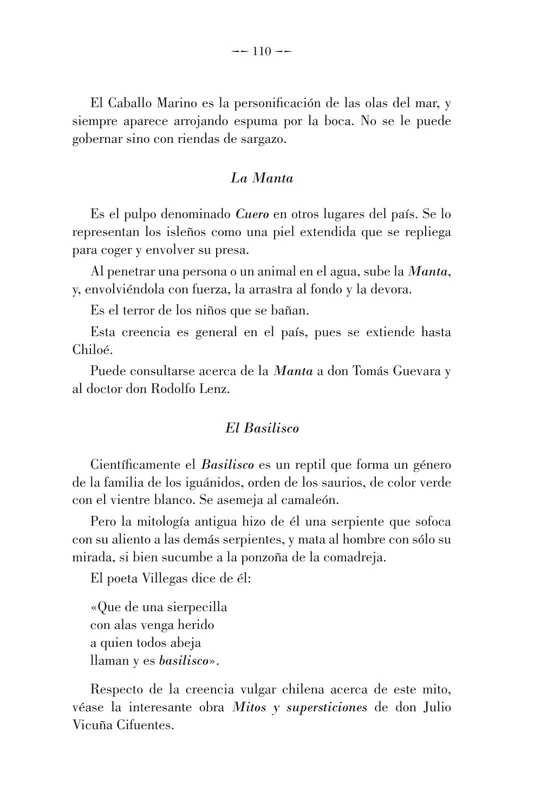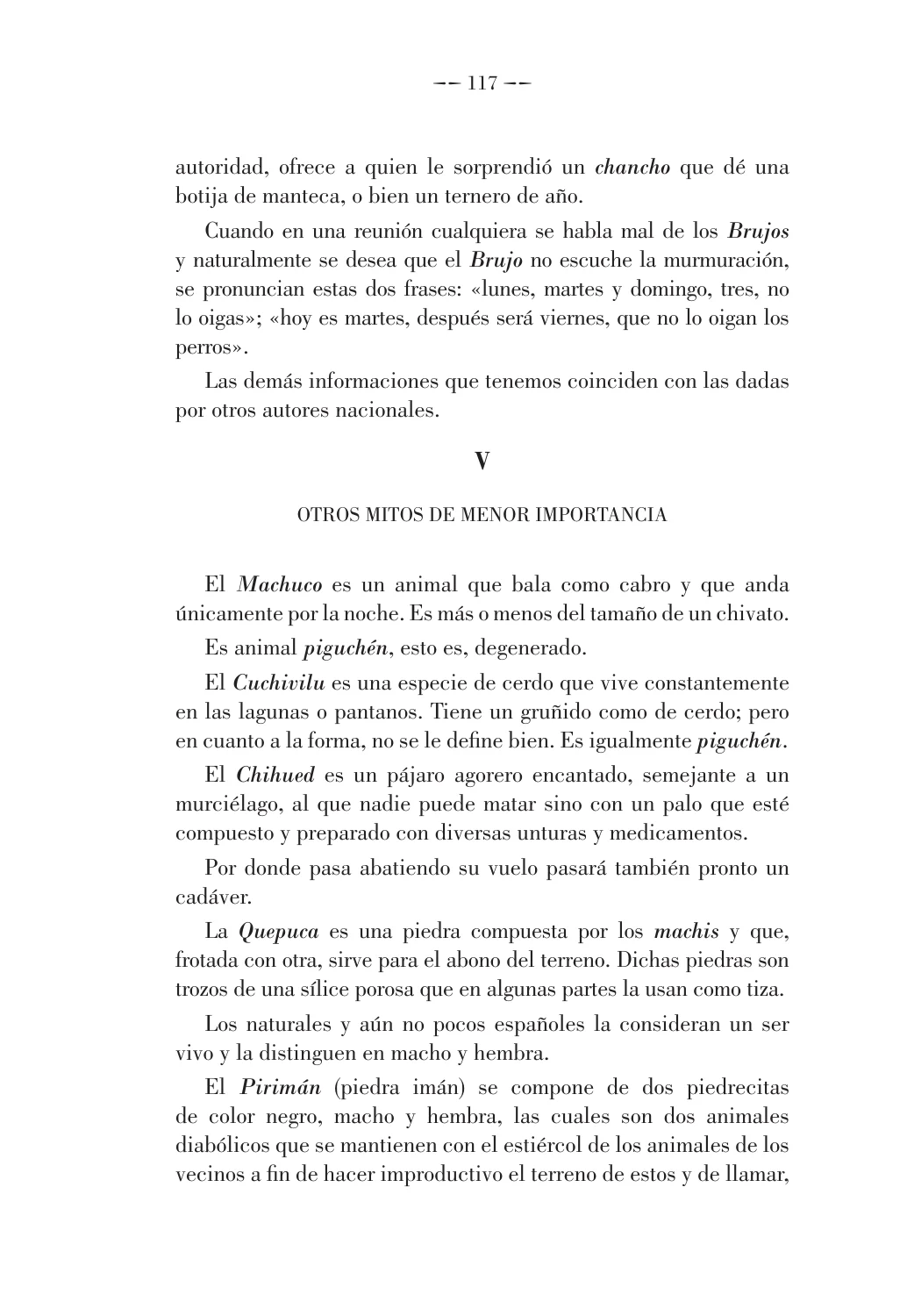
cuchivilu, named printed passage in Cavada museum edition, page117; documentary source-page facsimile
Exact documentary text facsimile of the named being, not creature artwork. Original1914 source reprinted in the2016 museum edition; page contains historical terminology and collector interpretations.
Overview
The Cuchivilu appears among the less extensively described beings in Cavada's Chiloé collection. He locates it in lakes and marshes and compares both its grunting and its general appearance with a pig. Yet he immediately qualifies the comparison: it is a Piguchén, a transformed or unusual being whose proper form has not been settled. An ordinary pig therefore does not exhaust the account's meaning.
This combination of a recognisable voice with an uncertain body makes the creature a specific presence within wetland stories. The witness does not supply a complete life cycle, a list of attacks or a prescribed method for catching it. Later depictions may give it additional fishlike features, but those require their own evidence. Here the short historical record is preserved without filling its gaps with an invented monster manual.
Vicuña Cifuentes’s 1915 comparison preserves an additional water-danger motif. He quotes Cavada’s vocabulary entry, separately from the short myth description, and Cañas’s Vocabulario: the creature inhabits hidden caves and comes out to bathe in flowing water. A person who subsequently bathes in the same water is said to develop sarna, a skin condition. This is a narrated consequence of shared water, not a recorded bite or a medical explanation. Vicuña explicitly says he collected no oral information himself and does not know whether the account extends beyond Chiloé. His proposed name components, cuchi and Mapuche vilu, do not supply missing anatomical details or establish a fixed half-pig, half-snake body.
Origins & earliest records
Cavada lists Cuchivilu in his collection published in 1914, now republished by the Ancud museum. This is a dated written witness to a local name and description, not a first-attestation claim or a date of oral origin. Its position in a short concluding list explains why the source gives fewer details than for some neighbouring beings.
Records & interpretation
Printed page 117 supports the lake-and-marsh habitat, pig comparison, grunting and explicitly uncertain form. The evidence is a collector's condensed report rather than a named narrator's complete performance. The present article therefore avoids attributing an exact hybrid anatomy, attacks or rituals to communities whose versions were not individually recorded in that passage.
In the literature
“una especie de cerdo que vive constantemente en las lagunas o pantanos.”
V: Otros mitos de menor importancia; printed p.117; paragraph beginning “El Cuchivilu es una especie de cerdo…”
Cavada reports a piglike swamp or lagoon dweller with a pig’s grunt, explicitly saying its form is not well defined and calling it piguchén.
Selected bibliography
Documented works and useful reading. This is not a list of every appearance.
- 01
Chiloé y los chilotes
Historical folklore witness; cited printed pages 117. The museum edition updates orthography.
- 02
Chiloé y los chilotes (1914) de Francisco J. Cavada: un estudio glotopolítico
Critical context for the collector's linguistic authority and national modernisation project.
- 03
Mitos y supersticiones recogidos de la tradición oral chilena
X, El Cuchivilu, complete pp. 37–38; three quotations credited to Cavada pp. 112 and 318 and Cañas, Vocabulario. Earlier vocabulary passages remain indirect; collector expressly lacks oral information.
Family & connections
A source-supported family tree or inspiration record has not yet been compiled for this profile. Related reading below indicates a connection in subject matter, not a proven lineage or creative influence.
Located primary passages
Specific passages supporting details in this entry, grouped by their published witness.
Chiloé y los chilotes
Underlying work1914; inspected fourth museum edition, Ancud, November2016 (ISBN978-956-9172-04-5); modern typography, pagination and annotations.
- Cavada reports a piglike swamp or lagoon dweller with a pig’s grunt, explicitly saying its form is not well defined and calling it piguchén.
This is Cavada’s historical collected account reproduced in2016, with its Christian and colonial framing; source criticism does not endorse its judgments or alleged practices. Exact inspected2016 pages, not assumed original1914 pagination. Spanish passage retained without an invented translation.
References
Sources supporting this profile. Linked pages have their own scope and editorial standards.
- Primary textChiloé y los chilotes — Museo Regional de Ancud edition, pp. 117Research access: 2026-10-05
- ResearchCritical study of Cavada's collectionResearch access: 2026-10-05
- Primary textVicuña Cifuentes 1915: complete Cuchivilu comparisonResearch access: 2026-10-05
Image credits
Historical text facsimilecuchivilu, named printed passage in Cavada museum edition, page117; documentary source-page facsimile
Exact documentary text facsimile of the named being, not creature artwork. Original1914 source reprinted in the2016 museum edition; page contains historical terminology and collector interpretations.