Centaur
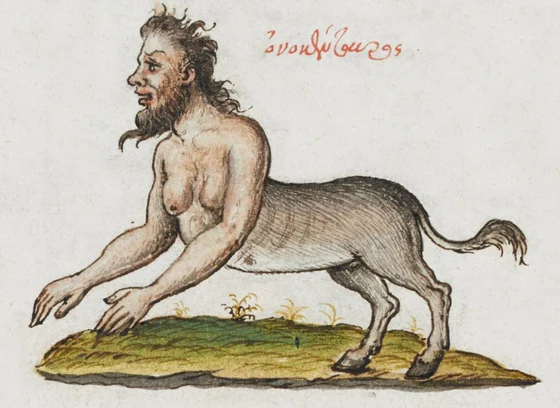
Image associated with the exact linked encyclopedia article; consult credited file description for its interpretation.
Overview
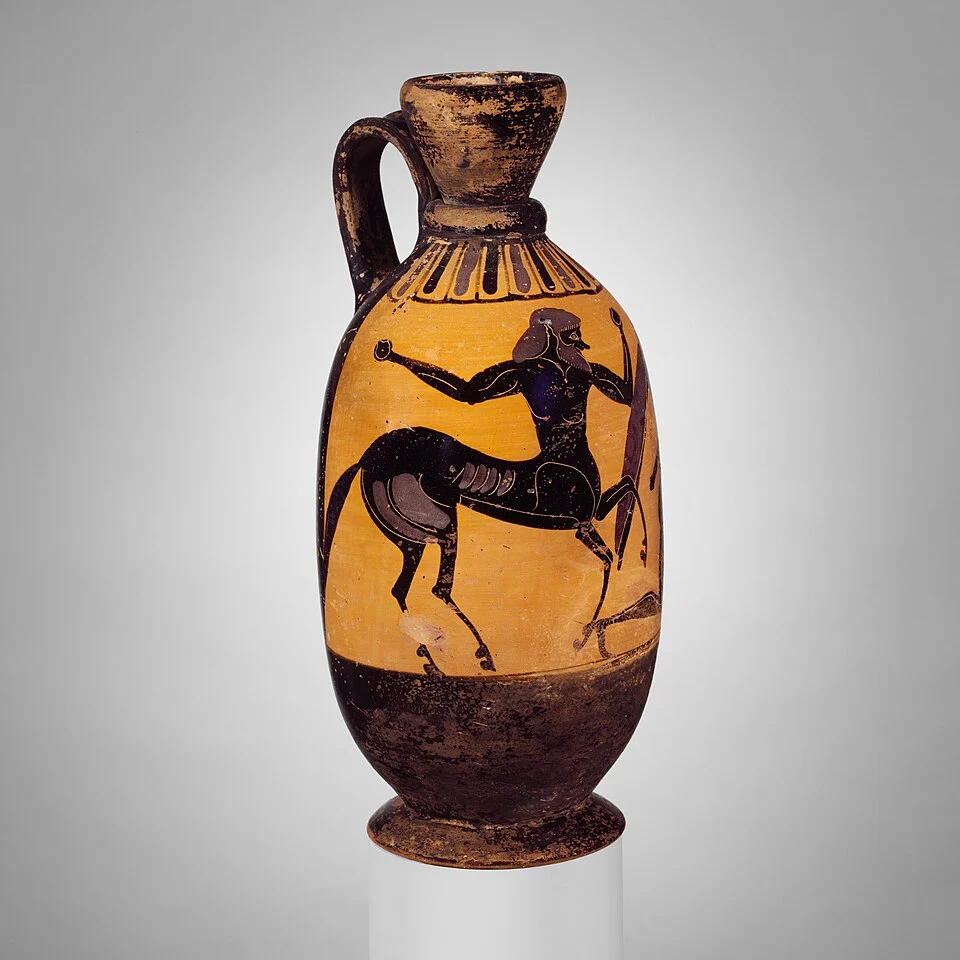
Ancient representations give a centaur the body of a horse joined to human features, but the junction is not identical in every period. The Met’s seventh-century BCE Nessos vase retains human legs at the front, while the horse body extends behind. Its scene depicts Herakles punishing Nessos after an attempted abduction of Deianeira. The museum distinguishes the sword in the picture from the poisoned arrow prominent in the associated narrative. That difference makes art an independent witness rather than a simple illustration of one fixed prose account. Later collective battles likewise emphasize the creature’s strength and ability to wield stones or trees.
Pseudo-Apollodorus’s Epitome tells of centaurs invited to Pirithous’s wedding because of kinship. Their drunken assault on the bride brings a battle with the Lapiths and Theseus. It also describes Caeneus being overcome with fir trees despite invulnerability to ordinary wounds. Bulfinch’s nineteenth-century retelling contrasts these violent guests with Chiron’s teaching and healing role. Chiron’s exception matters: a creature type does not determine every individual’s character. Genealogies involving Ixion and a cloud belong to particular textual versions, while explanations through early horse riders are interpretations rather than demonstrated origins. This profile concerns the mythic hybrid, without turning ancient labels into a zoological or historical classification of real people.
Library 2.5.4 supplies a further episode with sharply different individual roles. On his way to hunt the Erymanthian boar, Heracles is welcomed at Pholoe by Pholus, identified as the son of Silenus and a Melian nymph. The host offers roast meat while eating his own raw. He hesitates to open wine held in common by the centaurs, but Heracles does so. The smell attracts others carrying rocks and firs. Anchius and Agrius are driven back with burning brands; the pursuit reaches Chiron, where an arrow passing through Elatus’s arm accidentally strikes the healer’s knee. Chiron supplies medicine, but it cannot cure the wound. His immortality prevents the death he desires until the account’s exchange involving Prometheus allows him to die.
Pholus’s end is another accident rather than a hostile duel. Examining an arrow taken from a corpse and wondering how so small a weapon killed such large beings, he drops it onto his foot and dies. Heracles returns, finds his host dead and buries him. Surviving centaurs scatter to named refuges, including Nessus at the Evenus; others are hidden by Poseidon. This episode places hospitality, collective claims over wine, armed retaliation, unsuccessful healing and accidental death within one account. It therefore gives more than the contrast of savage centaur and exceptional teacher: the friendly host is distinct from Chiron and from the combatants gathered at his cave.
Origins & earliest records
The selected evidence includes a seventh-century BCE Attic vase, Pseudo-Apollodorus’s ancient mythographic account and Bulfinch’s later retelling. These establish separate artistic and literary witnesses, not a single moment of invention. The profile does not treat a modern hypothesis about riders as proven or imply that every ancient text describes the same body.
Records & interpretation
The Met vase supplies an early Nessos image; Epitome I.20–22 supplies the wedding battle; Library 2.5.4 differentiates Pholus’s hospitality, the armed company, Chiron’s wound and the two accidental deaths. Bulfinch separately documents a later literary contrast. Artistic and textual witnesses retain their different settings and purposes.
In the literature
“the Centaurs, men to the waist, while the rest was the form of a horse.”
Chapter X, “The Centaurs”, opening paragraph
An excerpt of Bulfinch’s composite-body description.
Selected bibliography
Documented works and useful reading. This is not a list of every appearance.
- 01
Library, Epitome I.20–22
Inspected genealogy and wedding-battle passages.
- 02
The Age of Fable, chapterX: The Centaurs
Later literary retelling, including the contrast with Chiron.
- 03
Library 2.5.4: Pholus’s hospitality and the centaur battle
Complete labour paragraph includes communal wine, named attackers, Chiron’s incurable wound, refuge of survivors and Pholus’s accidental death and burial.
- 04
Bulfinch’s Mythology: The Age of Fable (revised by E. E. Hale)
Exact contiguous excerpt checked against the linked primary e-text on 2026-10-05; only whitespace normalized. Work first published 1855; date of the Hale revision used by this e-text is not specified.
Family & connections
A source-supported family tree or inspiration record has not yet been compiled for this profile. Related reading below indicates a connection in subject matter, not a proven lineage or creative influence.
Located primary passages
Specific passages supporting details in this entry, grouped by their published witness.
The Age of Fable, chapterX: The Centaurs
Exact contiguous excerpt checked against the linked primary e-text on 2026-10-05; only whitespace normalized. Work first published 1855; date of the Hale revision used by this e-text is not specified.
- An excerpt of Bulfinch’s composite-body description.
This source represents its own literary or collected version. A novel or poem is evidence for depiction, not a universal definition or a zoological claim. Original source verification is preserved; attachment performed after exact generic profileID became available.
Encyclopedia background
An additional attributed reference, separate from the editorial profile above.
Read the open encyclopedia overview
A centaur ( SEN-tor, SEN-tar; Ancient Greek: κένταυρος, romanized: kéntauros; Latin: centaurus), occasionally hippocentaur, collectively called the Centaurs or the Ixionidae (Ancient Greek: Ἰξιονίδαι, romanized: Ixionídai, lit. 'sons of Ixion'), is a creature from Greek mythology with the upper body of a human and the lower body and legs of a horse that was said to live in the mountains of Thessaly. In one version of the myth, the centaurs were named after Centaurus, and, through his brother Lapithes, were kin to the legendary tribe of the Lapiths.
Centaurs are thought of in many Greek myths as being as wild as untamed horses, and were said to have inhabited the region of Magnesia and Mount Pelion in Thessaly, the Foloi oak forest in Elis, and the Malean peninsula in southern Laconia. Centaurs are subsequently featured in Roman mythology, and were familiar figures in the medieval bestiary. They remain a staple of modern fantastic literature.
Text from Wikipedia contributors, “Centaur”. CC BY-SA 4.0. Extracted introduction; formatting changed. Retrieved 5 October 2026. The source article may have changed since retrieval.
References
Sources supporting this profile. Linked pages have their own scope and editorial standards.
- MuseumMetropolitan Museum, Nessos Painter neck-amphora, seventh-century BCEResearch access: 2026-10-05
- Primary textPseudo-Apollodorus, Library Epitome I.20–22Research access: 2026-10-05
- Primary textBulfinch, The Age of Fable, chapterXResearch access: 2026-10-05
- Primary text in historical translationPseudo-Apollodorus, Library 2.5.4Research access: 2026-10-05
Image credits
Reference illustrationCentaur
Image associated with the exact linked encyclopedia article; consult credited file description for its interpretation.