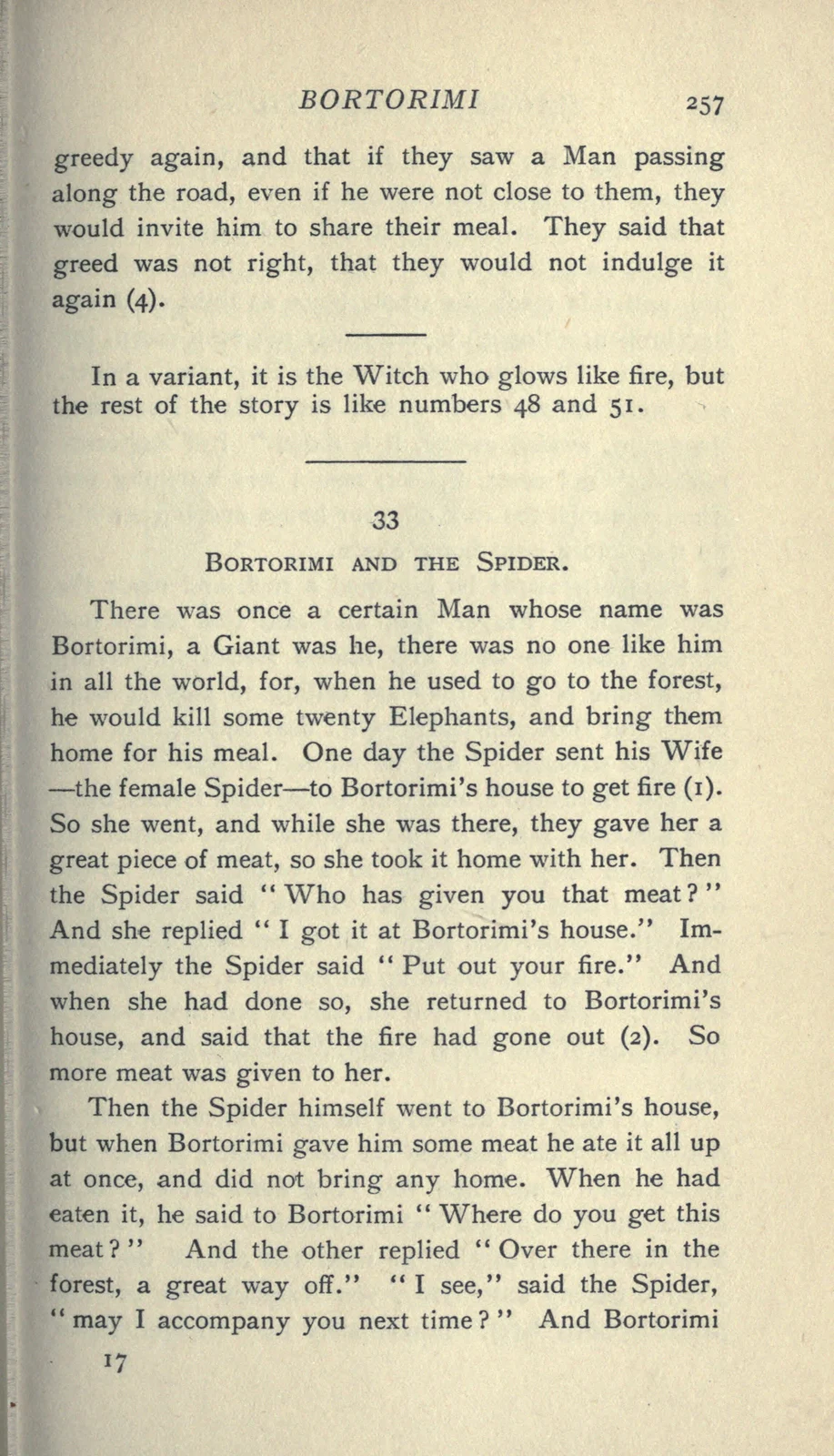
Bortorimi:1913 documentary text page257; documentary source-page facsimile
Exact named narrative text facsimile, not a creature illustration. Printed page257; actual returned IIIF canvas298. Catalogue identifies1913 edition, author1877–1915, US NOT_IN_COPYRIGHT; historical translated text is life70 expired. Oral narrator attribution retained from profile. Actual scan directly inspected: exact named tale/episode text read, including printed page number and narrative features.
Overview
Bortorimi is presented as an unmatched giant who hunts elephants and takes about twenty home for a meal. His generosity first reaches Spider's household when Spider's wife visits for fire and receives a large piece of meat. Spider deliberately puts the new fire out so she can ask again, then goes himself and eats his gift immediately. Hoping for more, he asks to join the giant's next hunt. Impatient for morning, he burns the roof of his own hut to imitate daylight, then tries a premature prayer call. Bortorimi sees through both tricks and refuses to depart until the actual dawn.
The giant's nose is as large as a house and contains a market. On the journey he first lets Spider drink his fill at a great river, then purses his lips and drains all the remaining water, leaving mud. At the elephant feeding place, he tells Spider to provoke the animals and run into his nose when they charge. Spider obeys, escaping inside while Bortorimi captures and kills the herd. Within the nasal market the guest pretends to be a king's son and demands groundnuts from a seller. The internal people and commerce are expressly narrated features of the enormous nose, rather than an invented city inferred from the giant's scale.
When the hunt ends Bortorimi calls Spider out and offers him his choice of elephant. Spider cannot carry even one, so the giant gathers the whole kill and transports it home. Spider receives his share there, roasts and consumes it without sharing with his wife, then asks to go hunting again. Bortorimi declines, saying the existing provisions suffice. The ending contrasts the giant's strength and practical sufficiency with his guest's appetite. The collector follows it with Butorami and Futaranga comparisons, including a failed imitation made from mud; these remain separately labeled variants rather than additional anatomy or adventures silently assigned to Bortorimi.
Origins & earliest records
Tale credited to Mohamma (M.) in Tremearne’s contents; storyteller initials resolved by the introduction. Exact narrative collection session is unspecified. English translation and colonial collector mediation retained.
Records & interpretation
Complete main narrative 33, Bortorimi and the Spider, pp 257–260 directly read, including its conclusion. Appended variants and external comparisons remain separate. No modern monkey species or numerical anatomical measurement is inferred from the story.
Selected bibliography
Documented works and useful reading. This is not a list of every appearance.
- 01
Hausa Superstitions and Customs
Second edition; tale 33, Bortorimi and the Spider, pp 257–260
Family & connections
A source-supported family tree or inspiration record has not yet been compiled for this profile. Related reading below indicates a connection in subject matter, not a proven lineage or creative influence.
References
Sources supporting this profile. Linked pages have their own scope and editorial standards.
- Collected primary narrative with individual storyteller attributionHausa Superstitions and Customs — tale 33, Bortorimi and the Spider, pp 257–260Research access: 2026-10-05
Image credits
Historical text facsimileBortorimi:1913 documentary text page257; documentary source-page facsimile
Exact named narrative text facsimile, not a creature illustration. Printed page257; actual returned IIIF canvas298. Catalogue identifies1913 edition, author1877–1915, US NOT_IN_COPYRIGHT; historical translated text is life70 expired. Oral narrator attribution retained from profile. Actual scan directly inspected: exact named tale/episode text read, including printed page number and narrative features.