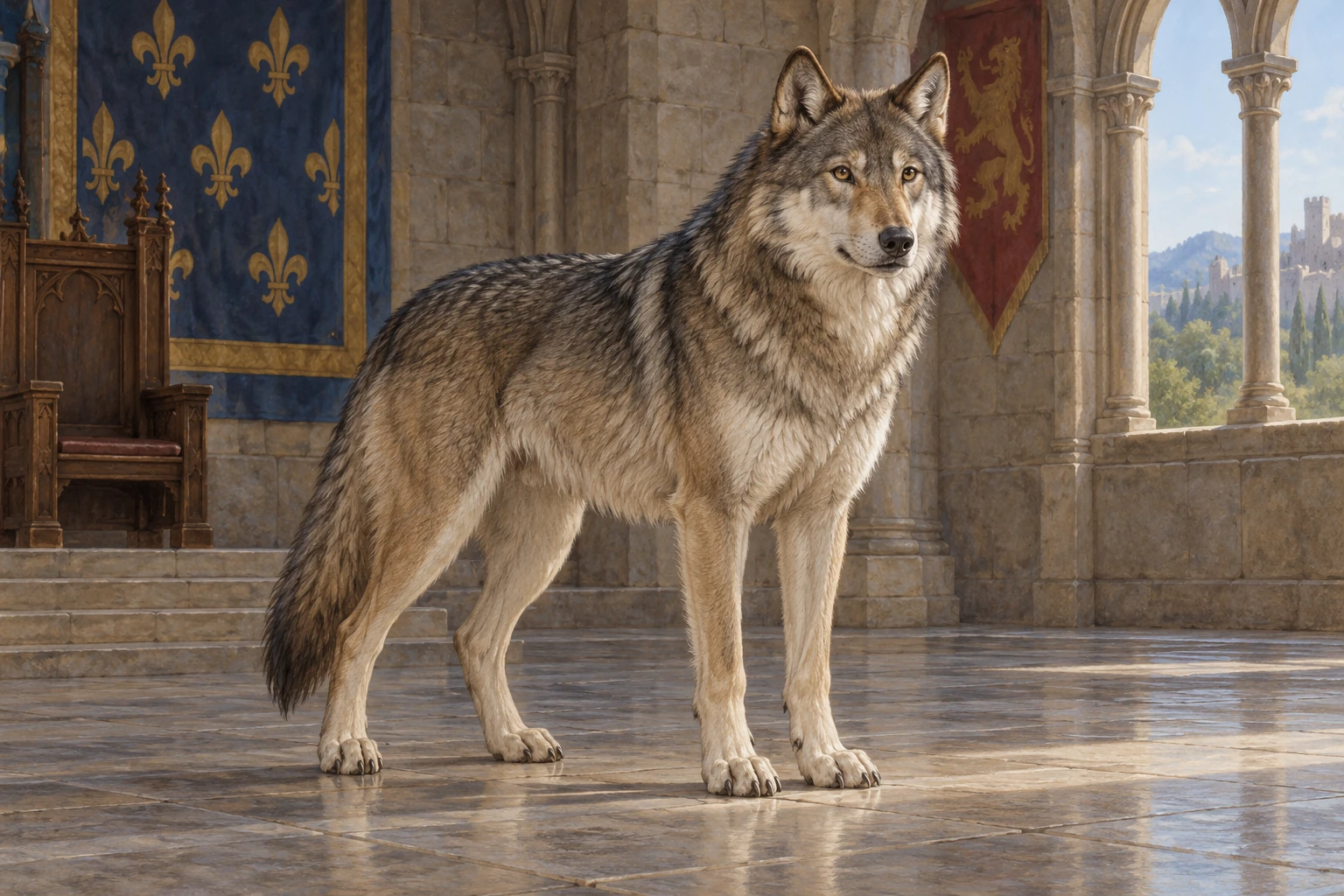
AI-generated interpretation of Bisclavaret as the king’s protected wolf companion in Mason’s 1911 translation. Coat, face, posture, architecture, furniture, banners and heraldry are imagined; the lay prescribes no wolf breed or colour. This is not a reconstruction of a particular historical court or a Harry Potter design.
A quiet scene of the wolf companion, not a depiction of transformation or attack. The complete narrative retains human understanding in animal form.
Overview
Mason’s translation of Marie de France’s lay places a respected married baron in Brittany and calls the werewolf Bisclavaret. Its opening distinguishes that Breton name from the Norman Garwal. The baron disappears for three days each week, and his wife presses him to explain why. He finally tells her that he becomes a wolf and lives in the forest. He must recover the clothes hidden beside an old chapel before he can become a man again. The lay supplies neither a lunar timetable nor an infection acquired from a bite.
After learning the hiding place, the wife fears living with him and offers herself to a knight who has long sought her love. She explains how the clothes can be stolen, leaving her husband trapped in wolf form, and then marries her accomplice. More than a year after the baron’s disappearance, the king’s hunters pursue the wolf. Instead of attacking the king, he takes the stirrup in his paws and appeals for mercy through his behaviour. The king recognises something like human understanding, calls off the hounds and brings him to the castle.
Bisclavaret becomes the king’s protected companion. He is fed and housed, moves among the courtiers without harming them, and sleeps in the royal chamber. His exceptional hostility toward the wife’s new husband therefore attracts notice. Later he attacks the wife herself and bites away her nose. A counsellor connects those two particular targets with the missing baron and urges an inquiry. The king subjects the pair to severe questioning, and the wife reveals the theft. The narrator’s opening general description of ravening werewolves must therefore be kept distinct from this hero’s selective actions and courtly reception.
When the clothes are laid before him, the wolf does not change in public. The counsellor advises privacy, and the king leaves wolf and clothes together in his own chamber. On returning with two companions, he finds the restored knight asleep in his bed. The king embraces him, restores his estate and adds gifts. The wife and her second husband are expelled from the realm. This complete ending belongs to Mason’s 1911 prose version; no details from other translations or later adaptations are added. The lay is a literary account of transformation, betrayal and recognition, not evidence that all Breton people held one uniform belief about wolves.
Origins & earliest records
Marie de France, The Lay of the Were-Wolf, VIII in French Mediaeval Romances from the Lays of Marie de France, translated into prose by Eugene Mason,1911. The consulted heading and library catalogue identify the 1911 translation.
Records & interpretation
Complete selected lay read, from the narrator’s Breton/Norman naming introduction through restored estate and the traitors’ exile. Original Old French manuscripts and other translations were not collated. Bisclavret is a discovery alias; the selected English witness spells the name Bisclavaret.
Selected bibliography
Documented works and useful reading. This is not a list of every appearance.
- 01
French Mediaeval Romances from the Lays of Marie de France: VIII The Lay of the Were-Wolf
Complete selected lay, not the whole collection. Text heading gives 1911; catalogue identifies Dent/Dutton, Everyman 557. No original print-page or Old French collation claimed.
Family, evolution & connections
Werewolf (Harry Potter)
Marie de France’s werewolf, in Mason’s 1911 version, is a human baron trapped in wolf form when his clothes are stolen; the king protects him and the recovered clothes permit restoration. This is one named literary werewolf context. Its weekly absences, clothing rule and courtly story do not establish the rules or creative sources of the Potter werewolf.
Worgen
In Mason’s 1911 version of Marie de France’s lay, a baron remains a wolf after his clothes are stolen. He retains recognisable understanding, becomes the king’s protected companion and regains human form when his clothes are restored in private. This is a particular literary human-to-wolf transformation context. The comparison does not establish shared transformation rules or a creative source for Worgen.
Jean Grenier in Baring-Gould’s werewolf trial account
Both accounts connect claims of wolf form with clothing, but their narrative status and outcomes differ. Mason’s Bisclavaret is a literary lay in which stolen clothes prevent restoration and their recovery permits the baron’s return. Baring-Gould transmits Grenier’s claims about a supplied wolf-skin and discarded ordinary clothes within a reported trial and confinement. The comparison is between motifs in texts, not proof of bodily transformation, common historical guilt or direct transmission.
References
Sources supporting this profile. Linked pages have their own scope and editorial standards.
- Medieval literary narrative in historical English translationMarie de France, The Lay of the Were-Wolf, VIII; Eugene Mason’s 1911 prose translation, complete layResearch access: 2026-10-25
Image credits
Modern interpretation of a historical narrativeAI-generated interpretation of Bisclavaret as the king’s protected wolf companion in Mason’s 1911 translation. Coat, face, posture, architecture, furniture, banners and heraldry are imagined; the lay prescribes no wolf breed or colour. This is not a reconstruction of a particular historical court or a Harry Potter design.
A quiet scene of the wolf companion, not a depiction of transformation or attack. The complete narrative retains human understanding in animal form.