Axolotl
Image associated with the exact linked encyclopedia article; consult credited file description for its interpretation.
Overview
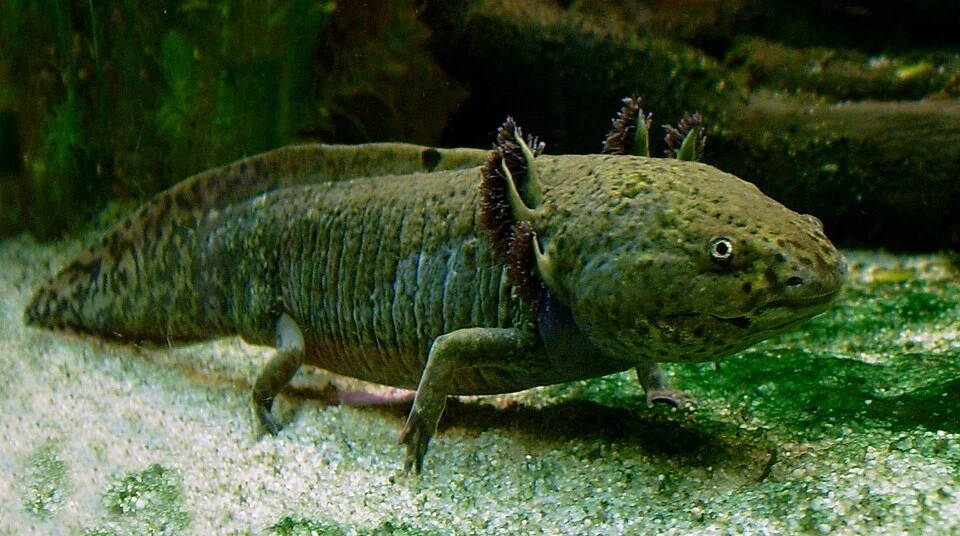
The axolotl keeps several larval features while becoming reproductively mature, a developmental pattern called paedomorphosis. Its feathery external gills and aquatic life contrast with the metamorphosis familiar in many other salamanders. Wild populations are associated with the altered freshwater landscape around Mexico City, while captive animals have spread through laboratories and breeding.
Regeneration makes axolotls valuable in developmental research: damaged limbs can be rebuilt with coordinated formation of several tissues. Experimental work does not mean every injury is harmless or that comparable human regeneration has been achieved. The abundance of captive axolotls also cannot substitute for healthy wild ecosystems. Habitat change, pollution and introduced fishes create pressures that need to be evaluated in the remaining native environment.
A 2018 genome study by Sergej Nowoshilow and colleagues examined the laboratory d/d strain. DNA came from liver and spleen of one three-year-old male, while RNA from 22 tissue types supported annotation. Long-read sequencing, optical mapping and the new MARVEL assembler addressed a particularly difficult feature: a genome of about 32 billion base pairs containing many repeated sequences. The investigators annotated 23,251 protein-coding genes, a number comparable to other vertebrates. The large genome therefore did not simply contain a proportionately larger catalogue of genes. Much of its expansion was associated with retroelements, enlarged introns and greater spacing between genes.
The expansion was uneven. Introns in genes associated with development were relatively constrained compared with those in other genes, and the HoxA cluster retained some compact internal features despite surrounding repetitive DNA. The proposed explanation that smaller developmental genes could be transcribed more rapidly is an interpretation, not a direct measurement of transcription speed in every such gene. The assembly also lacked Pax3, a developmental regulator found in other vertebrates. Searches of raw reads, transcripts and the expected neighboring genomic region strengthened the case that this was a biological absence rather than merely an assembly gap.
Functional experiments then tested the related gene Pax7. Its disruption produced several abnormalities, including loss of limb muscle, later reduction of trunk and tail muscle, changes in pigment cells and defects in neural-tube closure. Comparisons with other vertebrates supported the conclusion that axolotl Pax7 performs some functions carried out by Pax3 elsewhere. Separately, the researchers identified candidate coding and noncoding sequences associated with regenerating limb tissue. Those candidates offered research directions rather than proof that any one sequence explains regeneration. The paper reports that experiments were neither randomized nor blinded and that sample size was not statistically predetermined; its genomic and developmental observations should be read within that experimental design.
Origins & earliest records
The species originated through salamander evolution, not through modern laboratory breeding. Its Indigenous cultural history, scientific naming and adoption as a research animal are different accounts of human relationships with it. This profile assigns no unsupported fossil age and distinguishes native populations from the long-established captive stocks used in experiments.
Evidence & interpretation
Living observations and experiments directly demonstrate retained gills and regenerative capacities. Museum records confirm salamander classification, while field surveys address native populations. Captive colour forms and breeding histories may differ from wild animals. Regeneration results depend on injury and conditions, and laboratory availability does not establish successful conservation in the original habitat.
Selected bibliography
Documented works and useful reading. This is not a list of every appearance.
- 01
Axolotl
Selected institutional scientific reading; not a complete bibliography.
- 02
The axolotl genome and the evolution of key tissue formation regulators
Nature 554:50-55, DOI10.1038/nature25458. Main report and Methods; retained corrected d/d label. CC BY 4.0.
Family, evolution & connections
Central Mexican salamander clusters in the 2021 quartets tree
Selected central-Mexican branches of Figure 3 right; sampled individuals collapsed by its colored blocks. Northern-Mexican, US and outgroup branches omitted.
Scroll sideways to see all branches. With a keyboard, focus the tree and use the arrow keys.
- Selected central-Mexican quartets subtree
- CM1: A. altamirani / A. leorae / A. rivulare samples
- Remaining selected central-Mexican samples
- CM3: A. ordinarium samples
- Other selected central-Mexican samples
- CM3: A. amblycephalum / A. andersoni / A. dumerilii / A. flavipiperatum samples
- CM2 and CM4
- CM2: A. bombypellum / A. granulosum / A. lermaense samples
- Two sampled CM4 blocks
- CM4: A. taylori / A. velasci samples
SVDquartets subset of sampled individuals; network and concatenated analyses provide comparisons. These population clusters do not establish one species per branch. CM3 is split in the displayed topology. Network reticulation, admixture and often low bootstrap support limit a strictly branching account; two concatenated-analysis conflicts are drawn as dashed alternatives in the source. The source states branch lengths are not scaled to time or substitution rate; no dates are shown.
Taxonomic classification
A hierarchy of classified groups, not a chain of direct ancestors.
- kingdomAnimalia
- phylumChordata
- classAmphibia
- orderCaudata
- familyAmbystomatidae
- genusAmbystoma
- speciesAmbystoma mexicanum
CM4 A. taylori / A. velasci sample block (Everson 2021)
The selected quartets tree places the A. mexicanum sample block beside another CM4 block. Admixture, reticulation and limited support prevent treating these population blocks as a settled species genealogy.
Located primary passages
Specific passages supporting details in this entry, grouped by their published witness.
The axolotl genome and the evolution of key tissue formation regulators
Nature554,50–55; online24January2018, issue1February2018; DOI10.1038/nature25458. Retained PDF uses corrected d/d strain label.
- The32-gigabase genome assembly connects expanded introns and intergenic regions chiefly with retroelement proliferation rather than a correspondingly huge gene count. Developmental-gene introns show comparatively constrained expansion. The authors find evidence for loss of Pax3 and for Pax7 taking on overlapping developmental functions. Proposed links between species-restricted sequences and regeneration remain research leads, rather than proof of a complete regenerative mechanism.
Methods, supplementary experiments and underlying sequencing data not independently reanalysed. Gene-function and regeneration hypotheses remain attributed to this study; no laboratory protocol reproduced.
Encyclopedia background
An additional attributed reference, separate from the editorial profile above.
Read the open encyclopedia overview
The axolotl ( ; from Classical Nahuatl: āxōlōtl [aːˈʃoːloːtɬ] ; Ambystoma mexicanum) is a species of mole salamander. It is neotenic, reaching sexual maturity without undergoing metamorphosis, and the adults remain fully aquatic with obvious external gills. Axolotls may be difficult to distinguish from the larval stage of other neotenic adult mole salamanders, in particular the tiger salamander, or other species such as mudpuppies.
Axolotls originally inhabited a system of interconnected wetlands and lakes in the highlands of Mexico. They were known to inhabit the smaller lakes of Xochimilco and Chalco and are presumed to have inhabited the larger lakes of Texcoco and Zumpango. The desiccation of these lakes, initiated by the Aztecs and accelerated during the 20th century, has led to the destruction of much of the axolotl's natural habitat, an area now largely occupied by Mexico City. Wild axolotls have been driven to near extinction by the introduction of invasive species such as tilapia and carp; with a decreasing population of around 50 to 1,000 adult individuals, the species has been assessed as critically endangered by the International Union for Conservation of Nature (IUCN) and is listed under Appendix II of the Convention on International Trade in Endangered Species (CITES).
There currently exists a large captive population of axolotls, with specimens used extensively in scientific research because of their unusual ability to regenerate body parts, including limbs, gills and parts of their eyes and brains. The species is also used as a model organism. As aquarium technology has developed, axolotls have become a common exhibit in zoos and public aquariums, as well as an occasional pet in home aquariums. The axolotl is a popular subject in contemporary culture, inspiring a number of works and characters in the media.
Text from Wikipedia contributors, “Axolotl”. CC BY-SA 4.0. Extracted introduction; formatting changed. Retrieved 5 October 2026. The source article may have changed since retrieval.
References
Sources supporting this profile. Linked pages have their own scope and editorial standards.
- MuseumAxolotlResearch access: 2026-10-05
- ResearchAxolotlResearch access: 2026-10-05
- ResearchNowoshilow and colleagues 2018, CC BY 4.0Research access: 2026-10-05
Image credits
Reference illustrationAxolotl
Image associated with the exact linked encyclopedia article; consult credited file description for its interpretation.