Anhangá
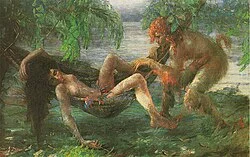
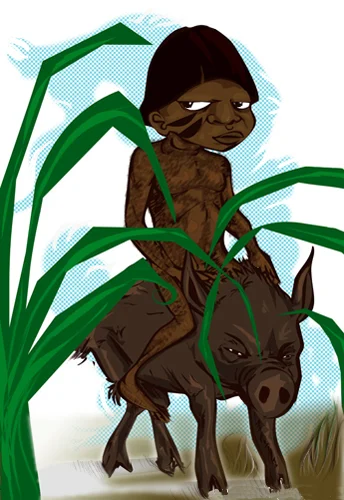
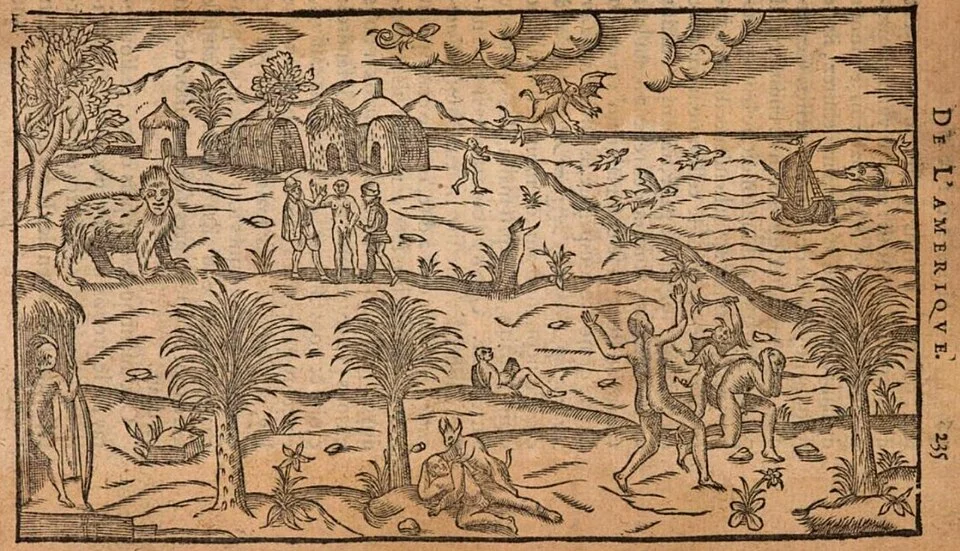
Image associated with the exact linked encyclopedia article; consult credited file description for its interpretation.
Overview
In O selvagem, Couto de Magalhães associates Anhangá with game in open country and describes a white deer with fiery eyes. A hunter who pursues an animal nursing its young risks encountering the spirit and suffering fever or mental disturbance. The collector interprets this relationship as protection of animals against excessive destruction, making the spirit's threatening appearance inseparable from its protective role.
Magalhães also tells an Anhangá episode set near Santarém and identifies its hunter as Tupinambá. After wounding a nursing doe, the hunter captures her fawn and hides behind a tree, making it cry to draw her back. He shoots the approaching animal, then discovers that Anhangá has deceived him: the fallen doe is his own mother, pierced by the arrow. The collector argues that the story expresses restraint toward nursing game because hunting supplies food. That moral reading belongs to Magalhães’s interpretation within a colonial work of classifying Indigenous peoples and languages; it does not establish a single contemporary Tupi-speaking community’s account.
Barbosa Rodrigues prints a related Tapajós hunter story under Yurupari in 1890. Here the hunter first shoots the fawn, makes it cry to draw back the doe, then kills her and recognizes his own mother. The close says Yurupari changed the mother into a deer to deceive the son while he slept. A footnote expressly acknowledges the Anhangá attribution reported to Magalhães but calls it a confusion. Rodrigues also says in his surrounding discussion that he heard the related narrative on the Tapajós and elsewhere in 1872. These are a competing name attribution and a different framing of the episode, not grounds for silently correcting Magalhães into agreement.
Rodrigues’s separate Manaós-titled Anhangá tale concerns two women whose cassava plots have been damaged by a deer. One remains insulting the animal while the other goes to inspect her plot. The deer leaps up and threatens to eat the first woman; she climbs a tree and calls for her companion. When the second woman returns, the deer flees angrily. No woman is eaten or killed. The interlinear version includes Yurupari in a woman’s address, although the title says Anhangá and the separate Portuguese rendering omits that name from her speech. This internal variation further cautions against treating the collector’s terminology as perfectly consistent.
Origins & earliest records
O selvagem first appeared in 1876; the accessible UFRJ witness is its 1935 edition, reproducing the earlier text. This gives a dated collector's interpretation, not a first oral attestation. Earlier colonial uses and contemporary Indigenous meanings require separate language- and community-specific evidence before a single history of the name can be asserted.
Records & interpretation
The accessible edition's printed page 169 supports the deer appearance, fiery eyes, nursing-animal context and narrative illness. Its publication history is verified through university and museum catalogues. The passage documents a historical representation; it cannot verify spirit encounters, provide a zoological classification or settle all meanings of Anhangá across different languages and communities. Rodrigues’s original pp.135 and 137–138 are compared as separate attributed witnesses; exact differences in initial shooting, sleep framing and name use are retained. His 1872 recollection is not a date assigned to every tale.
Selected bibliography
Documented works and useful reading. This is not a list of every appearance.
- 01
O selvagem
Selected 1935 edition, printed pp. 162–163: complete Santarém/Tupinambá hunter narrative and collector’s protective interpretation; p. 169: white deer, fiery eyes and attributed fever/madness account. Colonial classification context retained.
- 02
Poranduba amazonense, ou Kochiyma-uara porandub
Complete selected Tapajós Yurupari hunter tale V, p.135, and Manaós Anhangá tale VI, pp.137–138, including the footnote, Portuguese renderings and selected interlinear Portuguese glosses. The author’s recollection of hearing a related tale in 1872 is located at p.95. No independent Nheengatu translation is claimed.
Family & connections
A source-supported family tree or inspiration record has not yet been compiled for this profile. Related reading below indicates a connection in subject matter, not a proven lineage or creative influence.
Encyclopedia background
An additional attributed reference, separate from the editorial profile above.
Read the open encyclopedia overview
Anhangá or Anhanga (Tupi: Anhang<añánga; Sateré-Mawé: Anhang/Ahiag Kag or Ahiãg; French: Agnan, aignen) is a type of spirit present in the cosmovision of several native groups from Brazil and Indianist literature.
The spirit is believed to torment the soul of the dead, manifested in nature as tempestuous noises. It also constantly afflicts the living, with torment which feels like beating, appearing in the forms of birds and beasts and other strange beings (also as armadillo, the pirarucu fish, etc. according to modern collected lore). It particularly afflicts hunters with madness and fever, especially if they target females (does) with young, as it is a guardian of wildlife game in the open field (or the forest, according to modern sources), and as such, usually appears in the guise of white deer with fiery eyes. People also feared the presence of Anhangá during funerary rituals, where the virtuous dead are supposed to journey to the elysian Land Without Evils.
Text from Wikipedia contributors, “Anhangá”. CC BY-SA 4.0. Extracted introduction; formatting changed. Retrieved 5 October 2026. The source article may have changed since retrieval.
References
Sources supporting this profile. Linked pages have their own scope and editorial standards.
- Primary textO selvagem — UFRJ digital editionResearch access: 2026-10-05
- ResearchUSP CEDOCH — publication history of O selvagemResearch access: 2026-10-05
- MuseumMuseu Nacional dos Povos Indígenas — O selvagem catalogueResearch access: 2026-10-05
- Primary textUFPE: Rodrigues 1890, Tapajós and Manaós accountsResearch access: 2026-10-05
Image credits
Reference illustrationAnhangá
Image associated with the exact linked encyclopedia article; consult credited file description for its interpretation.