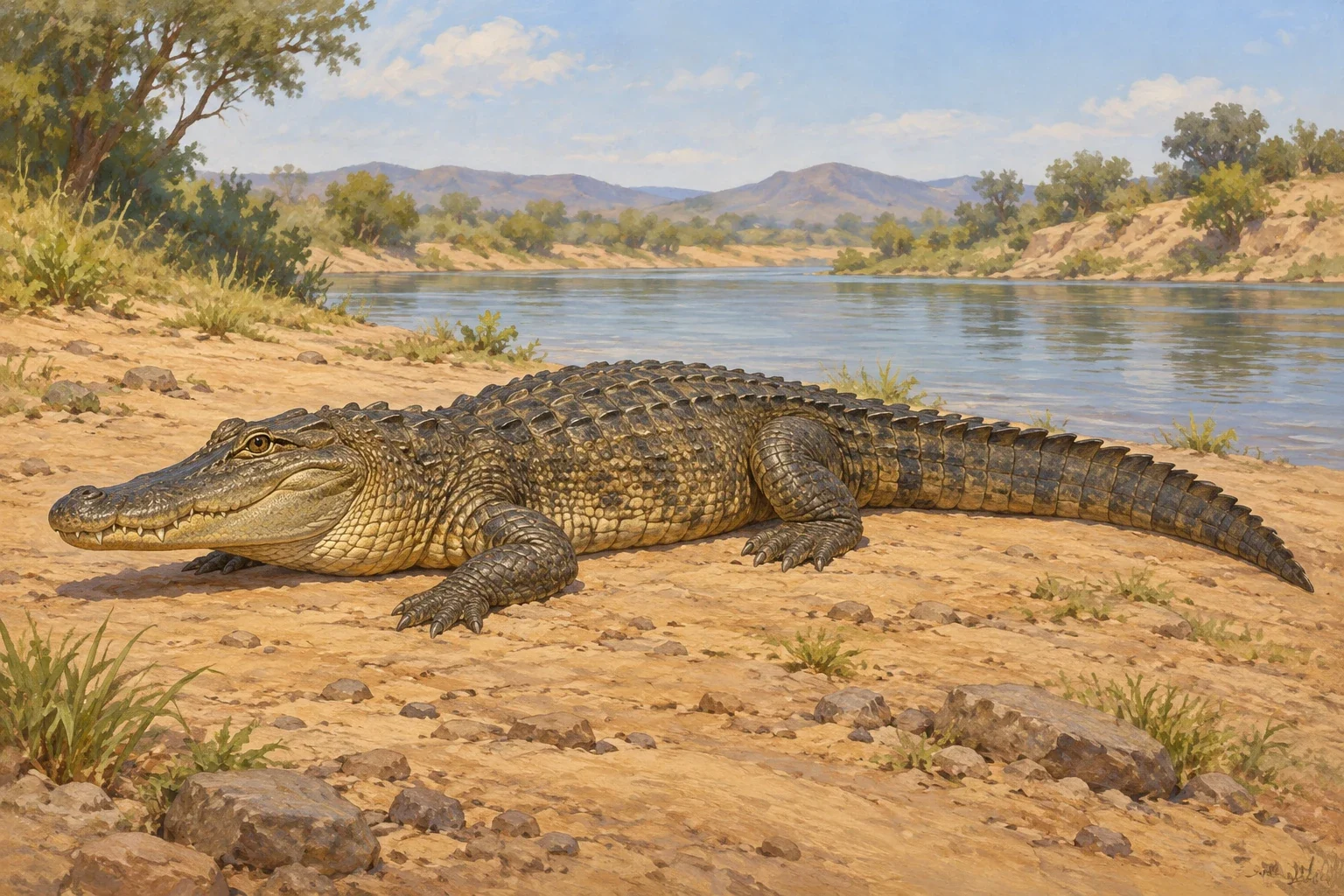
AI narrative interpretation of The Alligator in Thorburn’s Jackal Fable in Thorburn’s Bannú; or Our Afghan Frontier (1876).
AI narrative interpretation of Thorburn’s speaking alligator. Crocodilian anatomy details, color, dry-bank pose and river landscape are invented; the English animal label establishes neither a biological species nor an American locality.
Overview
An alligator and a jackal are close friends, to the distress of the alligator’s wife, who feels neglected. She pretends to be ill and initially refuses to name a remedy. When her husband presses her, she says that she needs a jackal’s heart. Her illness and proposed cure are part of her deception, rather than medical information or a demonstrated magical requirement.
The alligator reassures her and invites his friend to go across the river with him. The jackal says that he cannot swim, and the alligator offers to carry him on his snout. Once they reach the middle of the river, the frightened jackal asks about the danger. The alligator admits that he intends to kill him and give his heart to his wife.
The jackal responds by claiming that he left his heart on the bank and telling the alligator to take him back if he wants it. The alligator believes him and returns to shore. The moment the jackal reaches dry land, he runs into the jungle and abandons friendship with alligators. The tale ends with the failed betrayal, without a heart being removed or a further confrontation with the wife.
This is the river-crossing and heart-deception sequence in Thorburn’s collection. Parker’s separately recorded Sri Lankan crocodile-and-jackal tales concern a rescuer’s trial or flower-covered feigned death and a trapped-foot bluff; their episodes are not added here. Thorburn’s alligator is a source-specific speaking character. The English animal label does not establish a biological species or an American setting; the jackal’s supposedly detached heart is a successful lie, not supernatural anatomy.
Origins & earliest records
The Alligator and Jackal, Class III fables in Thorburn’s Bannú; or Our Afghan Frontier (1876), original pp.219–220. It is a condensed English Pashto-collection witness, with no individual teller or precise collection village supplied.
Records & interpretation
Complete The Alligator and Jackal from its heading on printed p.219 through the jackal’s escape and renunciation of the friendship on p.220; both native PDF235–236 checked. No attached comparative note appears with this tale.
Selected bibliography
Documented works and useful reading. This is not a list of every appearance.
- 01
Bannú; or Our Afghan Frontier
London: Trübner, 1876; consulted scan retains the original title and body in a later Sang-e-Meel facsimile whose notice says first published in Pakistan 1970. Thorburn says he condensed and translated fifty Pashto tales; these two tellers and collection villages are unnamed.
Family & connections
A source-supported family tree or inspiration record has not yet been compiled for this profile. Related reading below indicates a connection in subject matter, not a proven lineage or creative influence.
References
Sources supporting this profile. Linked pages have their own scope and editorial standards.
- Historical condensed English translation of collected Pashto tales; original text in later facsimileThorburn, Bannú; or Our Afghan Frontier (1876), Class III fables, original pp.219–220Research access: 2026-10-21
Image credits
AI-generatedAI narrative interpretation of The Alligator in Thorburn’s Jackal Fable in Thorburn’s Bannú; or Our Afghan Frontier (1876).
AI narrative interpretation of Thorburn’s speaking alligator. Crocodilian anatomy details, color, dry-bank pose and river landscape are invented; the English animal label establishes neither a biological species nor an American locality.