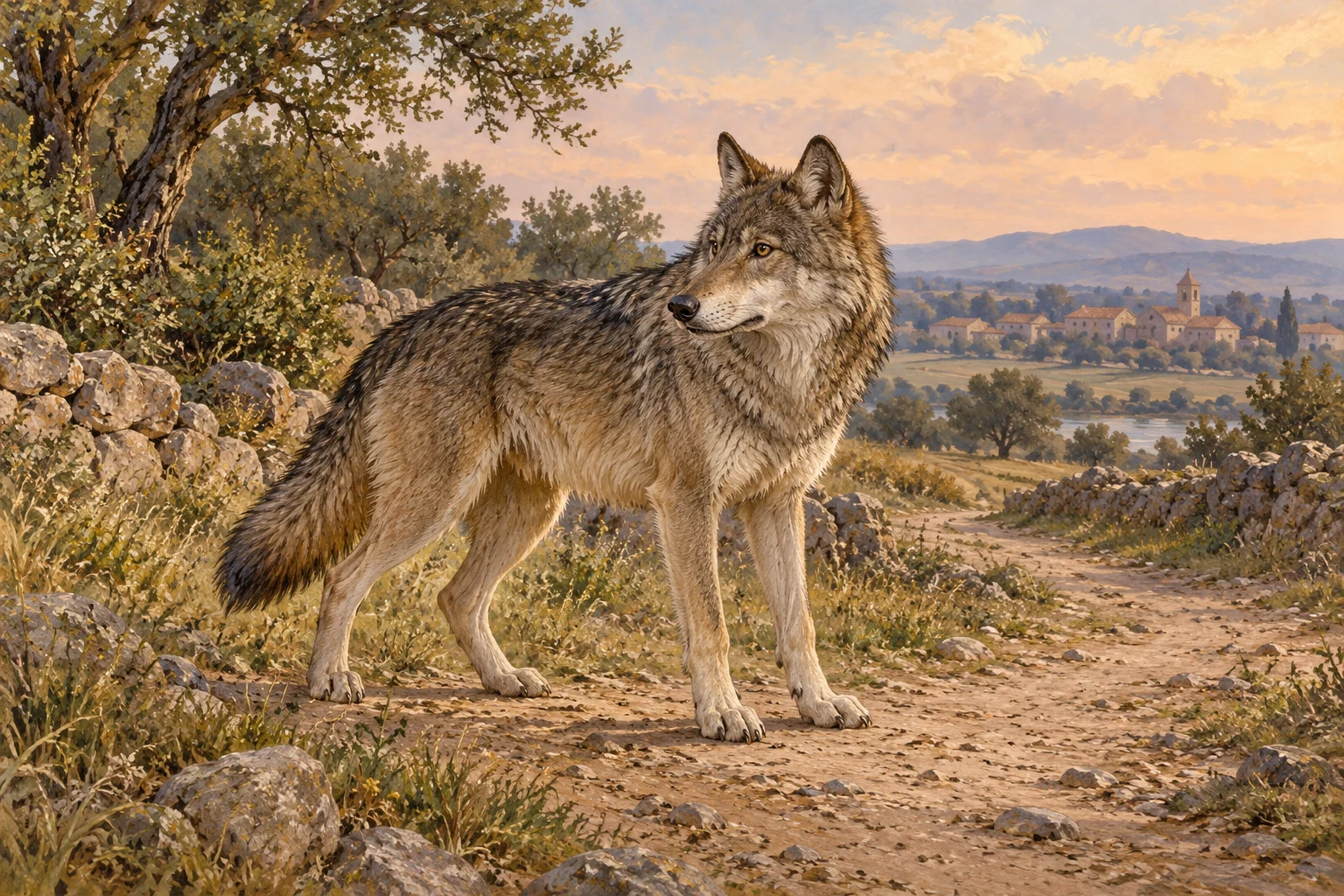
Thorburn’s repeatedly deceived wolf before the encounters; coat and setting imagined.
Original narrative illustration; species-like detail and setting imagined rather than an authenticated specimen.
Overview
The wolf and jackal in Thorburn’s fable hunt together, but their risks are unequal: the jackal keeps back while the wolf tackles the prey. A kid first persuades the wolf to hear a final song before killing it. The supposed song is bleating, which rouses village dogs and forces the wolf to flee. His companion mocks this unexpected interest in music. On the following day an ass offers to teach him to ride before being eaten. The wolf climbs onto its back, and the ass gallops towards the village. Beaten by the villagers, the frightened rider barely escapes; the jackal again jeers because their supper has been lost.
An aged camel supplies the final deception on the next day. It asks the wolf to read an amulet said to be written on its breast, promising that the charm will ensure future hunting success. When the wolf moves between its forelegs to look upwards, the camel throws itself forward and crushes him. The source gives no working magic: the amulet claim is the prey’s lure. Across the three encounters, apparent opportunities to enjoy music, learn a skill or obtain a hunting advantage each postpone the attack and expose the predator to danger. Unlike the earlier escapes, the last encounter kills him, and the tale ends without another intervention by the cautious jackal.
Origins & earliest records
S. S. Thorburn’s Bannú; or Our Afghan Frontier, original English publication 1876, read in a 1970 Lahore facsimile retaining the original title and pagination. Thorburn, a British district settlement officer, says he condensed and translated fifty popular Pashto tales. Neither this tale’s individual teller nor a precise collection village is named. His colonial judgments about the storytellers are historical mediation, not adopted assessments.
Records & interpretation
Complete The Wolf and the Jackal, Class III, printed pp. 221–222, through the camel’s fatal counterattack; full preface and complete chapter collection prelude read. Original selected pages and both edition notices visually inspected.
Selected bibliography
Documented works and useful reading. This is not a list of every appearance.
- 01
Bannú; or Our Afghan Frontier
Part II, Chapter II, Class III, The Wolf and the Jackal, printed pp. 221–222; original body in 1970 facsimile.
Family & connections
A source-supported family tree or inspiration record has not yet been compiled for this profile. Related reading below indicates a connection in subject matter, not a proven lineage or creative influence.
References
Sources supporting this profile. Linked pages have their own scope and editorial standards.
- Historical condensed English translation of a collected Pashto taleThorburn 1876: complete The Wolf and the JackalResearch access: 2026-10-18
Image credits
AI-generatedThorburn’s repeatedly deceived wolf before the encounters; coat and setting imagined.
Original narrative illustration; species-like detail and setting imagined rather than an authenticated specimen.