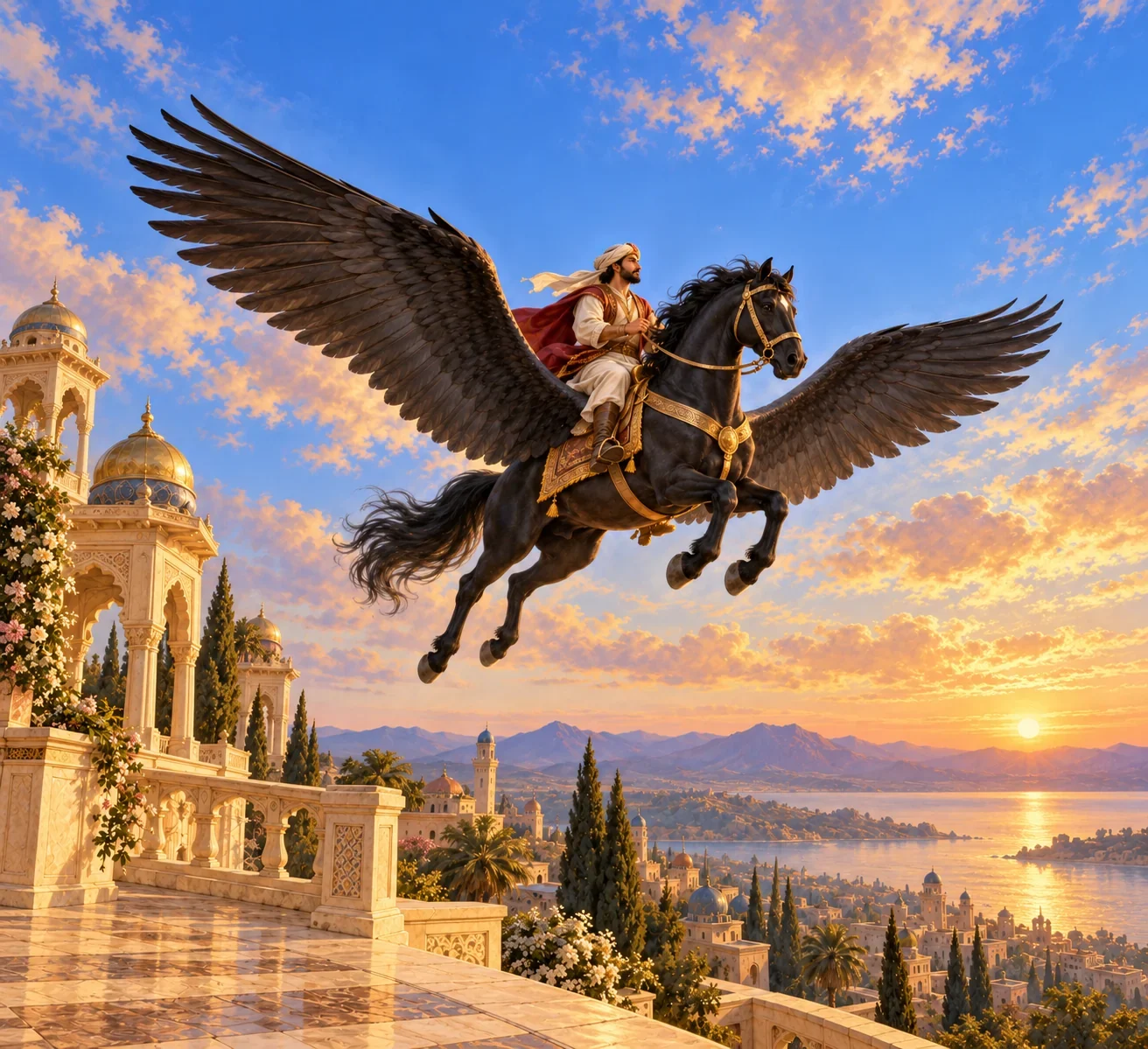
AI-generated illustration. Unofficial AI interpretation of Agib riding Lang’s black winged horse. Black coat, gold tack and flight follow the tale; feathered wing design, dress and palace are imagined. This shows the ascent before the later injury.
Unofficial AI interpretation of Agib riding Lang’s black winged horse. Black coat, gold tack and flight follow the tale; feathered wing design, dress and palace are imagined. This shows the ascent before the later injury.
Overview
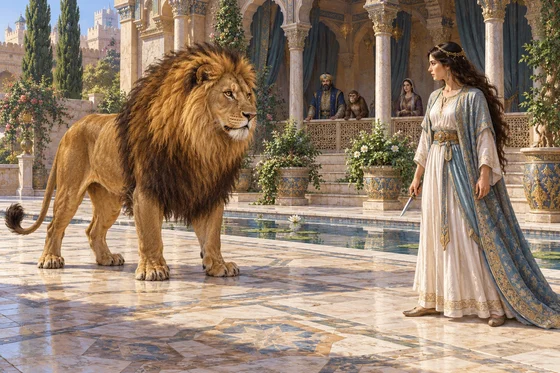
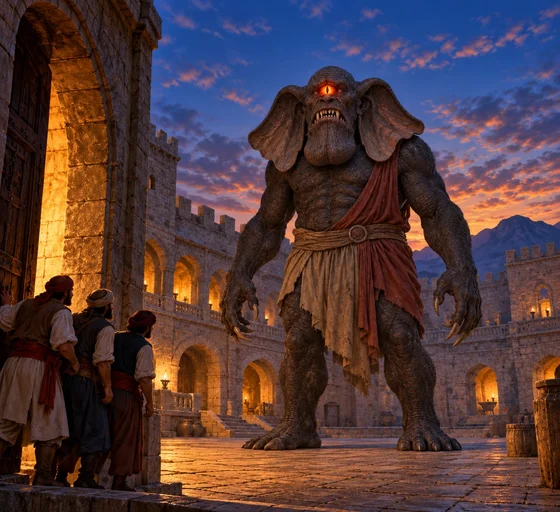
Agib, the Third Calender, explains his lost eye through a succession of warnings that he fails to observe. After shipwreck, an accidental killing and a meeting with ten one-eyed men, he reaches a marvelous castle with a hundred doors. Forty royal women welcome him and later leave for forty days, entrusting him with the keys but expressly forbidding him to open the golden door. Their absence and the prohibition give the horse encounter its setting.
Agib explores the permitted rooms for thirty-nine days, then persuades himself that merely looking through the last door will be harmless. Perfume overwhelms him at the threshold, yet he returns and enters. Inside the vaulted, lamp-lit chamber stands a magnificent black horse with a gold saddle and bridle. Its trough holds grain on one side and rose water on the other. The animal’s appearance draws his attention away from the room’s other treasures.
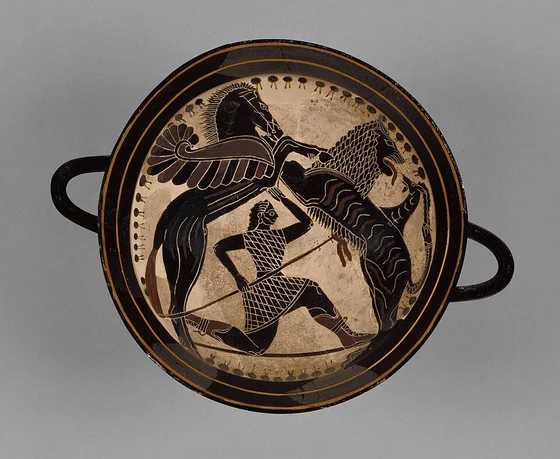
He leads the horse outside and mounts it. When the horse will not move, he touches it with a switch. Only then does it spread wings that he had not previously noticed and carry him high into the air. The horse abruptly descends onto a castle terrace, throws him from the saddle and strikes out his right eye with its tail. It then flies away; Agib follows the familiar rooms back to the ten men who warned him.
Those men say that they underwent the same experience after opening the prohibited door. They cannot add him to their established company, so he departs for Bagdad as a calender. The horse is neither a reward nor a lasting companion, and the tale never explains its origin, motive or final destination. It is also distinct from the brass horse statue on the magnetic mountain earlier in Agib’s adventures.
Origins & earliest records
The cached title identifies Andrew Lang’s selected Arabian Nights after Longmans, Green and Co., 1918 (1898). The preface declares French Galland mediation and shortening; the collective Fairy Book translators are credited without an individually identified translator for this unit. Its literary geography does not supply a modern national or ethnic attribution.
Records & interpretation
Complete Third Calender chapter14 read: voyage and magnetic mountain, statue and boat, hidden boy’s death, ten men, roc transport, forty women, prohibited chamber, horse flight and eye loss, return and final departure. Retained preface reused from prior full reading. No attached numbered notes occur within this selected cached chapter.
Selected bibliography
Documented works and useful reading. This is not a list of every appearance.
- 01
The Arabian Nights Entertainments: Third Calender, Son of a King
Complete tale, with horse episode and narrated consequences.
Family & connections
A source-supported family tree or inspiration record has not yet been compiled for this profile. Related reading below indicates a connection in subject matter, not a proven lineage or creative influence.
References
Sources supporting this profile. Linked pages have their own scope and editorial standards.
- Historical English literary adaptationLang, complete Third Calender narrativeResearch access: 2026-10-27
Image credits
Unofficial modern AI interpretationAI-generated illustration. Unofficial AI interpretation of Agib riding Lang’s black winged horse. Black coat, gold tack and flight follow the tale; feathered wing design, dress and palace are imagined. This shows the ascent before the later injury.
Unofficial AI interpretation of Agib riding Lang’s black winged horse. Black coat, gold tack and flight follow the tale; feathered wing design, dress and palace are imagined. This shows the ascent before the later injury.