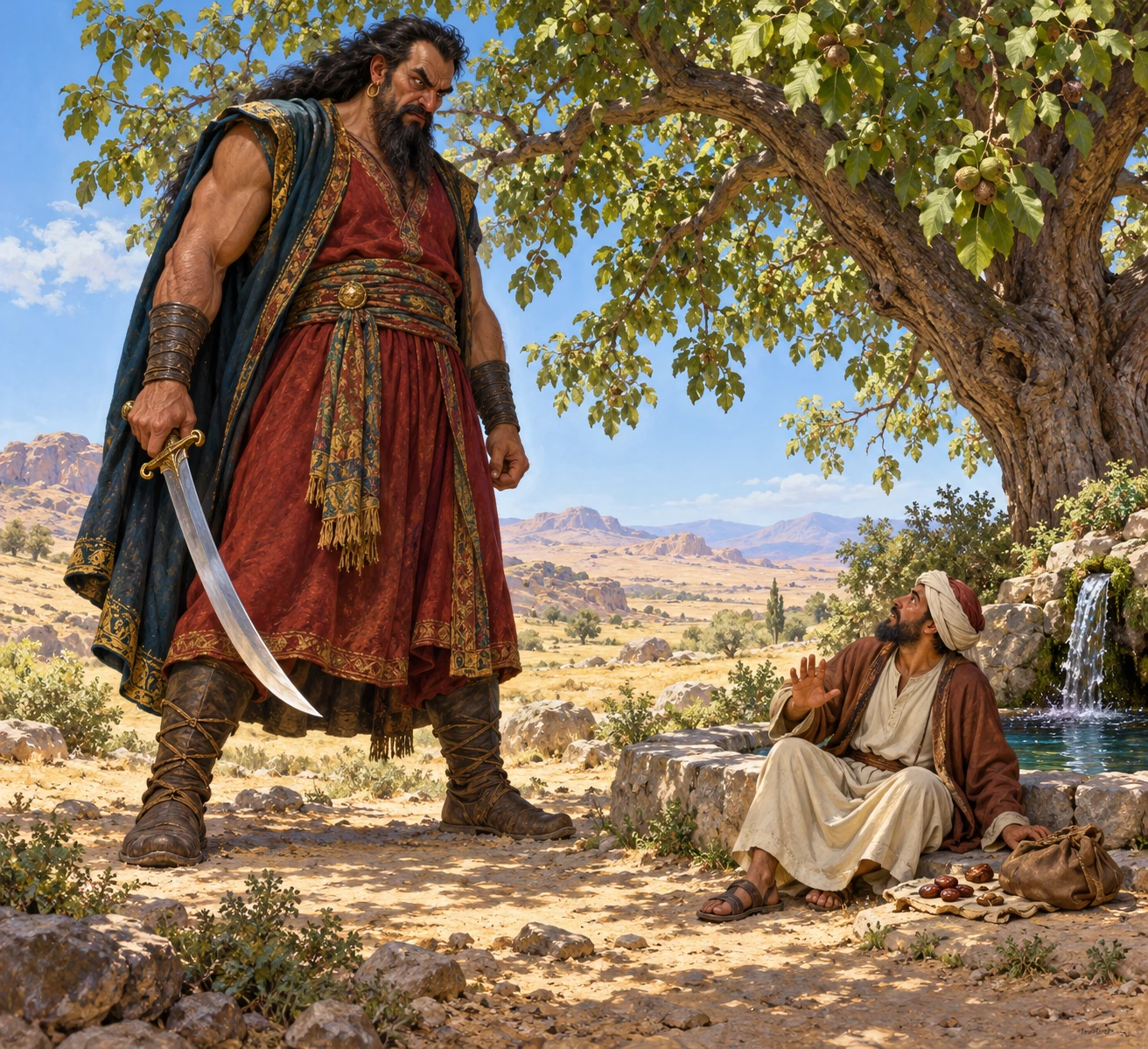
Unofficial AI interpretation of Lang’s unnamed avenging genius confronting the merchant. Giant, scimitar, walnut tree, fountain and dates follow the tale; faces, dress and landscape are imagined. Botanical form is an artistic approximation, not a verified depiction of walnut anatomy.
Unofficial AI interpretation of Lang’s unnamed avenging genius confronting the merchant. Giant, scimitar, walnut tree, fountain and dates follow the tale; faces, dress and landscape are imagined. Botanical form is an artistic approximation, not a verified depiction of walnut anatomy.
Overview
A wealthy merchant stops beside a fountain beneath a walnut tree while crossing a desert. After he eats dates, an enormous genius approaches with a scimitar and claims that one of the discarded stones struck his passing son in the eye and killed him. The merchant says that he has never seen the son and meant no harm. The accusation belongs to the genius’s own account; the story does not separately show the son or the alleged accident.
The genius initially refuses mercy but agrees to let the merchant return home for a year to settle his affairs. The merchant pays debts, makes gifts, frees his enslaved people and provides for his household before returning on the promised day. The narrator’s interruption by dawn places this threatened execution inside Scheherazade’s own struggle to postpone death through storytelling.
Three old travelers gather beside the merchant. When smoke approaches and clears to reveal the armed genius, the first traveler offers a story about his wife, now a hind, in return for a third of the punishment. The second tells how his fairy wife saved him from drowning and punished his treacherous brothers by turning them into black dogs. The genius accepts each bargain. The third traveler earns the final third with a still more marvelous story, but Lang’s narrator explicitly does not supply that story.
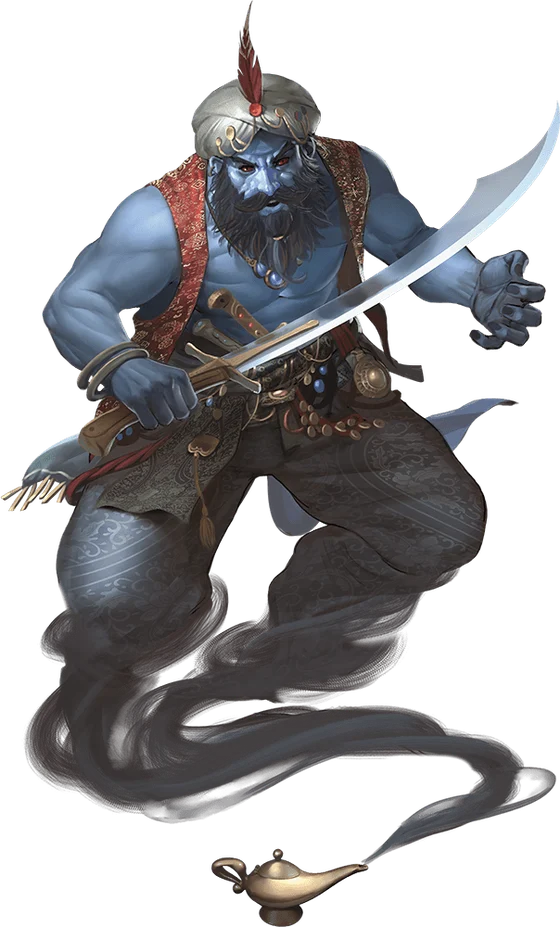
The genius disappears and the merchant returns safely to his family. His change of decision is accomplished through listening and negotiated remissions rather than imprisonment in a lamp, compelled service or a fixed allowance of wishes. The tale supplies an imposing face, great size, a sword and a smoke-associated arrival, but gives no personal name, precise body color, horns or fire anatomy.
Origins & earliest records
The retained Gutenberg title identifies Longmans, Green and Co., 1918 (1898). Lang’s preface declares French Galland mediation, abridgment and omitted verse; the collective Fairy Book translators are credited without a named translator for this tale. This is a historical English literary adaptation, not a direct Arabic manuscript edition or a statement of present-day religious belief.
Records & interpretation
Complete chapters 02–04: The Story of the Merchant and the Genius, First Old Man and Hind, and Second Old Man and Two Black Dogs, including Scheherazade interruptions, the unsupplied third story, final remission and return home. The complete cached preface was also read. No independent Arabic manuscript or ethnographic attestation is claimed.
Selected bibliography
Documented works and useful reading. This is not a list of every appearance.
- 01
The Arabian Nights Entertainments: Merchant and Genius with the two Old Men stories
Complete chapter02–04 cluster; the third old man’s story is intentionally not narrated.
Family, evolution & connections
Djinni (Dungeons & Dragons)
Lang's sword-bearing genius and the merchant supply a specific historical literary account beside the game's separate genie category. The accusation, reprieve and three old men belong to this tale; no game rules, shared identity or direct designer consultation are inferred.
References
Sources supporting this profile. Linked pages have their own scope and editorial standards.
- Historical English literary adaptationLang’s Merchant and Genius, complete narrative clusterResearch access: 2026-10-26
Image credits
Unofficial modern AI interpretationUnofficial AI interpretation of Lang’s unnamed avenging genius confronting the merchant. Giant, scimitar, walnut tree, fountain and dates follow the tale; faces, dress and landscape are imagined. Botanical form is an artistic approximation, not a verified depiction of walnut anatomy.
Unofficial AI interpretation of Lang’s unnamed avenging genius confronting the merchant. Giant, scimitar, walnut tree, fountain and dates follow the tale; faces, dress and landscape are imagined. Botanical form is an artistic approximation, not a verified depiction of walnut anatomy.