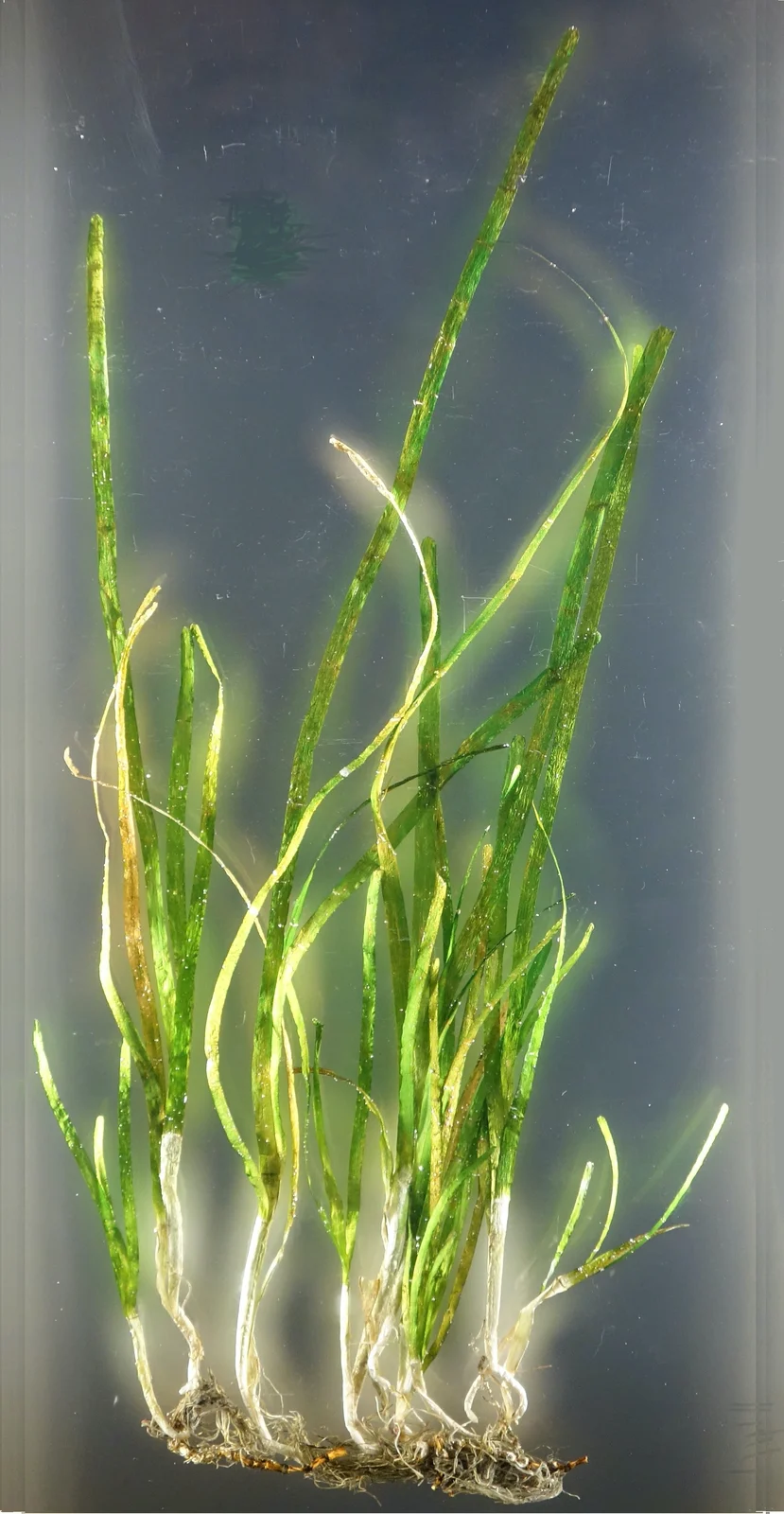
Mounted eelgrass specimen with long narrow green leaves, pale sheaths and attached roots and rhizome against a grey background.
Zostera marina exhibit photographed at Tokyo’s National Museum of Nature and Science, 5 September 2013; prepared museum specimen, rather than a meadow habitat photograph.
Overview
Eelgrass, Zostera marina, is a marine flowering plant rather than a true grass of the family Poaceae. Its meadows create three-dimensional coastal habitat, and it has become a model for studying plant life in seawater. Ma and colleagues improved its reference genome in 2021 using the same Finnish genotype that supplied the earlier draft. This is a reference for a particular clone, not a catalogue of the genetic diversity of every eelgrass meadow.
The researchers combined long DNA reads with chromosome-contact information to order and orient assembled fragments. Their version 3.1 contained about 260.5 million bases, with 87.6 percent of the assembled sequence placed into six chromosome-scale sequences. Those structures correspond to a diploid chromosome count of twelve. Additional unanchored sequence remained. A large repetitive scaffold described provisionally as a seventh chromosome during assembly was not evidence that the organism possesses an extra ordinary chromosome; the authors suggested it could contain a nucleolus-organizing region.
Improvement over the earlier short-read assembly chiefly involved continuity and better representation of repeats. Approximately 67 percent of the new assembly was annotated as repetitive sequence. More assembled DNA therefore did not mean that the living clone had evolved a larger genome between publications. It reflected different sequencing and assembly methods applied to the same biological source. Gaps and unresolved sequence still distinguish a chromosome-scale reference from a complete, base-perfect account of every chromosome.
The final annotation contained 21,483 protein-coding gene models after automated prediction and manual revision. About 91.8 percent had support from available leaf, root and flower transcript data. A benchmark recovered 95.7 percent of the expected complete conserved plant genes. These are different measures: transcript support indicates expression evidence, while the benchmark assesses a selected reference set rather than proving that every eelgrass gene has been recovered.
Predicted protein similarity supplied functional assignments for many models, but sequence resemblance is not an experimental demonstration of each function. The study also distinguished conserved small regulatory RNAs from additional candidates inferred computationally. Its resource supports subsequent questions about metabolism, environmental responses and adaptation to marine conditions; it does not directly test all of those processes. Population resilience, conservation outcomes and the timing of marine adaptation require their own ecological and comparative evidence beyond this single-clone assembly.
Origins & earliest records
A living marine angiosperm. The focal assembly compares versions of one Finnish clone rather than dating the species or identifying a direct ancestor.
Evidence & interpretation
Long-read sequencing and Hi-C scaffolding support six chromosome-scale sequences with remaining unanchored material. Transcript-supported annotation, conserved-gene benchmarks and inferred protein functions provide different forms of evidence.
Selected bibliography
Documented works and useful reading. This is not a list of every appearance.
- 01
Improved chromosome-level genome assembly and annotation of the seagrass, Zostera marina (eelgrass)
F1000Research 10:289, version 1, 15 April 2021; retained record reports two approved peer reviews. Complete main Introduction, Methods, Results and Discussion, Conclusions, tables and textual figure caption read. Original explicit CC BY4; no underlying dataset, annotation rerun or figure pixels inspected.
- 02
The genome of the seagrass Zostera marina reveals angiosperm adaptation to the sea
Nature530:331–335; online27January2016.
Family, evolution & connections
Taxonomic classification
A hierarchy of classified groups, not a chain of direct ancestors.
- genusZostera
- speciesZostera marina
Located primary passages
Specific passages supporting details in this entry, grouped by their published witness.
The genome of the seagrass Zostera marina reveals angiosperm adaptation to the sea
2016 original study
- A Finnish clone supplies a fragmented draft genome. Comparative searches support losses in stomatal differentiation, volatile signalling and pollen-coat pathways, while EIN3 downstream genes remain. Gene-family changes suggest marine adaptations; candidate functions and duplication dates are inferred, not experimentally established here.
Complete Main and Methods; textual captions1–3 and original licence.
Single-clone historical assembly; no supplements, extended-data analysis, rawdata, images or rerun. Fragmentation limits duplication reconstruction; conservation applications remain prospective.
References
Sources supporting this profile. Linked pages have their own scope and editorial standards.
- ResearchImproved chromosome-level genome assembly and annotation of the seagrass, Zostera marina (eelgrass)Research access: 2026-10-06
Image credits
Museum plant-specimen photographMounted eelgrass specimen with long narrow green leaves, pale sheaths and attached roots and rhizome against a grey background.
Zostera marina exhibit photographed at Tokyo’s National Museum of Nature and Science, 5 September 2013; prepared museum specimen, rather than a meadow habitat photograph.