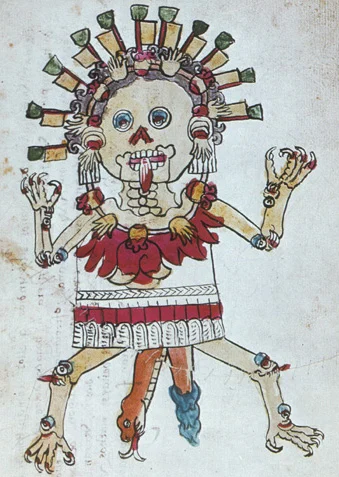
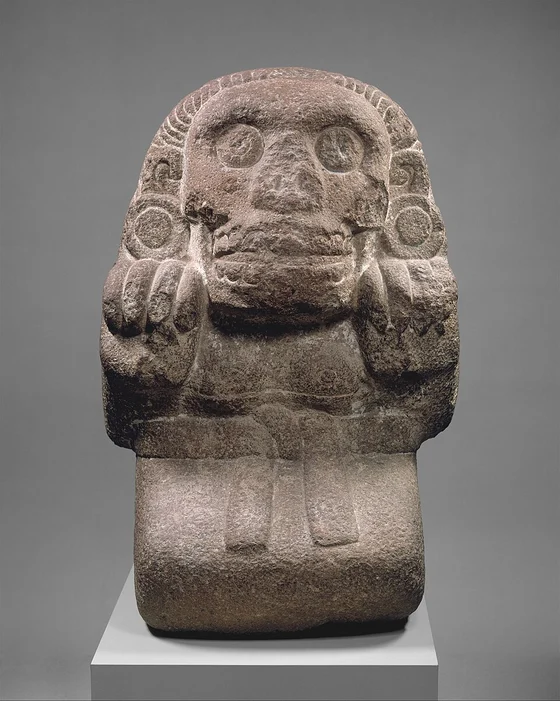
A sourced illustration has not yet been added. This gap is included in the coverage record.
Overview
López Austin's translation of Florentine Codex book V, chapter III, begins with nighttime chopping heard during mountain observances. Following it reveals a headless body whose chest edges strike together. A determined pursuer can seize its exposed heart and bargain for favour. Three or four thorns signify future war captives; another response is to take the heart away and examine its transformed contents at dawn. White feathering or thorns promise good fortune, while charcoal or rag foretells hardship.
The apparition is described as a manifestation of Tezcatlipoca, whose encounter can reward or afflict. A distinct contemporary reception appears in Karloz Miranda Yaoehecatl's 2020 mountaineering account: he describes reports of chopping above the tree line and a small red cuatepoxtle leaping among rocks. That account juxtaposes modern mountaineers' reports with Sahagún, but does not establish that every such mountain being has the historical apparition's headless anatomy.
The Spanish account printed in Sahagún's Historia general, edited by Carlos María de Bustamante in 1829, places the sound in the night's first deep sleep. It particularly names Tlamacazquez, temple ministers taking reeds and pine branches to customary mountain offering places, and experienced warriors willing to pursue the noise. The apparition runs about and pretends to tire before allowing its pursuer to approach. Its two chest flaps, meeting in the middle, produce the blows: the comparison with an axe describes the sound rather than a weapon it carries. Grasping its heart can become a demand for wealth or prowess in taking captives, but the chapter explicitly allows the opposite result, poverty and misfortune, at Tezcatlipoca's discretion.
This Spanish witness distinguishes prolonged bargaining from silently tearing out the heart, fleeing, and tying it tightly in cloth. The first procedure can yield three or four maguey thorns corresponding to future captives. In the second, the morning wrapping may contain loose feather, cotton, or one or two thorns as favourable signs; charcoal or dirty torn cloth indicates hardship. The fearful hearer instead loses the ability to walk or run and crawls, expecting illness, death, or poverty. These are textual encounter alternatives within the chapter, not successive stages that every witness must experience. The 1829 Spanish edition and López Austin's later Nahuatl-based translation are separate textual presentations of Sahagún's material, not independent modern sightings.
Origins & earliest records
The central witness is the sixteenth-century Florentine Codex's Nahua account, book V, chapter III. López Austin published his translation and analysis in 1963. Manuscript attestation does not reveal when the story first circulated; the modern mountaineering comparison is a later documented association rather than proof of an unchanged oral lineage.
Records & interpretation
The complete 1963 study was inspected, including its bilingual passage and the contrasting outcomes of the encounter. Its translation draws on Anderson and Dibble's published paleography. The 2020 account supplies a separately attributed modern comparison, without named interview records. Orthographic variants and modern game adaptations should not be mistaken for additional historical witnesses. The complete Spanish Book V chapter III in the 1829 second volume was also read, with its original title and pp. 5–7 scans checked. It supplies a historical edition comparison, including different negotiated and stolen-heart outcomes; it does not provide an independently named eyewitness.
In the literature
“que era un hombre sin cabeza”
Book V, chapter III, printed pp.5–7; p.6, the pursuer sees its bodily form
A wood-cutting sound at night is attributed to Tezcatlipoca. A determined pursuer encounters a headless body with a cut neck and an opening chest whose two sides produce the blows; gripping its exposed heart permits a demand for favour.
Selected bibliography
Documented works and useful reading. This is not a list of every appearance.
- 01
El hacha nocturna
Estudios de Cultura Náhuatl 4, pp. 179–185; translation of Florentine Codex book V, chapter III.
- 02
Yohualtepoztli. Hacha Nocturna
APROMECI article, 14 October; separately credits Sahagún and compares modern mountaineering reports.
- 03
Historia general de las cosas de Nueva España, tomo segundo
Book V, chapter III, printed pp. 5–7, complete Spanish encounter account. The colonial author’s Christian framing and the later editor’s commentary are distinct from the reported Nahua beliefs. Title and selected chapter scans checked; no complete-volume or Nahuatl-manuscript collation claimed.
- 04
Historia general de las cosas de Nueva España, tomo II
Bernardino de Sahagún and Nahua collaborators, Historia general de las cosas de Nueva España, tomo II, edited with notes and supplements by Carlos María de Bustamante; México: Imprenta del ciudadano Alejandro Valdés,1829. Spanish historical text; inspected John Carter Brown Library scan and OCR. Earlier sixteenth-century composition is context, not this edition’s publication date.
Family & connections
A source-supported family tree or inspiration record has not yet been compiled for this profile. Related reading below indicates a connection in subject matter, not a proven lineage or creative influence.
Located primary passages
Specific passages supporting details in this entry, grouped by their published witness.
Primary source witness
Alfredo López Austin, Estudios de Cultura Náhuatl4, pp179–185, 1963; publisher PDF. Modern research/translation, not public-domain text.
- The article translates the whole omen chapter from the Nahuatl text in Anderson and Dibble’s edition. The nighttime sound resembles wood splitting; the apparition is presented as Tezcatlipoca, with a damaged neck and open chest whose closing edges make the noise. The article distinguishes this account from its own interpretive prose.
pp180–182, bilingual translation of Florentine CodexV chapter3; PDF page4
- A courageous pursuer grips the apparition’s heart and negotiates for gifts; several spines signify future enemy captures. Another encounter turns a taken heart into favourable or unfavourable tokens by dawn. A frightened hearer instead receives fear and adverse omens. These are different outcomes in the translated witness, not one fixed reward.
pp182–185, continued translation and interpretive transitions; PDF page5
Article is modern copyright under CC BY-NC-ND4.0. Exact evidence reproduced across this article totals 7 words; no excerpts added to quotation collection. Underlying Sahagún and other editions remain explicitly indirect until independently inspected.
Primary source witness
Bernardino de Sahagún and Nahua collaborators, Historia general de las cosas de Nueva España, tomo II, edited with notes and supplements by Carlos María de Bustamante; México: Imprenta del ciudadano Alejandro Valdés,1829. Spanish historical text; inspected John Carter Brown Library scan and OCR. Earlier sixteenth-century composition is context, not this edition’s publication date.
- A wood-cutting sound at night is attributed to Tezcatlipoca. A determined pursuer encounters a headless body with a cut neck and an opening chest whose two sides produce the blows; gripping its exposed heart permits a demand for favour.
Book V, chapter III, printed pp.5–7; Nocturnal sound and open-chested apparition, pp.5–6
- The captor may ask for wealth or battlefield courage. The account expressly allows favourable or adverse answers; a bold captor rejects a single maguey spine and obtains three or four, interpreted as promises of captives, honour and prosperity. This is reported omen narrative, not verified predictive efficacy.
Book V, chapter III, printed pp.5–7; Negotiation and maguey-spine promises, pp.6–7
- An alternative encounter ends with the heart pulled away and saved in cloth. Morning reveals feathers, cotton or thorns as auspicious tokens, or charcoal and a dirty rag as adverse ones. Frightened hearers instead flee or crawl away expecting misfortune. This variant outcome is retained apart from negotiation.
Book V, chapter III, printed pp.5–7; Alternative heart-token interpretation, p.7
Complete chapterIII and chaptersXI–XIII read in OCR. Quote-bearing printed pages6,15,16 and chapterIII conclusion7 visually checked using actual scan images; OCR errors and editor’s hostile judgments are not adopted. No ritual formulas or prayers reproduced; narrative beliefs are not presented as verified causation.
References
Sources supporting this profile. Linked pages have their own scope and editorial standards.
- ResearchLópez Austin 1963: El hacha nocturnaResearch access: 2026-10-05
- CommunityAPROMECI 2020: Yohualtepoztli. Hacha NocturnaResearch access: 2026-10-05
- PrimarySahagún / Bustamante 1829, volume II, Book V, chapter IIIResearch access: 2026-10-05
Image credits
A sourced illustration has not yet been added. This gap is included in the coverage record.