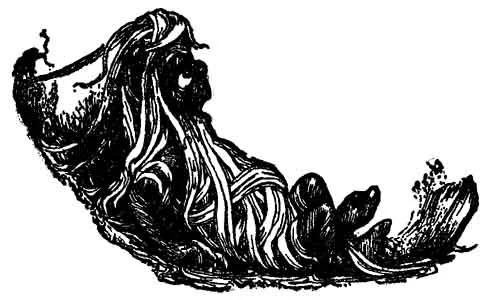
Yallery Brown, long-haired wrinkled helper, Batten
Actual small wrinkled figure tangled in flowing hair; primary caption gives wrinkles, bright black eyes and yellow hair. Monochrome illustration does not independently demonstrate yellow color.
Overview
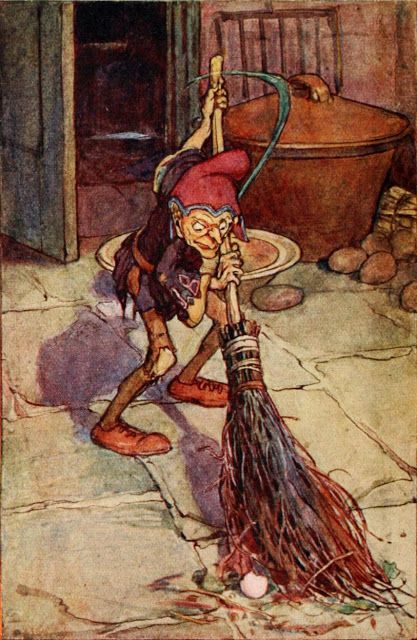
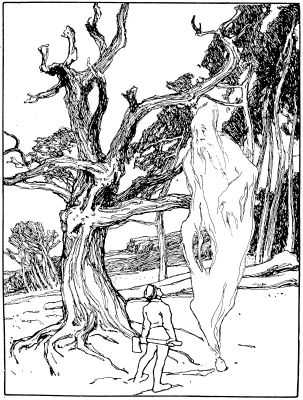
Tom Tiver hears childlike sobbing and lifts a buried stone, finding a creature no larger than a year-old baby. Long shining yellow hair and beard wrap around its body, while its face is deeply wrinkled, its eyes bright black and its skin the brown of newly turned earth. The creature already knows Tom’s thoughts, rejects his assumption that it is a bogle and offers wealth, a wife or help with work. Tom chooses work. Yallery Brown warns that thanks will end their visible dealings and vanishes behind a puff of dandelion seeds.
At first the arrangement seems profitable: stable duties and other tasks complete themselves while Tom rests. Yet the helper sabotages neighbouring workers’ tools, horses and buckets, and even prevents Tom from taking his own tools back into his hands. His companions avoid him and his employer dismisses him. When Tom demands to be left alone and says he will thank the spirit to go, Yallery Brown treats this wording as the prohibited thanks. He withdraws useful assistance but promises continuing unseen harm, then floats away enveloped in his hair like a dandelion head. The ending attributes failed work, rotting crops and family misfortune to his spite. Jacobs’s note openly considers the informant’s possible invention, rather than presenting the autobiographical claim as independently confirmed.
Origins & earliest records
Jacobs adapted Balfour’s account in Folk-Lore volume II, changing first-person testimony into a named third-person story and reducing its dialect. Tom Tiver is therefore Jacobs’s supplied name, not an independently identified historical labourer. Oral collection and literary reshaping both belong to the attestation.
Records & interpretation
The evidence is a recorded and subsequently edited narrative, including an informant’s claimed personal involvement. No physical specimen or independently tested cause of the misfortunes is supplied. Jacobs’s own caution about invention is material to evaluating the story.
In the literature
“no bigger than a year-old baby”
Yallery Brown; Tom uncovers the crying creature beneath a stone
The account combines a very small body with an ancient-looking face.
Selected bibliography
Documented works and useful reading. This is not a list of every appearance.
- 01
More English Fairy Tales
Complete “Yallery Brown” and its source note inspected. Preface acknowledges rewritten and combined sources.
- 02
More English Fairy Tales — Yallery Brown
Joseph Jacobs, More English Fairy Tales; first publication1894, selected Gutenberg14241 witness explicitly Fourteenth Impression, undated. Jacobs’s preface acknowledges rewriting, combined sources and altered incidents. Exact heading/anchor used; no invented print pagination.
Family & connections
A source-supported family tree or inspiration record has not yet been compiled for this profile. Related reading below indicates a connection in subject matter, not a proven lineage or creative influence.
Located primary passages
Specific passages supporting details in this entry, grouped by their published witness.
More English Fairy Tales — Yallery Brown
Joseph Jacobs, More English Fairy Tales; first publication1894, selected Gutenberg14241 witness explicitly Fourteenth Impression, undated. Jacobs’s preface acknowledges rewriting, combined sources and altered incidents. Exact heading/anchor used; no invented print pagination.
- Tom Tiver lifts a stone after hearing sobs and finds a baby-sized, brown, yellow-haired being with an ancient wrinkled face. It reads his thought, denies being a bogle and chooses Yallery Brown as a usable name. It offers a wife, wealth or help with work.
- Tom chooses work assistance and is warned never to thank the creature. His work becomes self-performing, but other workers' tasks are undone and tools spoiled. He cannot resume his own work because tools evade him; coworkers shun him and he loses his position.
Yallery Brown; Labour help, forbidden thanks and worsening isolation
- Angry Tom thanks Yallery Brown to leave him alone. The creature stops helping but insists this does not mean leaving him alone, curses his fortunes and departs with its hair wrapped around it like a dandelion puff. The narrator reports continued losses and spite through Tom's life.
Complete selected tale and its source note read. Jacobs’s edited narrative is distinct from direct oral transcription. No song or ritual-formula excerpts; no invented print page or earliest date.
Primary source witness
Joseph Jacobs, More English Fairy Tales; first publication1894, selected Gutenberg14241 witness explicitly Fourteenth Impression, undated. Jacobs’s preface acknowledges rewriting, combined sources and altered incidents. Exact heading/anchor used; no invented print pagination.
- Jacobs says Balfour heard the tale from a labourer who claimed to be its protagonist; Jacobs supplied a name, changed first-person narration and reduced dialect. His note considers possible invention and adaptation of local legend, without establishing which occurred.
Notes and References, XLIX Yallery Brown; Jacobs's editing and caution about the informant
This verifies what Jacobs reports and changes; listed earlier works and informant claims are not independently verified by this note alone.
References
Sources supporting this profile. Linked pages have their own scope and editorial standards.
- Primary textJacobs, More English Fairy Tales: Yallery Brown and editorial noteResearch access: 2026-10-05
- ReferenceUniversity of Pennsylvania Online Books Page: Joseph Jacobs bibliographic listResearch access: 2026-10-05
Image credits
Historical illustrationYallery Brown, long-haired wrinkled helper, Batten
Actual small wrinkled figure tangled in flowing hair; primary caption gives wrinkles, bright black eyes and yellow hair. Monochrome illustration does not independently demonstrate yellow color.