Yaksha
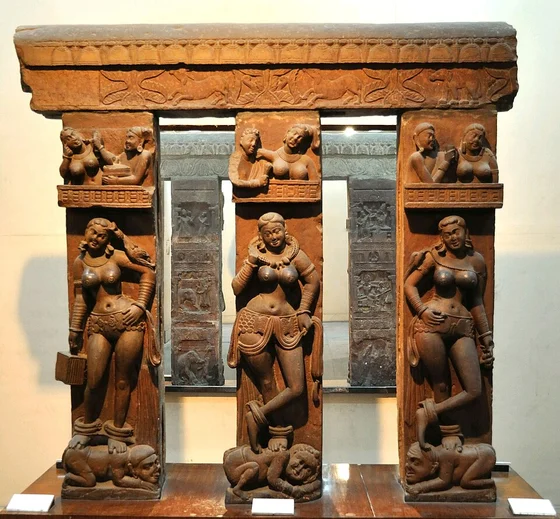
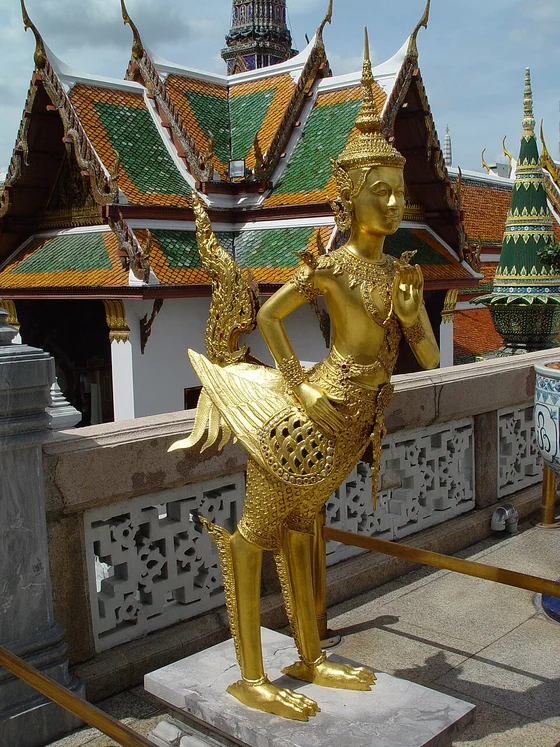
Image associated with the exact linked encyclopedia article; consult credited file description for its interpretation.
Overview
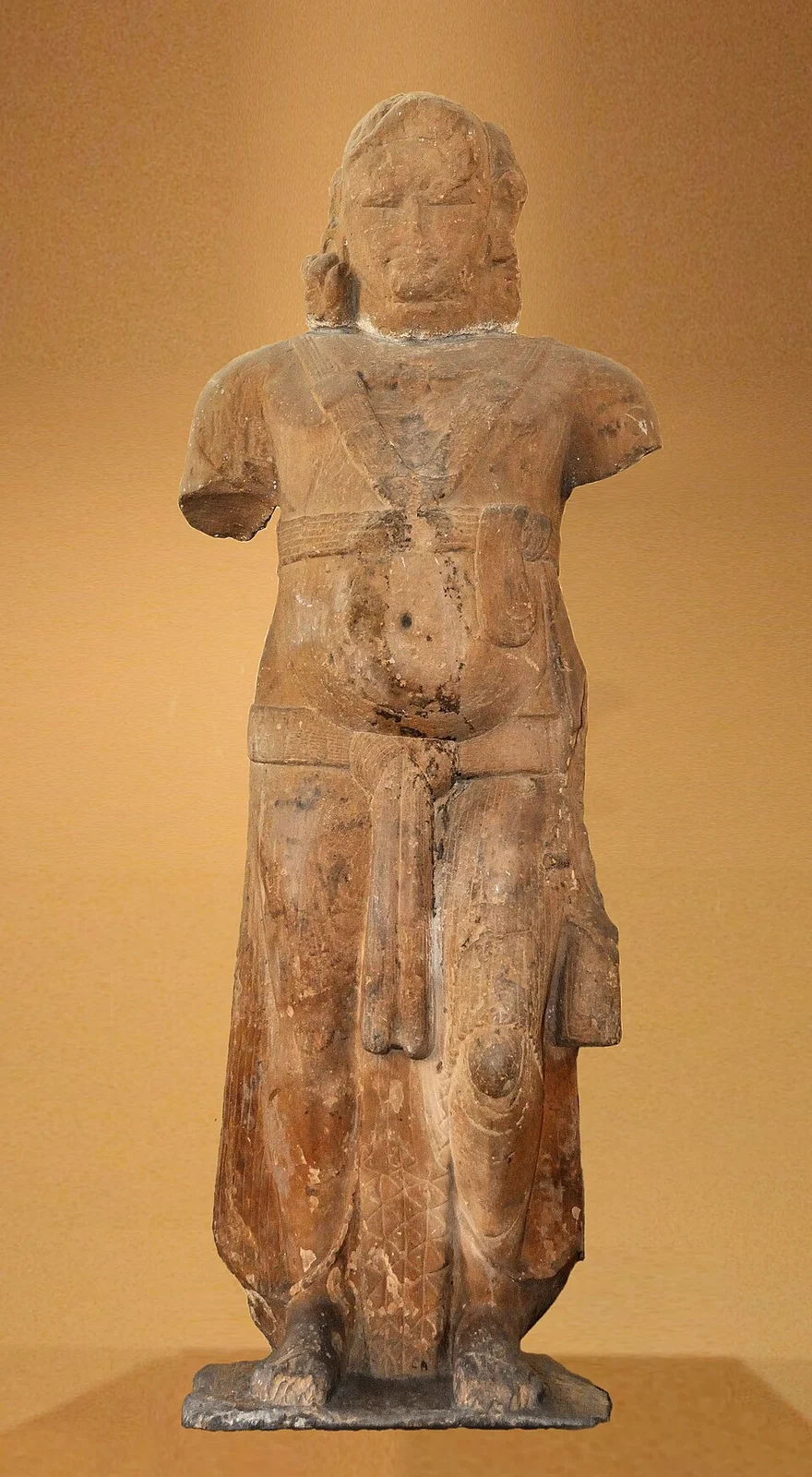
Yaksha is a broad supernatural category whose bodies and roles vary between narrative and sculptural witnesses. The Met’s sandstone Patravahaka yaksha from Madhya Pradesh, dated about50BCE, presents a powerful humanlike figure wearing elaborate ornaments. Its substantial chest and rounded abdomen combine strength with the abundance that the museum associates with the form. The necklace includes paired makara sea monsters around a jewel; a tightly drawn, knotted waist-sash passes beneath the rounded abdomen. This is a particular historical representation, not a model from which every yaksha’s anatomy must be derived.
The raised arms suggest an architectural supporting function. The museum proposes that the figure once held aloft a sculpted bowl containing intoxicating liquids, perhaps including the ritual drink soma. The bowl and its contents are curatorial reconstruction, rather than surviving details visible in the object. Its accession is 1988.354. The record notes that such figures could be honored by individual names, although those names are often lost. The material witness consequently supports the category and an interpreted function without supplying this yaksha’s personal biography or an earliest date for all yaksha traditions.
A contrasting named narrative appears in Dutt’s 1891 Ramayana, Balakandam sectionXXV. Suketu is a powerful yaksha who has no child and performs severe austerities while maintaining pure conduct. Brahma grants him a daughter, Taraka, and gives her the strength of a thousand elephants. Suketu later marries her to Sunda, and she bears Maricha. The episode makes a yaksha the parent in a family history involving devotion, a divine boon, marriage and descendants. His daughter’s exceptional strength comes from the specified boon rather than an automatic property shared by all yakshas.
After Sunda’s death, Taraka and Maricha threaten Agastya. The sage curses Maricha into a rakshasa and orders Taraka to abandon her original appearance for a terrifying form. This episode therefore crosses supernatural categories within one family, while continuing to call Taraka a yakshi. Rama’s question about supposedly limited yaksha prowess is a character’s premise that the sage’s account corrects through the boon. It should not be converted into an independent universal classification. The sculpture and the epic together illustrate why a single label such as harmless nature spirit or dangerous demon would flatten these source-specific representations.
Origins & earliest records
South Asia; named epic yaksha and Madhya Pradesh sculptural witness.
Records & interpretation
Identified primary passage directly read; sculpture and interpretive museum record distinguished where applicable.
Selected bibliography
Documented works and useful reading. This is not a list of every appearance.
- 01
Patravahaka yaksha
Met 1988.354; load-bearing role and lost bowl are curatorial interpretations.
- 02
The Ramayana, Volume1: Balakandam and Ayodhyakandam
Balakandam sectionXXV, Suketu and Taraka family history
Family & connections
A source-supported family tree or inspiration record has not yet been compiled for this profile. Related reading below indicates a connection in subject matter, not a proven lineage or creative influence.
Primary records and illustrations
Patravahaka yaksha
Metropolitan Museum of Art, India, Madhya Pradesh, ca. 50 BCE. Museum object 1988.354
Institutional object record and public-domain photograph directly inspected. Date, material, accession and subject identification come from the museum, not an inferred historical story.
This sandstone yaksha survives as a powerful torso and head, with the upper arms and lower legs broken away. The belly projects beneath a broad chest, and a tightly knotted sash binds the waist above a short, folded garment. A decorated band crosses the hair, and a heavy necklace lies against the upper chest. The museum identifies the figure as Patravahaka yaksha and dates it approximately to 50 BCE in Madhya Pradesh. Its interpretation of an architectural supporting role depends on the raised-arm arrangement, although the hands and any carried object no longer survive. The image should therefore be captioned as a fragmentary religious sculpture, rather than a complete reconstruction of a named narrative character.
Encyclopedia background
An additional attributed reference, separate from the editorial profile above.
Read the open encyclopedia overview
The Yakshas (Sanskrit: यक्ष, IAST: Yakṣa, Pali: Yakkha) are a broad class of nature spirits in Hindu mythology which are associated with water, trees, forests, wilderness, treasure, and fertility. They are usually considered benevolent, and sometimes mischievous or capricious. They appear in Hindu, Jain and Buddhist texts, as well as ancient and medieval temples of South Asia and Southeast Asia as guardian deities. The feminine form of the word is IAST: Yakṣī or Yakshini (Sanskrit: यक्षिणी, IAST: Yakṣiṇī; Pali: Yakkhini).
In Hindu, Jain and Buddhist texts, the yakṣas have a dual personality. A yakṣa may be an inoffensive nature spirit associated with woods and mountains, or a darker version of the yakṣa which is a kind of Bhoota (ghost) that haunts the wilderness and waylays and devours travellers, similar to the rakṣasas.
A unique cultural dance form related to the Yakshas is Yakshagana. Yakshagana is a traditional stage performance, found in Dakshina Kannada, Udupi, Kasaragod district and Uttara Kannada, Shimoga and western Chikmagalur districts, in the state of Karnataka.
Text from Wikipedia contributors, “Yaksha”. CC BY-SA 4.0. Extracted introduction; formatting changed. Retrieved 5 October 2026. The source article may have changed since retrieval.
References
Sources supporting this profile. Linked pages have their own scope and editorial standards.
- Museum / primary objectPatravahaka yakshaResearch access: 2026-10-05
- Secondary referenceYaksha — contextual bibliographyResearch access: 2026-10-05
- Primary narrative in historical translationDutt Ramayana Volume1, BalakandamResearch access: 2026-10-05
Image credits
Reference illustrationYaksha
Image associated with the exact linked encyclopedia article; consult credited file description for its interpretation.