
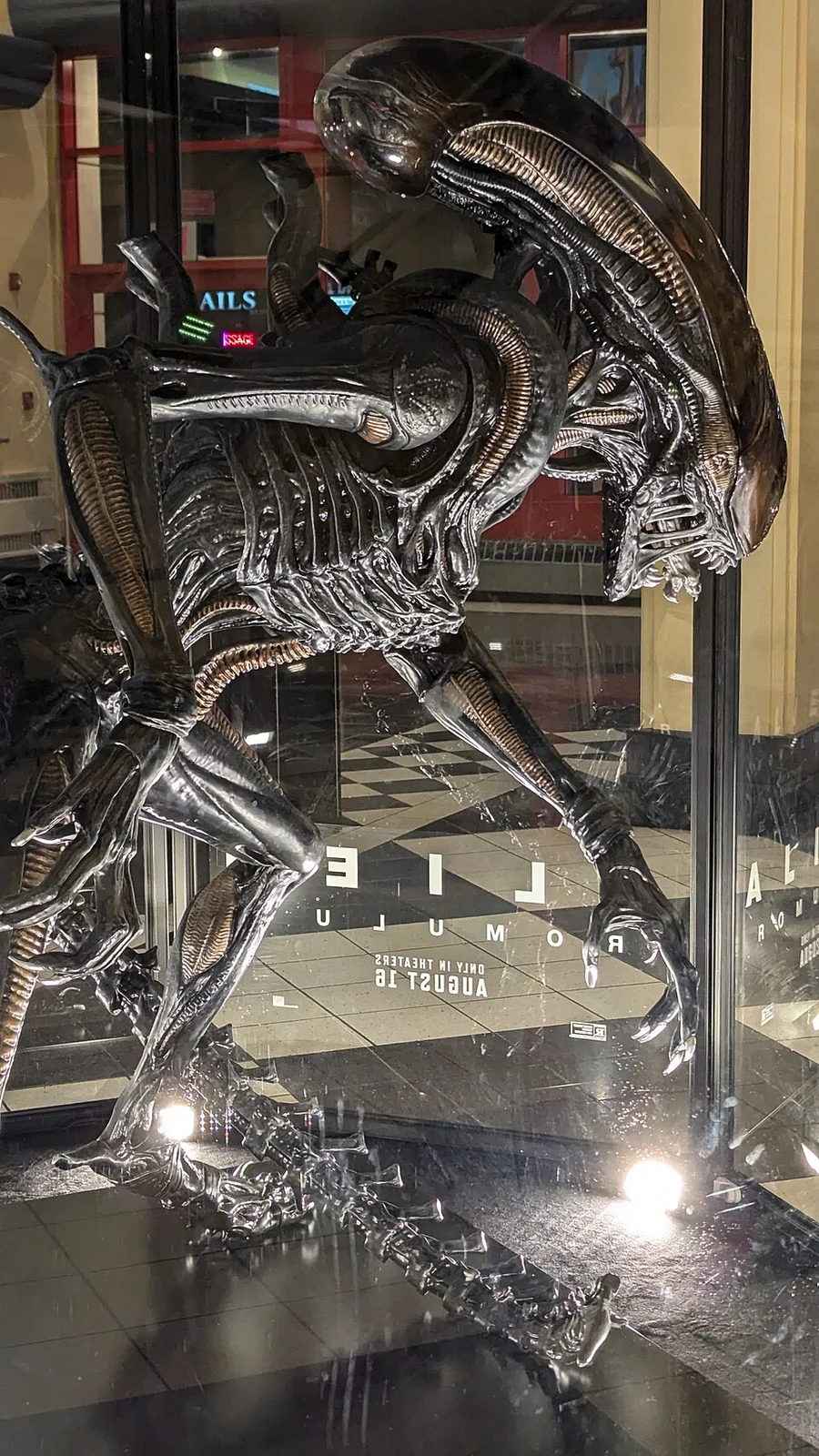
Xenomorph
Image associated with the exact linked encyclopedia article; consult credited file description for its interpretation.
Overview
The adult xenomorph joins a skeletal, machine-like exterior to a dangerous reproductive cycle that needs living hosts. Its elongated head, extending inner jaw and blade-tipped tail provide a recognizable silhouette, but the body is not identical in every film. Human-hosted creatures are generally upright; Alien 3 instead features an animal-hosted, predominantly four-legged form. The theatrical version uses a dog and the Assembly Cut an ox. Acidic blood makes injury to the creature hazardous to nearby people and structures. In Alien, this danger compounds the confines of the Nostromo and the crew’s incomplete knowledge. Aliens enlarges the threat into a resin-lined hive where people can be restrained for implantation, making capture as significant as immediate killing. Corporate interest in obtaining the organism repeatedly compromises ordinary survival decisions.
The sequel also changed how the creature moved on screen. Cameron and producer Gale Anne Hurd describe lighter, less restrictive suits intended for vigorous climbing, running and leaping; that is production history, rather than a newly evolved biological caste. Alien: Romulus later shows an adult emerging from a cocoon. Shane Mahan recalls that its director deliberately left open whether this stage was local to the station or previously unseen. It should therefore not be imposed as a documented event in every earlier film. The same interview distinguishes actor suits, animatronics and lightweight puppets used to represent a single creature. These methods explain the performance without changing the in-world life cycle. Comics, games and Predator crossovers add other forms, which require their own continuity labels.
First appearances & development
The principal film creature debuted in Alien in 1979. Its name became a common franchise label rather than a single consistent scientific classification. This profile follows the film baseline through selected sequels, preserving differences between cuts and treating the prequels’ engineering questions separately from the original crew’s limited understanding of the organism.
Canon & continuity
The films listed here witness the adult and hive roles; the reference guide supplies anatomy and the Alien 3 cut distinction. Independently inspected Cameron/Hurd testimony explains movement requirements. Mahan’s later firsthand account supports the Romulus cocoon and practical representation, with its uncertainty retained. No definitive universal origin or complete review of every licensed continuity is claimed.
Selected bibliography
Documented works and useful reading. This is not a list of every appearance.
- 01
Alien
Nostromo creature and parasitic life stages.
- 02
Aliens
Hive, egg-laying Queen and colonist outbreak.
- 03
Alien 3
Animal-hosted adult; dog in the theatrical film, ox in the later Assembly Cut.
- 04
Alien: Romulus
Station infestation and the newly shown adult-emergence cocoon.
Family, evolution & connections
Giger’s Necronom IV and Necronom V
Giger says the team returned to his eyeless Necronom IV and V designs after unsuccessful movement experiments. This concerns the first film’s creature, not every later Alien variant.
Human skull inside the 1979 Alien prop
Giger states that he included a skull inside the Alien despite expecting it to be unseen. This is an artist’s account of prop construction, not human ancestry for the fictional species.
Octopus-tentacle-like support around Alien eggs
Giger describes making the egg’s supporting area organic and like octopus tentacles. The statement concerns the 1979 egg-set design, not octopus descent or proof that the egg itself has living tentacles.
Encyclopedia background
An additional attributed reference, separate from the editorial profile above.
Read the open encyclopedia overview
The xenomorphs (also known as a XX121 xenomorph, Internecivus raptus, or simply the Alien or the creature) are a fictional endoparasitoid extraterrestrial species and the titular main antagonists of both the Alien and Alien vs. Predator franchises from 20th Century Studios.
The species made its debut in the film Alien (1979) and reappeared in the sequels Aliens (1986), Alien 3 (1992), Alien Resurrection (1997), and Alien: Romulus (2024). The species returns in the prequel series, first with a predecessor in Prometheus (2012) and a further evolved form in Alien: Covenant (2017), and the 2019 short films Alien: Containment, Specimen, Night Shift, Ore, Harvest, and Alone. It also featured in the crossover films Alien vs. Predator (2004) and Aliens vs. Predator: Requiem (2007), with the skull and tail of one of the creatures respectively appearing briefly in Predator 2 (1990), Predator: Concrete Jungle (2005), Predators (2010), and The Predator (2018), as a protagonist (named 6) in the video game Aliens vs. Predator (2010). It also returned in the FX television series Alien: Earth (2025–present). In addition, the xenomorph appears in various literature and video game spin-offs from the franchises.
The xenomorph's design is credited to Swiss surrealist and artist H. R. Giger, originating in a lithograph titled Necronom IV and refined for the series's first film, Alien. The practical effects for the xenomorph's head were designed and constructed by Italian special effects designer Carlo Rambaldi. Species design and life cycle have been extensively augmented, sometimes inconsistently, throughout each film.
Unlike many other extraterrestrial races in film and television science fiction (such as the Daleks and Cybermen in Doctor Who, or the Klingons and Borg in Star Trek), the xenomorphs are not sapient toolmakers — they lack a technological civilization of any kind, and are instead primal, predatory creatures with no higher goal than the preservation and propagation of their own species by any means necessary, up to and including the elimination of other lifeforms that may pose a threat to their existence. Like wasps or termites, xenomorphs are eusocial, with a single fertile queen breeding a caste of warriors, workers, or other specialist strains. The xenomorphs' biological life cycle involves traumatic implantation of endoparasitoid larvae inside living hosts; these "chestburster" larvae erupt from the host's body after a short incubation period, mature into adulthood within hours, and seek out more hosts for implantation.
Text from Wikipedia contributors, “Xenomorph”. CC BY-SA 4.0. Extracted introduction; formatting changed. Retrieved 5 October 2026. The source article may have changed since retrieval.
References
Sources supporting this profile. Linked pages have their own scope and editorial standards.
- ReferenceXenomorph — reference guideResearch access: 2026-10-05
- Primary workCameron and Hurd interviewResearch access: 2026-10-05
- Primary workRomulus effects participantsResearch access: 2026-10-05
Image credits
Reference illustrationXenomorph
Image associated with the exact linked encyclopedia article; consult credited file description for its interpretation.