A sourced illustration has not yet been added. This gap is included in the coverage record.
Overview
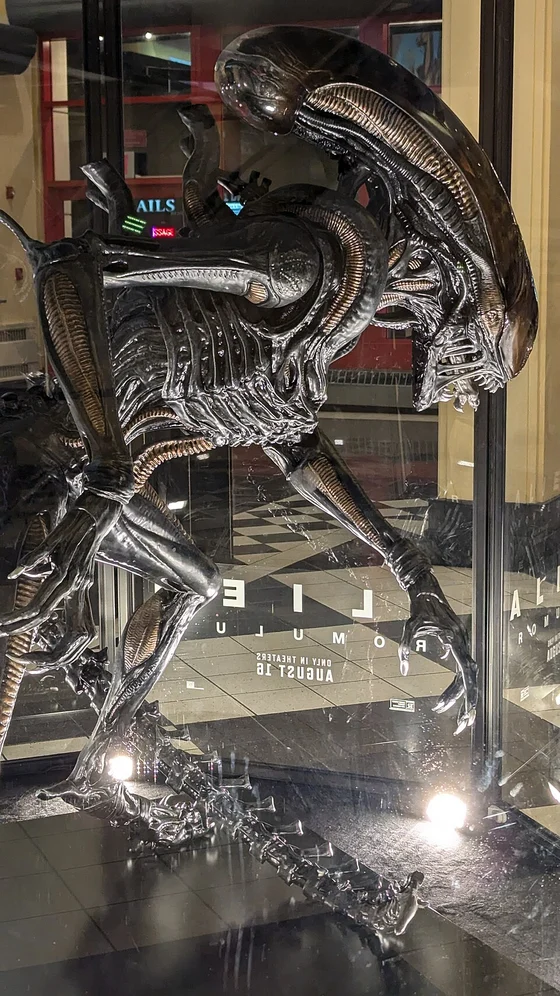
The Queen is a large reproductive form with a broad cranial crest, an extending face, two prominent arms and a smaller chest-mounted pair. In Aliens she occupies the egg chamber, connected to a bulky egg-laying apparatus. This explains how the colony’s infestation can sustain a supply of eggs without treating each adult predator as an independent egg layer. Ripley’s threat to the eggs briefly affects the surrounding creatures’ behaviour, and destruction of the chamber provokes pursuit. The Queen detaches from the apparatus and becomes mobile, eventually confronting Ripley after reaching the Sulaco. That defensive response gives the encounter a recognizable conflict between protective figures while retaining the organism’s radically unfamiliar body. The method of communication within the hive is not thereby settled as telepathy.
Cameron describes the Queen as a thinking character and explains that her egg-laying cycle answered an issue left open by Alien’s theatrical cut. He explicitly distinguishes that film from its cut egg-transformation scene. The difference is a history of released versions and deliberate sequel choices, not grounds to claim all reproduction works one way. His renderings and Stan Winston’s sculptural work developed the design together. The studio’s account identifies Shane Mahan’s quarter-scale head sculpture and subsequent full-size work at Pinewood. Alien Resurrection then presents a cloned Queen affected by human genetic material, whose altered reproductive system produces the Newborn. That abnormal live birth is specific to the engineered clone, not a replacement for the 1986 Queen’s egg-laying baseline.
First appearances & development
The Queen first appeared on screen in Aliens in 1986. Cameron and Winston developed her from a deliberate expansion of the first film’s creature design. The later Resurrection clone and crossover Queens belong to specific stories; an individual Queen’s size, apparatus or altered reproduction is not a universal profile for all Alien organisms.
Canon & continuity
The two retained films witness the original reproductive role and later cloning abnormality. Cameron’s direct interview explains the intended sequel relationship and collaboration; the studio article independently identifies Mahan’s sculpting work. A specialist film reference supports the chamber and pursuit account. Its speculative communication and Queen-creation theories are not adopted as demonstrated canon.
Selected bibliography
Documented works and useful reading. This is not a list of every appearance.
- 01
Aliens
Hive, egg-laying Queen and colonist outbreak.
- 02
Alien Resurrection
Later film with a cloned Queen and altered reproductive features; do not universalize the hybrid.
Family, evolution & connections
H. R. Giger’s Alien design aesthetic
Stan Winston School’s production account describes Cameron and Winston preserving Giger’s established biomechanical aesthetic while developing the Queen for Aliens (1986). This identifies a design lineage across films, not an account of the Queen’s fictional biological ancestry.
References
Sources supporting this profile. Linked pages have their own scope and editorial standards.
- ReferenceAlien Queen — reference guideResearch access: 2026-10-05
- Primary workCameron and Hurd interviewResearch access: 2026-10-05
- Primary workQueen head sculpture historyResearch access: 2026-10-05
- ReferenceQueen film encountersResearch access: 2026-10-05
Image credits
A sourced illustration has not yet been added. This gap is included in the coverage record.