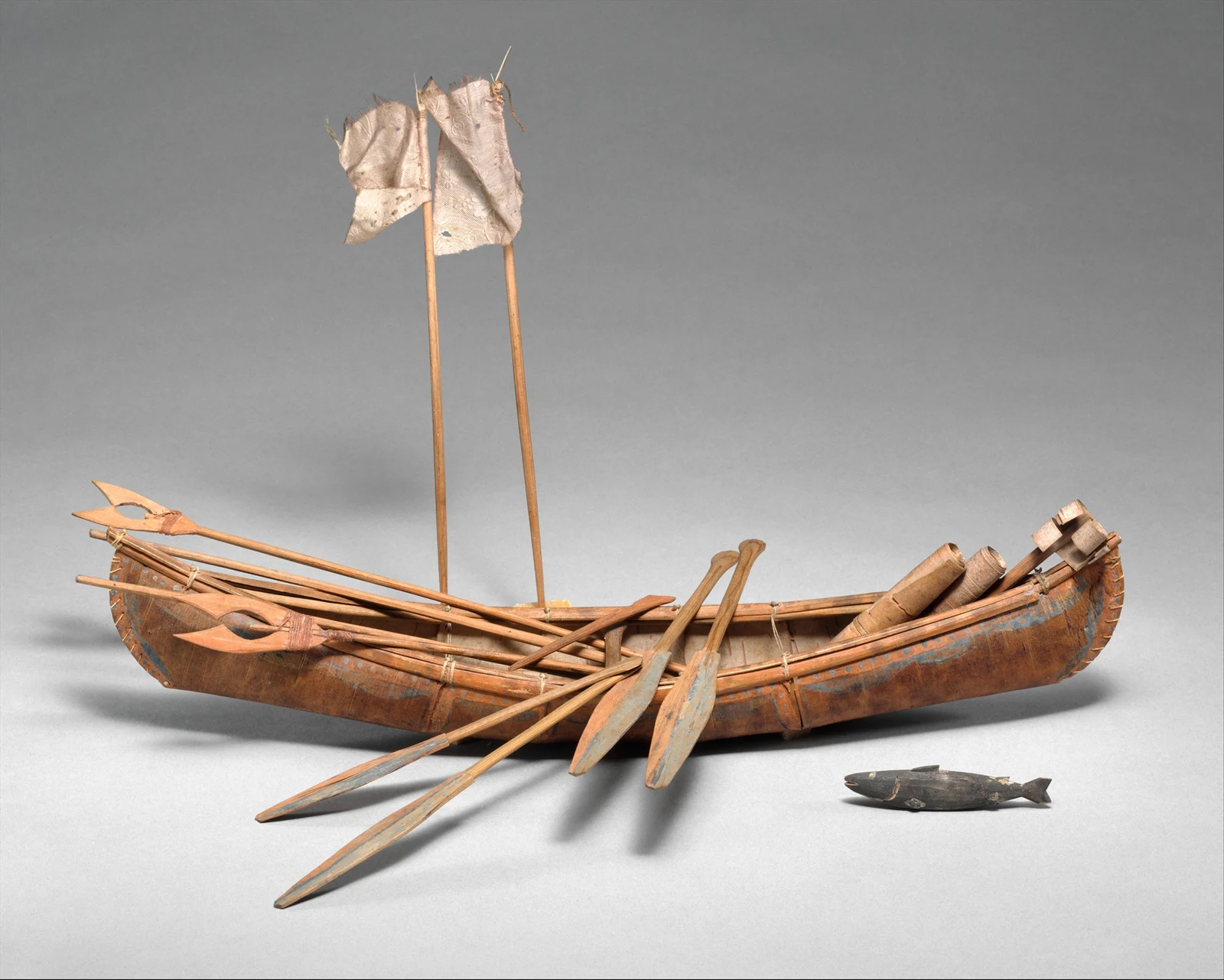
A decorated miniature birchbark canoe with paddles, poles, small tools and two upright fabric flags, with a small fish-shaped object beside it.
Canoe model with accessories from New Brunswick, dated before 1845 and catalogued by the Met as Maliseet, a name historically used for Wolastoqiyik. This particular miniature documents an artistic object, not a full-size vessel or uniform contemporary practice.
Overview
The Wolastoqiyik, also written Wəlastəkwiyik in the selected community source, are Indigenous people of the Wolastoq watershed and adjacent lands and waters. Their homeland extends between the Bay of Fundy and the St. Lawrence region, crossing present New Brunswick, Québec and Maine. Maliseet is another historically used name, attributed by this source to their Mi’kmaq neighbours. The Wolastoqey Nation in New Brunswick describes Wabanaki relationships as an alliance among distinct peoples; alliance does not make their communities or governments interchangeable. Its history also records dispossession and suppression of language through colonial schooling alongside continuing cultural work.
The organization called Wolastoqey Nation in New Brunswick was formed in 2017 to coordinate technical support for six communities. It expressly distinguishes itself from the communities that hold rights and to which consultation is owed. Its institutional founding is therefore not the origin of the Wolastoqiyik. The separately named Wolastoqey Tribal Council Inc. describes a service network with five member communities on its current homepage. Those different counts refer to different organizations, rather than conflicting censuses of the people.
The Tribal Council’s public programme spans health, education, recreation, employment preparation and access to services for children. Its education branch connects lifelong learning with Wolastoqey language, culture and history, while skills and employment support includes training and assistance beyond the classroom. These are organizational responsibilities and opportunities, not a claim that all Wolastoqiyik use the same services or share one local government. Neither membership in the service network nor participation in a course provides a general definition of Indigenous identity or political citizenship.
New Brunswick’s introductory Wolastoqey Latuwewakon curriculum offers a more specific view of language education. It uses the Francis and Leavitt orthography while explicitly allowing teachers to adapt materials to community variations. Its aims include everyday communication, reading, writing and learning with Elders and Knowledge Keepers. The resource notice credits Delbert Moulton, Walter Paul, Imelda Perley, Allan Tremblay and Ron Tremblay for source material used in optional teaching bundles. This acknowledgement identifies contributors without making them authors of every lesson. The complete written course outline and credits were inspected, but the linked bundles and pronunciation recordings were not. Curriculum goals should likewise not be mistaken for measured proficiency among all learners.
History & identity
Community history identifies a cross-border homeland; the selected institutional accounts mainly concern New Brunswick. No modern organization is presented as the people’s founding.
Sources & representation
Complete community history, Tribal Council homepage body and provincial written course outline with contributor credits read. Linked educational bundles and legal documents were not inspected.
Selected bibliography
Documented works and useful reading. This is not a list of every appearance.
- 01
Introductory Wolastoqey Latuwewakon 110
Undated online course outline; source-material contributors are named in the profile. Linked teaching bundles not read.
Language & cultural connections
Source-supported language and cultural connections have not yet been compiled for this profile.
References
Sources supporting this profile. Linked pages have their own scope and editorial standards.
- Community or public educational institutionOur History — Wolastoqey Nation in New BrunswickResearch access: 2026-10-05
- Community or public educational institutionWolastoqey Tribal CouncilResearch access: 2026-10-05
- Community or public educational institutionIntroductory Wolastoqey Latuwewakon 110Research access: 2026-10-05
Image credits
Museum photograph of a historical Wolastoqiyik canoe model and accessoriesA decorated miniature birchbark canoe with paddles, poles, small tools and two upright fabric flags, with a small fish-shaped object beside it.
Canoe model with accessories from New Brunswick, dated before 1845 and catalogued by the Met as Maliseet, a name historically used for Wolastoqiyik. This particular miniature documents an artistic object, not a full-size vessel or uniform contemporary practice.