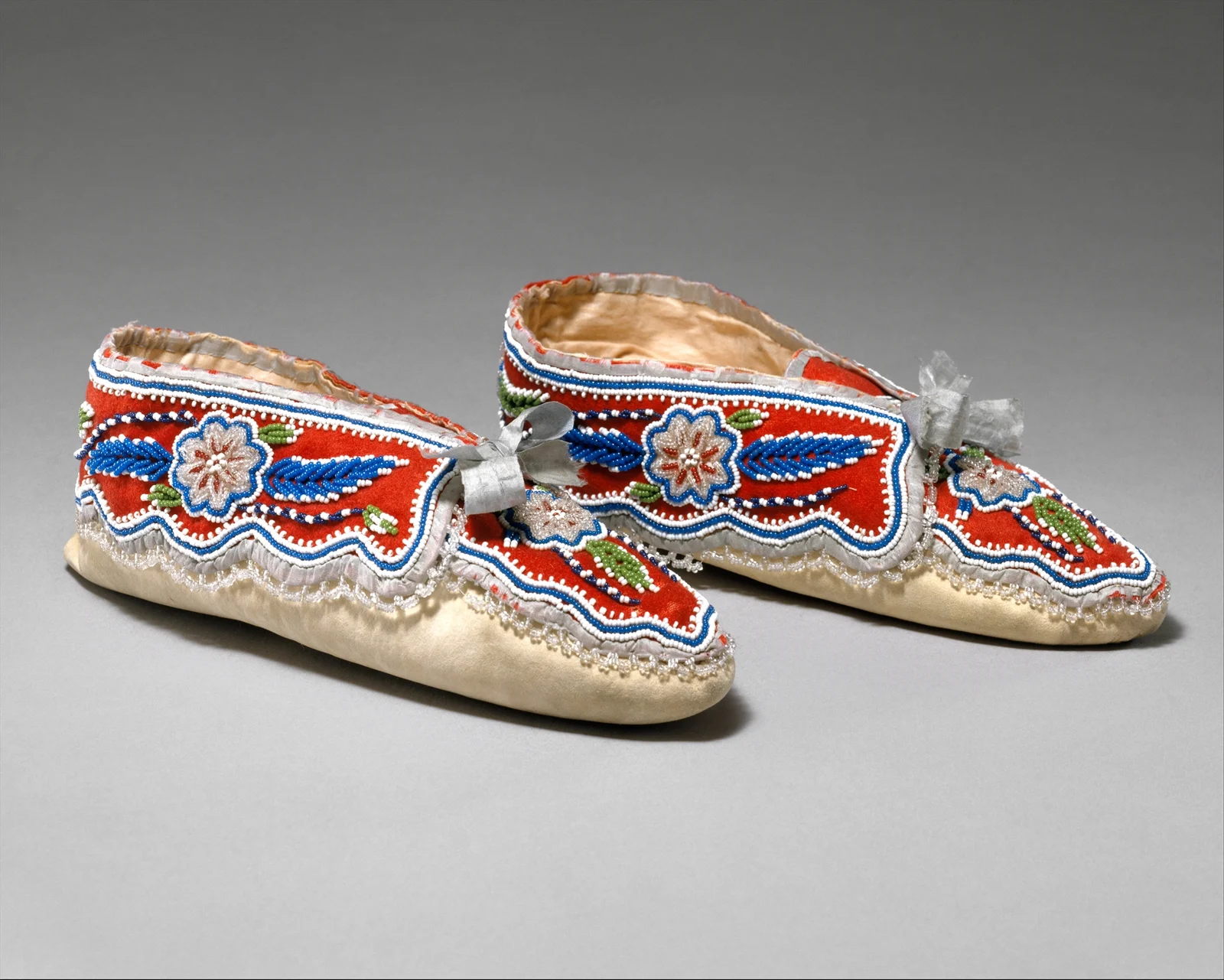
Pair of moccasins with red panels, blue and white floral beadwork, pale soles and silver-grey ribbons.
Moccasins, circa1850, Quebec, catalogued by The Met as Huron. A historical Wendat-context object; the record does not identify an individual maker or establish a specific Wendake workshop.
Overview
The Wendat Nation described here is the contemporary community centred on Wendake in Québec, also identified in its institutions’ documentation as Huron-Wendat. Its own history page explicitly includes members living elsewhere in Québec, other provinces and other countries. Residence within Wendake therefore does not encompass the whole Nation. This profile follows that community’s self-description rather than treating every historical Wendat confederacy or present related nation as the same political body. The page presents an elected Grand Chief and family chiefs with responsibilities across education, territory, health, culture and economic development.
Wendat belongs to the Iroquoian language family. The Nation’s linguistic history describes a nineteenth-century interruption of everyday transmission, while acknowledging uncertainty about the final speakers’ dates. Community initiatives revived interest in the late 1970s and early 1980s, including parents’ requests for school teaching. A later school-led programme developed standardized writing with a Wendat linguist and community committee. The university–community Yawenda project ran from July 2007 to July 2012. A language committee addresses spelling, pronunciation and new vocabulary; its present institutional history includes formalization in 2016 and restructuring in 2022. These are accounts of organized revitalization, not evidence that every citizen has the same proficiency.
Documentary memory also has community custodians. The Council archive dates its establishment to 1996 under Stéphane Picard and the chiefs. In its historical account, Raphaël Boney situates his work within a succession of Wendat archivists and describes oral transmission and written records as complementary. Holdings include family collections, correspondence, maps and photographs. The Marguerite Vincent collection preserves research for her 1984 book La Nation huronne, son histoire, sa culture, son esprit. That book is identified here through the archive’s catalogue description; its full text has not been inspected.
Tourisme Wendake dates the community’s establishment at its present location to 1697. Created by the Nation’s Council as a nonprofit organization, it supports local tourism enterprises, visitor information and cultural programming, including the Wendake Pow Wow and Onhwa’ Lumina. Its 2030 vision is an institutional aspiration, not a completed outcome. Together these sources show distinct educational, archival, governmental and economic activities. They provide public institutional perspectives rather than a census of individual beliefs or a citizenship rule, and the linked performances, films and archival manuscripts have not been reviewed.
History & identity
A community-specific account based on the Wendat Nation and its Council-created tourism organization. The 1697 settlement date is not a beginning date for Wendat identity.
Sources & representation
Read the history page’s identity and governance sections, the complete substantive language chronology and committee account, the archive’s full written body, and the complete tourism introduction. Website template placeholders were excluded. No linked books, performances or manuscripts were read.
Selected bibliography
Documented works and useful reading. This is not a list of every appearance.
- 01
La Nation huronne, son histoire, sa culture, son esprit
Bibliographic identification from the Nation archive’s description of the author’s papers; full book not inspected.
- 02
Langue Wendat
Institutional chronology and language-committee account; undated webpage.
Language & cultural connections
Source-supported language and cultural connections have not yet been compiled for this profile.
References
Sources supporting this profile. Linked pages have their own scope and editorial standards.
- Community institutionHistoire & cultureResearch access: 2026-10-05
- Community institutionLangue WendatResearch access: 2026-10-05
- Community institutionCentre d’archivesResearch access: 2026-10-05
- Community institutionÀ propos — Tourisme WendakeResearch access: 2026-10-05
Image credits
Contextual cultural object photographPair of moccasins with red panels, blue and white floral beadwork, pale soles and silver-grey ribbons.
Moccasins, circa1850, Quebec, catalogued by The Met as Huron. A historical Wendat-context object; the record does not identify an individual maker or establish a specific Wendake workshop.