
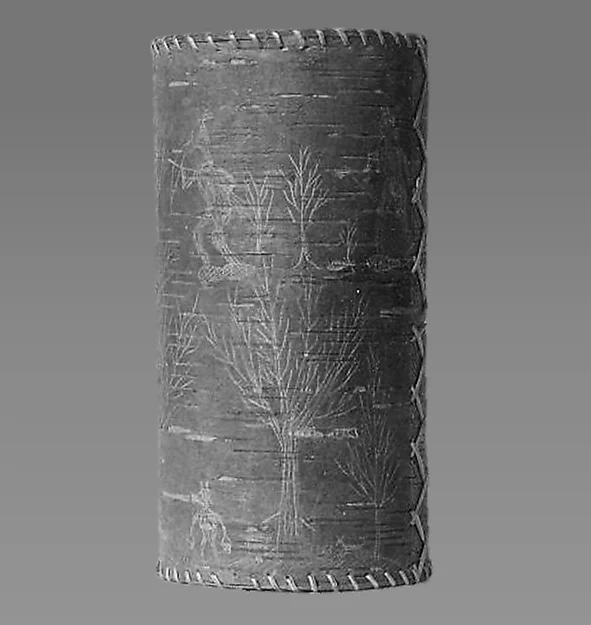
Late-nineteenth-century Mi’kmaq birch-bark vessel with stitched edges and incised trees and animals, catalogued as Drum or Container by the Met
The Met catalogues this late-nineteenth-century Nova Scotia object as Mi’kmaq and titles it “Drum or Container,” preserving uncertainty about its function. It is made from birch bark and white pine root, with stitched edges and incised designs. This particular historical object is cultural context, rather than a portrait or a claim about every Mi’kmaq community.
Overview
Mi’kmaq communities belong to Mi’kma’ki, a homeland extending across what are now several eastern Canadian provinces. The Parks Canada map developed with Mi’kmawey Debert identifies Nova Scotia, Prince Edward Island, Newfoundland and parts of New Brunswick and Quebec. It presents named districts and draws on a community place-name atlas and the work of Trudy Sable and Bernie Francis. These cultural geographies do not simply match modern provincial boundaries. Nor should a map of a homeland be mistaken for a list of membership rules for its distinct First Nations.
Mi’kmawey Debert’s teaching resource places language, family relationships and oral memory together. Stories can preserve knowledge of landscapes and resources; songs, place names and repeated practices aid remembrance. Wampum, petroglyphs and other forms of symbolic communication also have roles, so an oral tradition should not be confused with an absence of documentation. The resource describes tpi’tnewey through sharing and mutual responsibilities, and discusses consensus from families to the Grand Council. It presents values as ways of understanding community life rather than a checklist that every individual must satisfy. Its accounts of spiritually meaningful places deserve attribution without turning every narrative into an independently dated archaeological event.
Contemporary cultural institutions connect preservation with research and education. Mi’kmawey Debert describes its origins in efforts to protect the Debert-Belmont archaeological sites after new finds in 1989. Its project received a mandate from the thirteen Nova Scotia Mi’kmaw Chiefs, incorporated in 2001 and convened an Elders’ Advisory Council in 2002. The organization brings community expertise into museum work, archaeology and interpretation. Those institutional dates describe one project, not the origin of the Mi’kmaq; its provincial mandate does not make it a single government for all communities across Mi’kma’ki.
Named contemporary publications offer another form of transmission. A 2013 cultural-centre announcement introduces Our Grandmothers’ Words: Traditional Stories for Nurturing, by Murdena Marshall and collaborators, illustrated by Gerald Gloade. Its description follows a young woman’s entry into motherhood with guidance from older women. The same announcement presents Warrior Women, a collaborative work involving Sister Dorothy Moore and other First Nations educators. These are authored works situated in particular educational and family experiences, not anonymous statements by an entire people. Their announcement establishes bibliographic context; it is not a substitute for reading the complete books.
History & identity
Mi’kma’ki homeland relationships are retained without assigning one archaeological site or modern institution as an ethnic beginning.
Sources & representation
Complete written Family, Culture, Community resource, complete Parks map text and publication announcement; selected About MDCC opening history. No linked books, recordings or full personnel biographies claimed as read.
Selected bibliography
Documented works and useful reading. This is not a list of every appearance.
- 01
Our Grandmothers’ Words: Traditional Stories for Nurturing
Publication announcement and synopsis inspected; complete book not read.
Language & cultural connections
These connections link languages or specific cultural works and institutions; they do not establish biological ancestry or ethnic identity.
Mi’kmawey Debert Cultural Centre
The Centre describes a mandate from thirteen Nova Scotia Mi’kmaw Chiefs and guidance from an Elders’ Advisory Council. This is a regional institution, not all-Mi’kmaq government.
References
Sources supporting this profile. Linked pages have their own scope and editorial standards.
- Community and heritage collaborationParks Canada and Mi’kmawey Debert: Districts of Mi’kma’kiResearch access: 2026-10-05
- Community educational resourceMi’kmawey Debert: Family, Culture, CommunityResearch access: 2026-10-05
- Community organizationMi’kmawey Debert: organizational historyResearch access: 2026-10-05
- Community publication noticeMi’kmawey Debert: publications announcement,2013Research access: 2026-10-05
Image credits
Contextual cultural object photographLate-nineteenth-century Mi’kmaq birch-bark vessel with stitched edges and incised trees and animals, catalogued as Drum or Container by the Met
The Met catalogues this late-nineteenth-century Nova Scotia object as Mi’kmaq and titles it “Drum or Container,” preserving uncertainty about its function. It is made from birch bark and white pine root, with stitched edges and incised designs. This particular historical object is cultural context, rather than a portrait or a claim about every Mi’kmaq community.