Weeping Angel
Image associated with the exact linked encyclopedia article; consult credited file description for its interpretation.
Overview
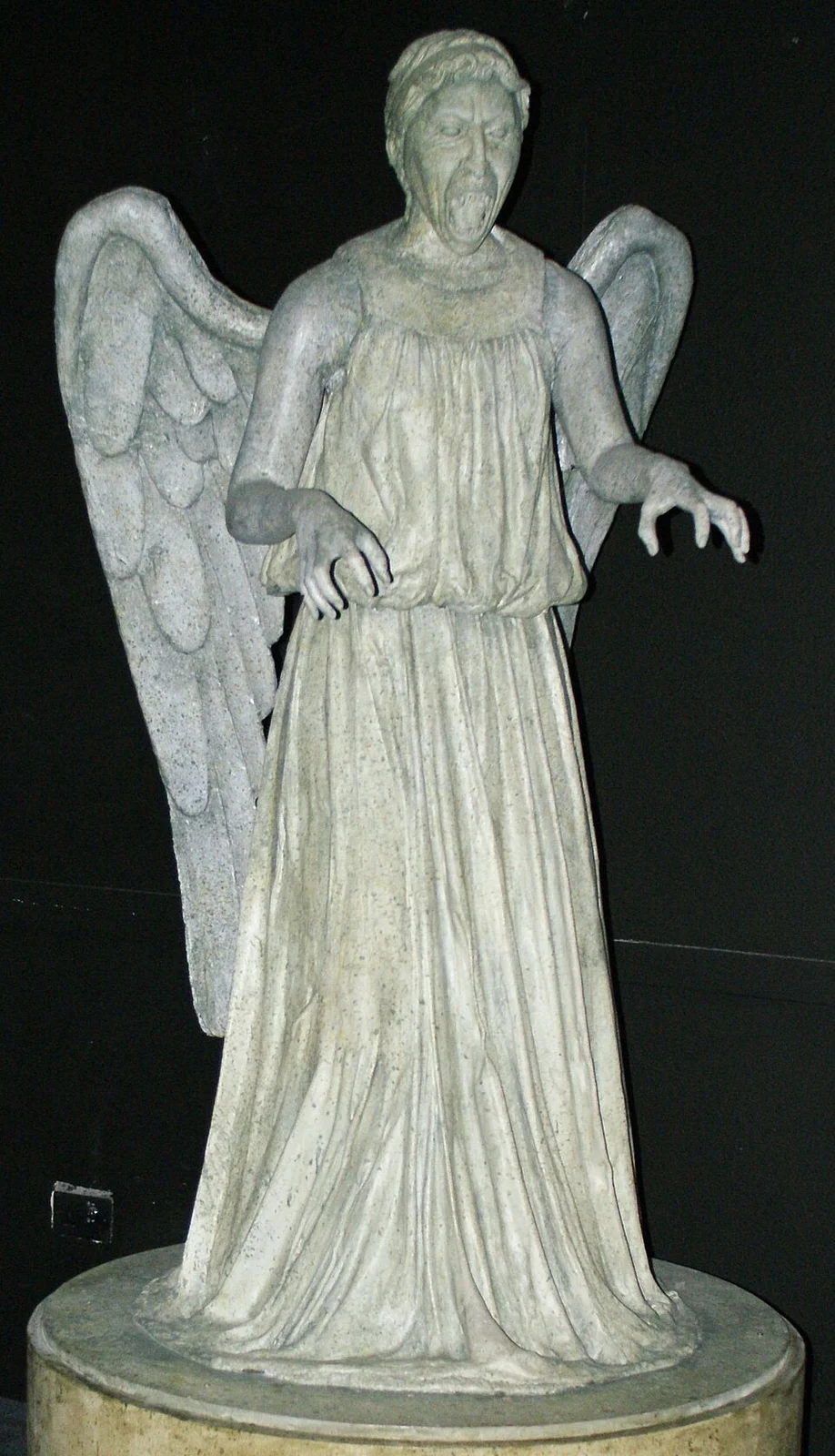
Weeping Angels are temporal predators whose stone-like stillness is a quantum-locked response to observation. When unwatched, they move rapidly; a touch can send a victim into the past, allowing the Angel to feed on the life that would otherwise have unfolded. Blink makes looking and coordinating sight immediate survival problems. The Doctor and Martha are stranded in 1969, leaving Sally Sparrow clues rather than confronting the threat beside her. Later stories do not merely repeat that encounter. The Time of Angels expands the danger to recorded images and perception: Amy’s viewed recording allows an Angel presence to grow inside her, and shutting her eyes becomes part of a particular response. The protective act of looking can therefore conflict with another hazard.
The 2021 Flux stories add organization and differing aims. A rogue Angel hiding within Claire seeks escape from Division’s extraction squad; other Angels take Medderton out of ordinary time and space. The apparent transformation of the Doctor needs its continuation: the BBC’s published Survivors of the Flux script explains an Angel-form encasement used for transport, followed by restoration and quantum realignment. It is not simply proof that she permanently becomes a new member of the species. Outside television, The Lonely Assassins returns to Wester Drumlins and makes technology a more direct attack route. Writer Gavin Collinson describes the game’s specific agenda and personal interaction with the player. That development concerns this licensed game, rather than establishing a new biological origin. Across versions, uncertain origins and changing demonstrated powers remain part of the creature’s identity.
First appearances & development
Steven Moffat introduced the Weeping Angels in Blink, first broadcast on 9 June 2007. His 2010 pair develops image and perception hazards, while the 2021 Flux story and licensed game extend the setting differently. These later demonstrations are identified as particular treatments rather than retroactively assigning every ability to the first encounter.
Canon & continuity
The official character guide supplies quantum locking and temporal feeding; the indexed official history supports Amy’s image-related danger. Actually inspected pages 3–4 and 7 of the BBC Survivors of the Flux script clarify transport encasement and restoration. Collinson’s full official interview independently supports the licensed game’s technology-focused treatment; no complete script survey is claimed.
Selected bibliography
Documented works and useful reading. This is not a list of every appearance.
- 01
Blink
Weeping Angels and observation mechanic.
- 02
The Time of Angels / Flesh and Stone
Expanded image and perception hazards.
- 03
Village of the Angels
Division extraction squad, Claire and Medderton; official character-guide account.
- 04
Survivors of the Flux
Published BBC script clarifies Angel-form encasement for transport and subsequent restoration.
- 05
Doctor Who: The Lonely Assassins
Licensed game revisiting Wester Drumlins with a specifically developed technological threat.
Family & connections
A source-supported family tree or inspiration record has not yet been compiled for this profile. Related reading below indicates a connection in subject matter, not a proven lineage or creative influence.
Encyclopedia background
An additional attributed reference, separate from the editorial profile above.
Read the open encyclopedia overview
The Weeping Angels are a race of fictional predatory alien creatures from the long-running British science fiction television series Doctor Who. The Weeping Angels look like stone statues to an observer since they only can move when unobserved. Weeping Angels feast by touching a victim; the victim is sent back in time, and the Angel feeds on the resulting time energy from the time travel caused. The Weeping Angels were introduced in the 2007 episode "Blink" and became recurring characters across a variety of Doctor Who media. These later episodes expand the Angels' list of abilities, which include the ability for an image of an Angel to become another Weeping Angel, the ability to turn other statues into Weeping Angels, and the ability to kill others by touching them twice.
The Angels were created by writer Steven Moffat. Moffat was inspired by a variety of sources, including an encounter with a statue of a crying angel in a graveyard, which had mysteriously disappeared when he returned to view it at a later date. The Weeping Angels are portrayed by actresses who portray the Angels physically, with freeze frames being used to make the Angels appear entirely still in the final product. The Weeping Angels were planned to act as the overarching, main antagonists of the spin-off series Class; however, due to the series's cancellation, this never came to fruition.
Since their initial appearance, the Weeping Angels have been repeatedly nominated as one of the most popular and frightening Doctor Who monsters. They have been praised for their concept and fear factor, but have been criticized for the expansion of their abilities and their overexposure across Doctor Who media. They have been significantly analyzed since their debut. The computer hacking tool Weeping Angel, which was leaked as part of Vault 7, is named after the Angels.
Text from Wikipedia contributors, “Weeping Angel”. CC BY-SA 4.0. Extracted introduction; formatting changed. Retrieved 5 October 2026. The source article may have changed since retrieval.
References
Sources supporting this profile. Linked pages have their own scope and editorial standards.
- OfficialDoctor Who: Weeping AngelsResearch access: 2026-10-05
- OfficialDoctor Who: A Brief History of the Weeping AngelsResearch access: 2026-10-05
- Primary workBBC Writersroom: Survivors of the Flux published scriptResearch access: 2026-10-05
- OfficialDoctor Who: Gavin Collinson on The Lonely AssassinsResearch access: 2026-10-05
- OfficialDoctor Who: Blink episode guideResearch access: 2026-10-05
Image credits
Reference illustrationWeeping Angel
Image associated with the exact linked encyclopedia article; consult credited file description for its interpretation.