Cyberman
Image associated with the exact linked encyclopedia article; consult credited file description for its interpretation.
Overview
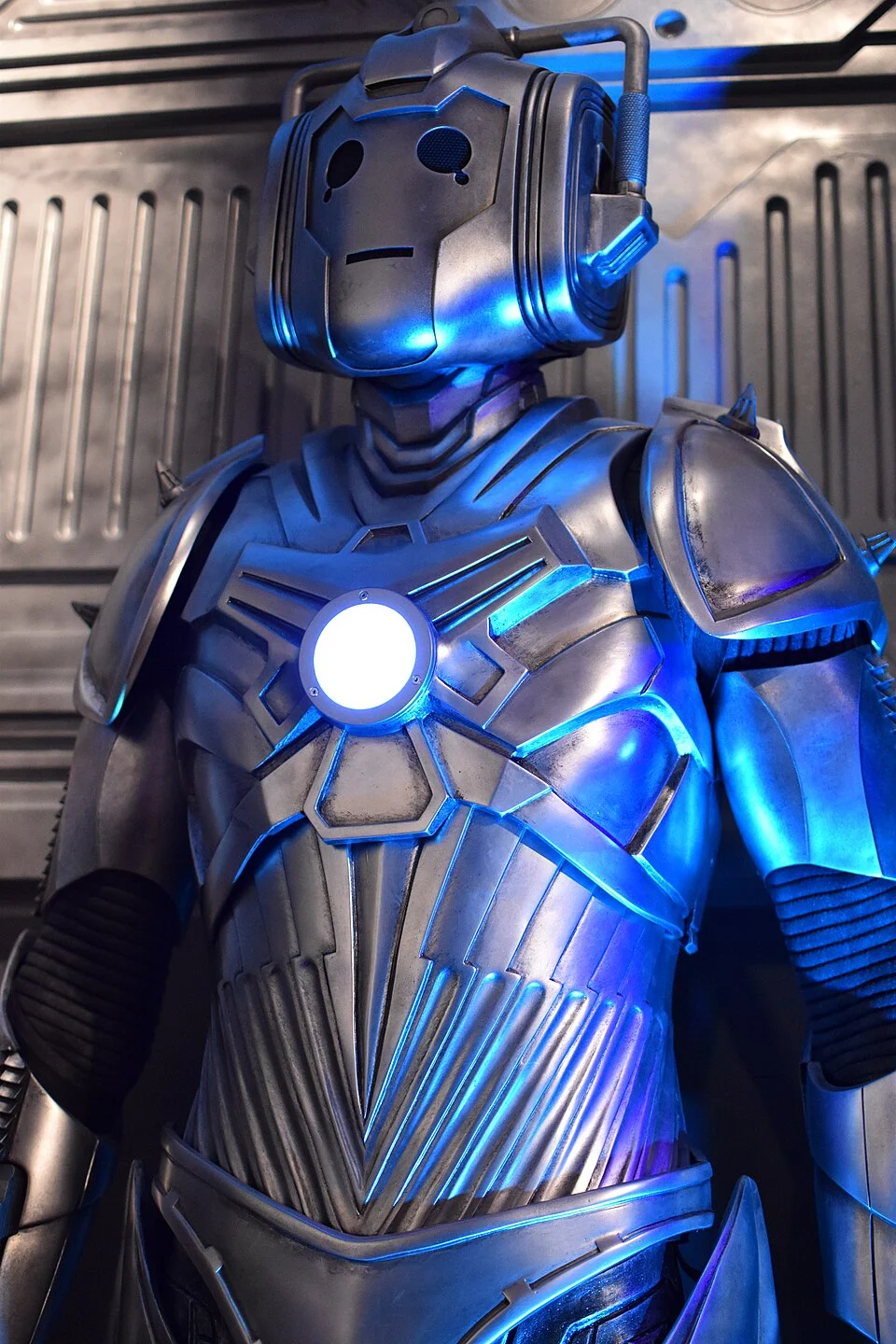
Cybermen turn the desire to survive into a process of technological replacement and conversion. Mondasians, living on Earth’s drifting twin planet, replace parts of their deteriorating bodies with plastic and steel; emotional inhibitors eventually suppress love, hate and fear. A recognizable metal body can therefore conceal a transformed person, not an ordinary empty robot. Their conversion threat makes survival and efficiency inseparable from the loss of identity. The official guide describes Cyberleaders directing drones, with leadership data transferable after a leader’s destruction. But Mondas does not explain every Cyberman: John Lumic’s Cybus Industries independently creates a parallel-Earth version, and later television follows another genesis aboard a Mondasian colony ship.
Their story roles extend beyond a straightforward marching invasion. The Moonbase attacks a weather-control system through infection, while The Tomb of the Cybermen uses an apparent archaeological discovery to lure intelligent humans into conversion. Revenge of the Cybermen introduces a fatal gold vulnerability that matters to subsequent encounters; it should not be assumed to defeat every later model. Nightmare in Silver depicts detachable parts, exceptional speed and adaptation to laser attacks. Dark Water adds an army assembled from the dead, and World Enough and Time makes Bill’s conversion a personal tragedy within a renewed origin account. Designs, resources and processes consequently vary. The common horror is an imposed answer to mortality that removes the qualities its victims want to preserve, while the means of resisting it depend on the particular story.
First appearances & development
Cybermen debuted in The Tenth Planet, first broadcast on 8 October 1966 according to the official episode guide. The 2006 Cybus story supplies a separate parallel-Earth creation, not the original Mondasian biography. Later returns revisit or multiply their origins, so a single unchanged homeworld and anatomy would misrepresent the television history.
Canon & continuity
BBC Studios’ Cybermen character guide establishes bodily replacement, inhibition, leadership and Cybus distinctions. Its inspected 2021 history supplies the Moonbase, tomb, gold, adaptive-model and later conversion cases. The Tenth Planet guide verifies the original broadcast and writers. This is selective official television evidence, not a newly inspected complete script or audio archive.
Selected bibliography
Documented works and useful reading. This is not a list of every appearance.
- 01
The Tenth Planet
Original Mondasian Cybermen.
- 02
Rise of the Cybermen / The Age of Steel
Parallel-Earth Cybus variant.
- 03
World Enough and Time / The Doctor Falls
Mondasian colony-ship genesis and Bill’s conversion; distinct later origin treatment.
Family & connections
A source-supported family tree or inspiration record has not yet been compiled for this profile. Related reading below indicates a connection in subject matter, not a proven lineage or creative influence.
Encyclopedia background
An additional attributed reference, separate from the editorial profile above.
Read the open encyclopedia overview
The Cybermen are a fictional race of cyborgs principally portrayed in the British science fiction television programme Doctor Who. The Cybermen are a species of space-faring cyborgs who often forcefully and painfully convert human beings (or other similar species) into more Cybermen in order to populate their ranks while also removing their emotions and personalities. They were conceived by writer Kit Pedler (who was also the unofficial scientific advisor to the series) and story editor Gerry Davis, and first appeared in the 1966 Doctor Who serial The Tenth Planet.
The Cybermen have seen many redesigns and costume changes over Doctor Who's long run, as well as a number of varying origin stories. In their first appearance, The Tenth Planet (1966), they are humans from Earth's nearly identical "twin planet" of Mondas who upgraded themselves into cyborgs in a bid for self-preservation. Forty years later, the two-part story, "Rise of the Cybermen" and "The Age of Steel" (2006), depicted Cybermen invented again in a parallel universe London as a business corporation's attempt at upgrading humanity. Doctor Who audio dramas, novels, and comic books have also elaborated on existing origin stories or presented alternatives. The 2017 episode, "The Doctor Falls", explains the different origins as parallel evolution, due to the inevitability of humans and human-like species upgrading themselves through technology; this perspective resolves continuity differences in the Cybermen's history.
A mainstay of Doctor Who since the 1960s, the Cybermen have also appeared in related programmes and spin-off media, including novels, audiobooks, comic books, and video games. Cybermen stories were produced in officially licensed Doctor Who products between 1989 and 2005, when the TV show was off the air, with writers either filling historical gaps or depicting new encounters between them and the Doctor. The species also appeared in the Doctor Who TV spin-off, Torchwood, appearing in the fourth episode, "Cyberwoman" (2006).
Text from Wikipedia contributors, “Cyberman”. CC BY-SA 4.0. Extracted introduction; formatting changed. Retrieved 5 October 2026. The source article may have changed since retrieval.
References
Sources supporting this profile. Linked pages have their own scope and editorial standards.
- OfficialDoctor Who: CybermenResearch access: 2026-10-05
- OfficialDoctor Who: The History of the CybermenResearch access: 2026-10-05
- OfficialDoctor Who: The Tenth Planet episode guideResearch access: 2026-10-05
Image credits
Reference illustrationCyberman
Image associated with the exact linked encyclopedia article; consult credited file description for its interpretation.