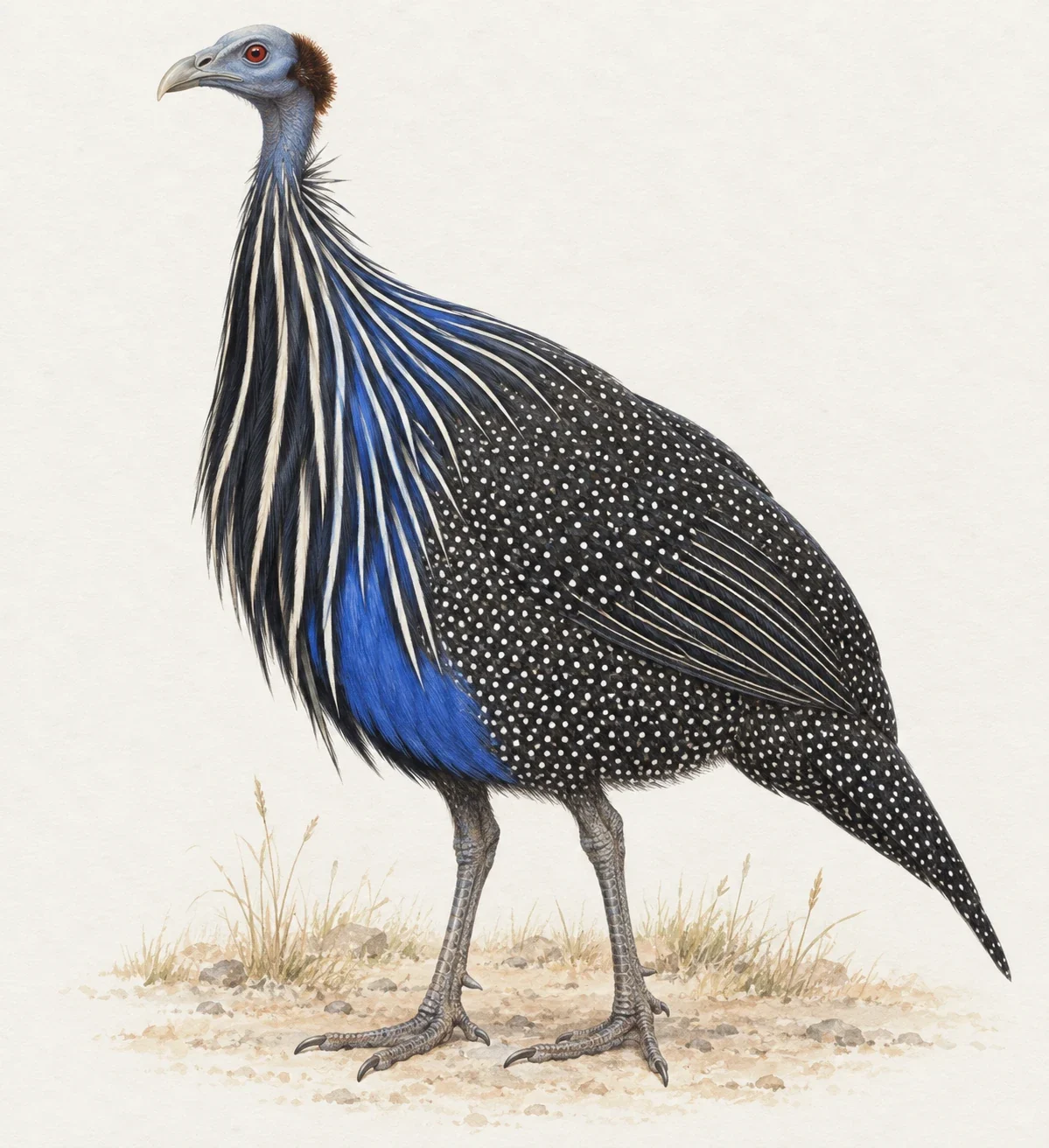
Vulturine guineafowl - AI-generated scientific interpretation.
Modern AI-generated scientific illustration. Diagnostic features follow selected sources; pose, individual markings and fine details are interpretive. Not photography or independent anatomical evidence.
Overview
The vulturine guineafowl combines a small bare head, brown nape feathers, a blue breast and long striped neck plumage over a spotted dark body. The name concerns its vulture-like head, not scavenging membership in a vulture family. Its legs suit terrestrial movement.
It uses open dry habitats, commonly escaping on foot and roosting above ground where vegetation permits. Seeds, other plant material and small animals contribute to an omnivorous diet. Ground nests and mobile chicks fit this terrestrial life, without implying that the bird cannot fly.
Max Planck’s 2019 field report describes stable social groups that preferentially associate with particular other groups. Researchers followed a marked Kenyan population across seasons. This supports multilevel sociality at that study site; it does not prove human-like cognition or identify a precise brain-size threshold for social complexity.
Origins & earliest records
A galliform in Numididae, not a small dinosaur outside the living bird radiation. NCBI identifies its genus as Acryllium; comparisons with mammals concern social organisation rather than ancestry.
Evidence & interpretation
Indianapolis Zoo supports appearance, habitat and diet; the Max Planck research-team report and linked primary publication support bounded social findings. UCI’s taxonomically organised bird account supports the blue, streaked and spotted plumage.
Selected bibliography
Documented works and useful reading. This is not a list of every appearance.
- 01
Vulturine Guineafowl
Selected bibliography; institutional account and study limits retained.
- 02
Complex society discovered in birds
Selected bibliography; institutional account and study limits retained.
- 03
The multilevel society of a small-brained bird
Indexed primary abstract and first-party field report.
- 04
Acryllium vulturinum: Avise’s Birds of the World
Selected bibliography; institutional account and study limits retained.
- 05
Acryllium vulturinum taxonomy
Selected bibliography; institutional account and study limits retained.
Family, evolution & connections
Taxonomic classification
A hierarchy of classified groups, not a chain of direct ancestors.
Source note: Current NCBI genus/family used; study-site social structure distinguished from universal cognitive claims.
- ClassAves
- OrderGalliformes
- FamilyNumididae
- GenusAcryllium
- SpeciesAcryllium vulturinum
References
Sources supporting this profile. Linked pages have their own scope and editorial standards.
- InstitutionalVulturine GuineafowlResearch access: 2026-10-10
- InstitutionalComplex society discovered in birdsResearch access: 2026-10-10
- ResearchThe multilevel society of a small-brained birdResearch access: 2026-10-10
- InstitutionalAcryllium vulturinum: Avise’s Birds of the WorldResearch access: 2026-10-10
- InstitutionalAcryllium vulturinum taxonomyResearch access: 2026-10-10
Image credits
AI-generated scientific interpretationVulturine guineafowl - AI-generated scientific interpretation.
Modern AI-generated scientific illustration. Diagnostic features follow selected sources; pose, individual markings and fine details are interpretive. Not photography or independent anatomical evidence.