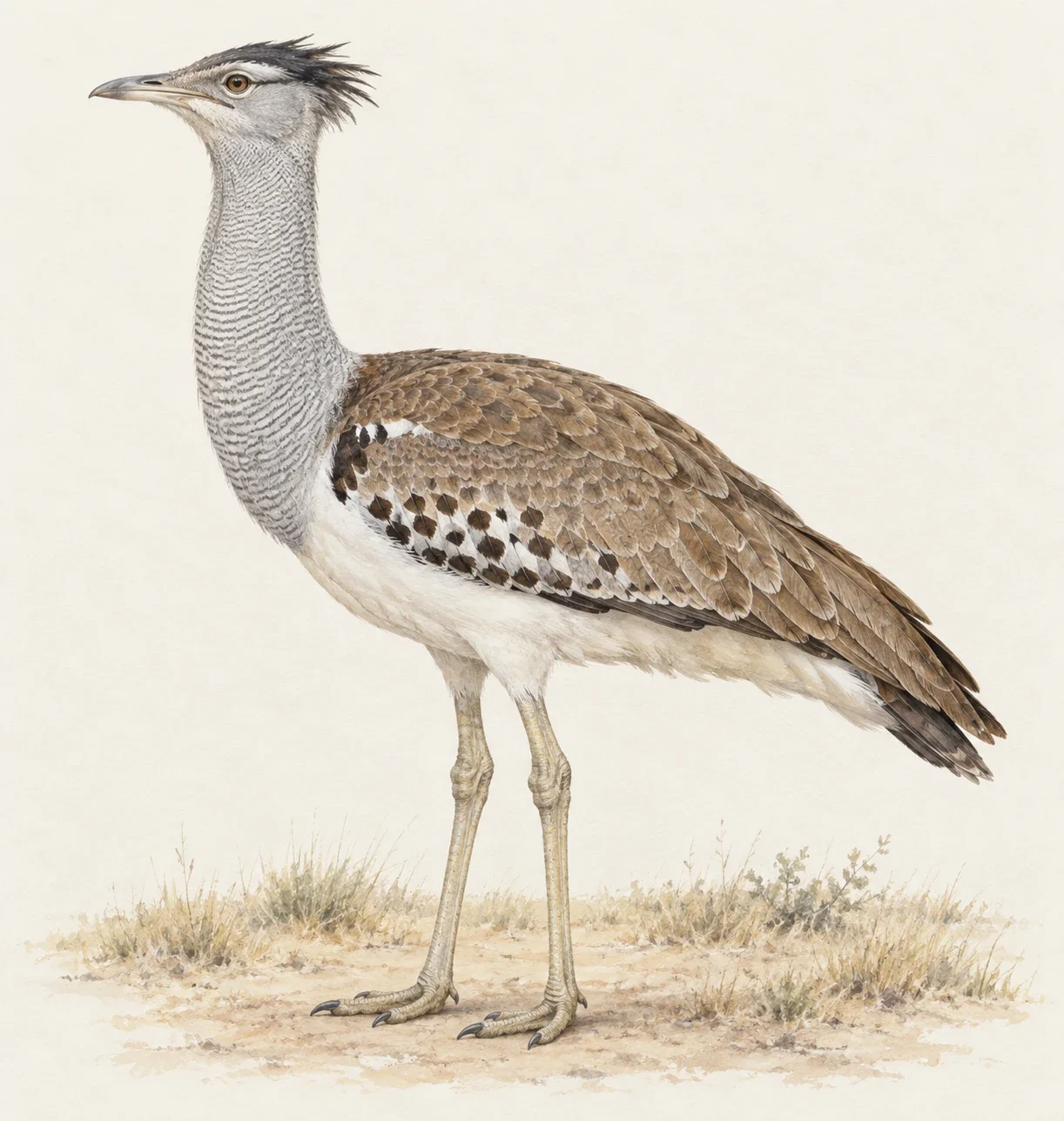
Kori bustard - AI-generated scientific interpretation.
Modern AI-generated scientific illustration. Diagnostic features follow selected sources; pose, individual markings and fine details are interpretive. Not photography or independent anatomical evidence.
Overview
The kori bustard is a heavy ground bird with finely patterned buff-brown upperparts, a long barred neck and strong running legs. The feet have three forward toes. Adult males are substantially heavier than females; the illustration shows an uninflated male rather than a courtship pose.
Open grassland and lightly wooded savanna provide foraging space. Insects and other small animals are eaten alongside plant foods. Males display with neck inflation and booming calls, while females incubate eggs in ground scrapes and care for chicks.
Smithsonian’s observations of a managed flock show individual variation in the development of booming and egg-laying. Its proposed dominance explanation for differences between two females was explicitly tentative. These husbandry observations should not be turned into a measured universal age of maturity or a conclusion about every wild group.
Origins & earliest records
A bustard in Otididae. ITIS places Ardeotis kori in Otidiformes; the zoo’s older Gruiformes order field is reconciled explicitly rather than copied.
Evidence & interpretation
Smithsonian supports anatomy and behaviour; its 2015 first-party breeding report supplies bounded individual observations. Current ITIS secures order placement. No dated range contraction is represented as a newly measured trend.
Selected bibliography
Documented works and useful reading. This is not a list of every appearance.
- 01
Kori bustard
Selected bibliography; institutional account and study limits retained.
- 02
New Kori Bustard Research Sheds Light On Breeding Behaviors
Selected bibliography; institutional account and study limits retained.
- 03
ITIS: Ardeotis kori
Selected bibliography; institutional account and study limits retained.
Family, evolution & connections
Taxonomic classification
A hierarchy of classified groups, not a chain of direct ancestors.
Source note: Otidiformes follows ITIS; outdated institutional Gruiformes label not adopted.
- ClassAves
- OrderOtidiformes
- FamilyOtididae
- GenusArdeotis
- SpeciesArdeotis kori
References
Sources supporting this profile. Linked pages have their own scope and editorial standards.
- InstitutionalKori bustardResearch access: 2026-10-10
- InstitutionalNew Kori Bustard Research Sheds Light On Breeding BehaviorsResearch access: 2026-10-10
- InstitutionalITIS: Ardeotis koriResearch access: 2026-10-10
Image credits
AI-generated scientific interpretationKori bustard - AI-generated scientific interpretation.
Modern AI-generated scientific illustration. Diagnostic features follow selected sources; pose, individual markings and fine details are interpretive. Not photography or independent anatomical evidence.