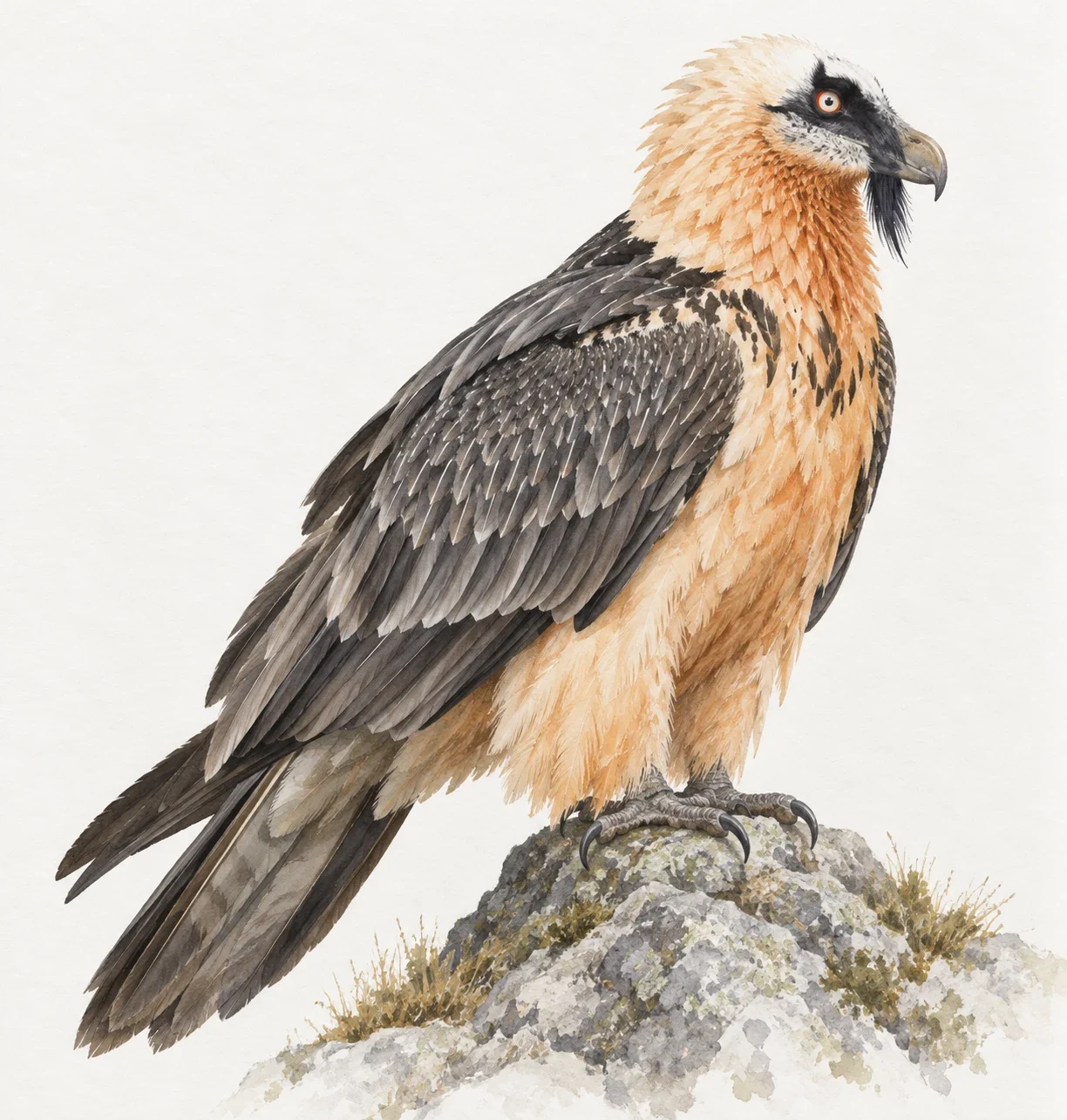
Bearded vulture - AI-generated scientific interpretation.
Modern AI-generated scientific illustration. Diagnostic external features follow selected sources; pose, individual pattern and fine details are interpretive. Not photography or independent anatomical evidence.
Overview
The bearded vulture has a feathered head, dark eye markings and black bristles below its bill. Dark upperparts contrast with a pale-to-orange underside. Its long tail and soaring build differ from the short-necked silhouette often associated with vultures.
Bone feeding is a major specialisation. Vulture Conservation Foundation’s captive radiograph documents a swallowed rabbit leg, a particular observation rather than a maximum-size limit for the species. Ossuary research also cautions that leftover bones do not always represent a simple food store.
Orange plumage comes from external iron-bearing material. Brown’s feather analyses support the mineral origin, while later experimental work did not support the proposed antibacterial benefit. The colour’s biological function remains an interpretive question; a rusty individual is not a separate species or proof of a health treatment.
Origins & earliest records
A mountain scavenger in Accipitridae. The common name lammergeier names the same species; older subspecies lists are not adopted here.
Evidence & interpretation
University of Michigan supports external form. Primary studies distinguish mineral identification from functional hypotheses. Indexed PMC evidence was accessible, but direct access stopped at reCAPTCHA; MDPI direct access failed and was not retried.
Selected bibliography
Documented works and useful reading. This is not a list of every appearance.
- 01
Gypaetus barbatus
Selected bibliography; institutional account and study limits retained.
- 02
Plumage colour and feather structure of the bearded vulture
Indexed primary abstract; mineral result separated from adaptive suggestions.
- 03
Cosmetic colouring by Bearded Vultures Gypaetus barbatus: still no evidence for an antibacterial function
Indexed study passages; direct page stopped at reCAPTCHA.
- 04
An X-ray reveals how Bearded Vultures can swallow long bones
Selected bibliography; institutional account and study limits retained.
Family, evolution & connections
Taxonomic classification
A hierarchy of classified groups, not a chain of direct ancestors.
Source note: Species and family secure; older ADW order/subspecies fields omitted.
- ClassAves
- OrderAccipitriformes
- FamilyAccipitridae
- GenusGypaetus
- SpeciesGypaetus barbatus
References
Sources supporting this profile. Linked pages have their own scope and editorial standards.
- InstitutionalGypaetus barbatusResearch access: 2026-10-10
- ResearchPlumage colour and feather structure of the bearded vultureResearch access: 2026-10-10
- ResearchCosmetic colouring by Bearded Vultures Gypaetus barbatus: still no evidence for an antibacterial functionResearch access: 2026-10-10
- InstitutionalAn X-ray reveals how Bearded Vultures can swallow long bonesResearch access: 2026-10-10
- InstitutionalCMS Raptors: Gypaetus barbatusResearch access: 2026-10-10
Image credits
AI-generated scientific interpretationBearded vulture - AI-generated scientific interpretation.
Modern AI-generated scientific illustration. Diagnostic external features follow selected sources; pose, individual pattern and fine details are interpretive. Not photography or independent anatomical evidence.