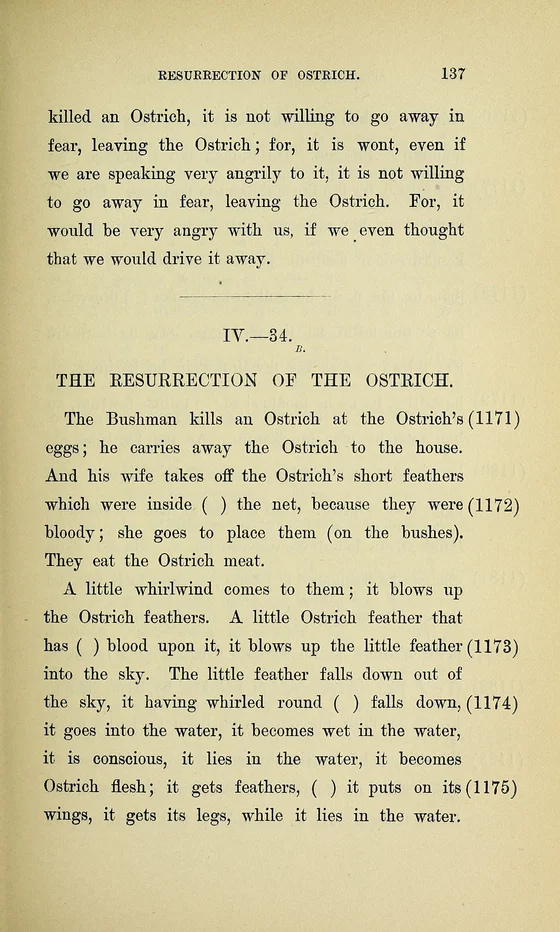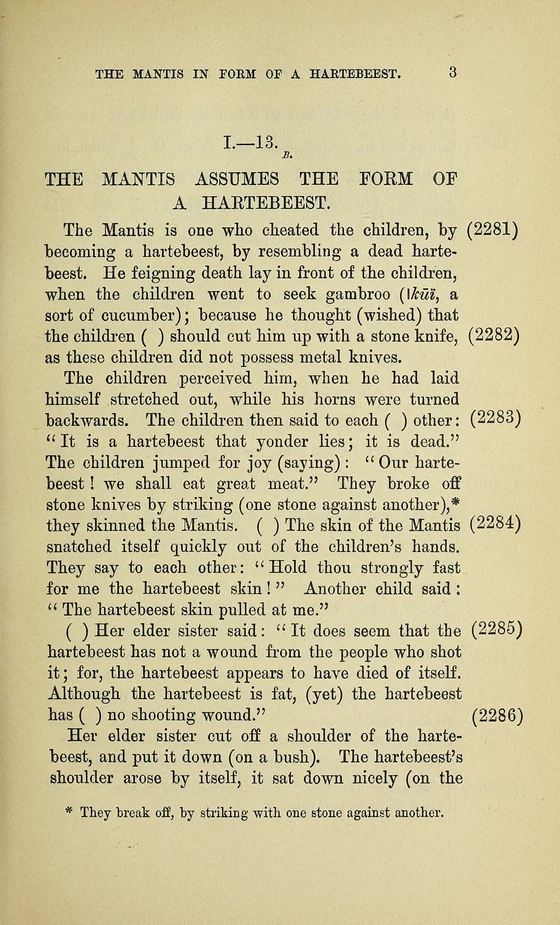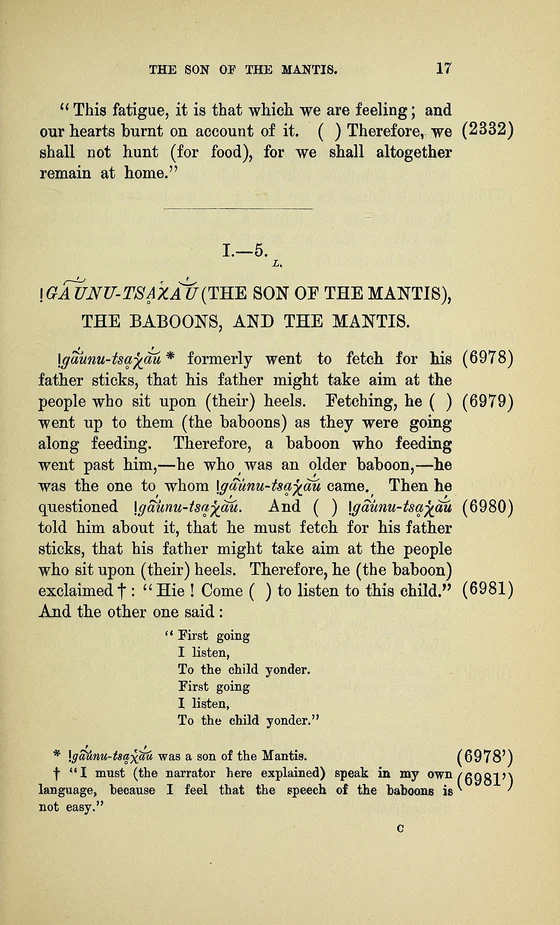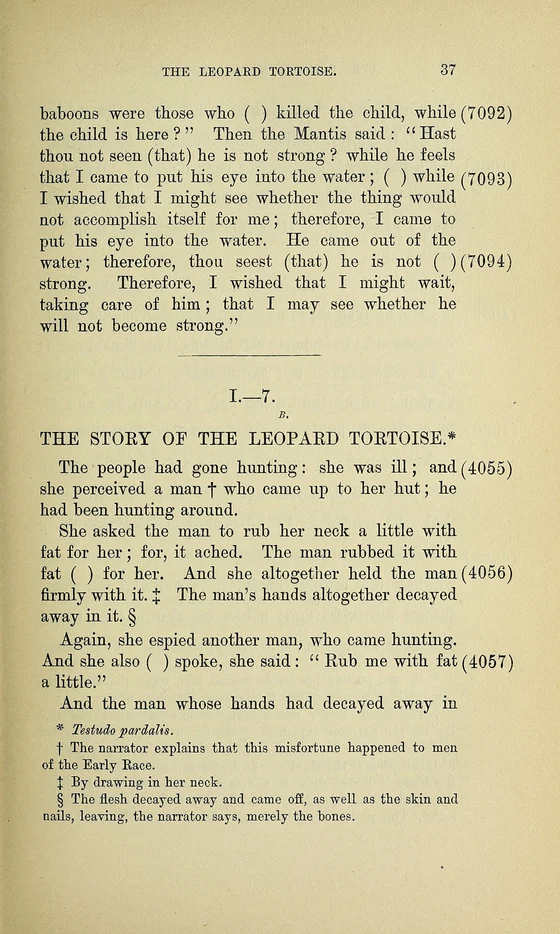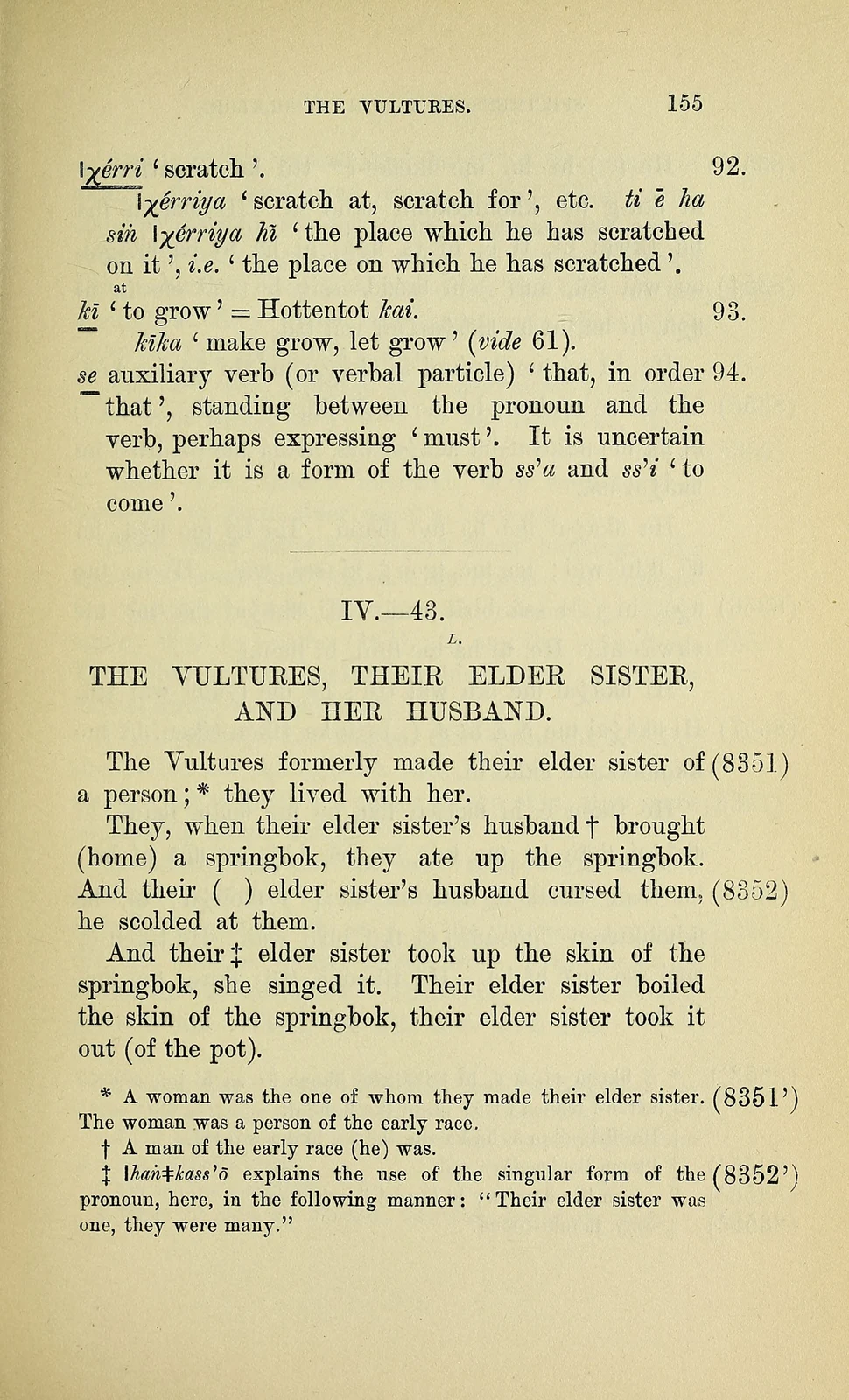
The Two Vulture Sisters, page155, historical printed text witness; documentary source-page facsimile
Primary text witness to The Two Vulture Sisters, page155 in the 1911 edition. Documentary text facsimile, not creature artwork; historical terminology and collector interpretations belong to the original publication.
Overview
The Vulture Sisters begin the selected story as companions of a human elder sister of the early race, living in her house. Her husband brings springbok home from hunting, but the sisters consume the meat. The elder sister then singes and boils the skin and gives pieces to them; they eat those too, drawing further scolding from the husband. They withdraw fearfully and watch him furtively. After another springbok is similarly consumed, he decides that his wife must accompany him and eat at the hunting ground, beyond her sisters’ appetites.
Left behind, the sisters confer outside the house and test what the sky offers. The youngest ascends first, vanishes from view and returns to recommend that an older sister also investigate. The older girl reports that the place is clear and beautiful: she can see large trees and could recognize a springbok lying beneath one. All the sisters then rise into the sky together; the explanatory note connects this ascent with becoming vultures. Their transformation creates a new means of finding meat from above, while their association with the human elder sister remains. The translation records bodily ambiguity rather than resolving every early action into either a fully human hand or an ordinary bird beak.
When they see the husband approaching they eat hurriedly and fly heavily away, leaving him bones. But when their elder sister approaches, they tell one another to reserve flesh for her, specifically a portion along the upper spine translated as undercut. The woman follows the birds to the carcass, reproaches their wary withdrawal as though she too had scolded them, and carries the springbok home while they seek another. This is a collective origin-and-kinship episode; the sisters are kept as one profile, not counted individually without names. Notes preserve |han#kass’o’s explanation of singular and plural reference and the editor’s uncertainty about handling food. No particular biological vulture species, exact modern range, or additional wing anatomy is established by the translated witness.
Origins & earliest records
Selected tale in Bleek and Lloyd’s bilingual collection, edited from recorded narratives and explanatory notes. London: George Allen & Co., 1911. Dictated in 1879 by |han#kass’o, learned from his mother |xabbi-an; printed heading p. 154.
Records & interpretation
Printed heading p. 154 credits |han#kass’o, 1879, from his mother |xabbi-an. The complete Vultures, Their Elder Sister, and Her Husband chapter and explanatory notes attest hungry sisterhood, ascent, transformation and reserved meat; printed credit independently checked by the literature researcher.
In the literature
“all of them, they ascended into the sky”
IV.43, The Vultures, their elder Sister, and her Husband, pp. 154–163; Flight and meat reserved for the human sister · W. H. I. Bleek and Lucy C. Lloyd
The sisters ascend as vultures, locate the hunt from the sky and reach the kill before the husband; they leave meat and skin for their human elder sister before flying away.
Selected bibliography
Documented works and useful reading. This is not a list of every appearance.
- 01
Specimens of Bushman Folklore
Selected witness: The Vultures, Their Elder Sister, and Her Husband
- 02
Specimens of Bushman Folklore — IV.43, The Vultures, their elder Sister, and her Husband, pp. 154–163
London: George Allen & Co., 1911. Dictated in 1879 by |han#kass’o, learned from his mother |xabbi-an; printed heading p. 154.
Family, evolution & connections
The unnamed woman made their elder sister
The opening says the vultures made a woman their elder sister. Her husband later calls the vultures his younger sisters-in-law. This stated social kinship does not supply biological parents or demonstrate descent of vultures from people.
Located primary passages
Specific passages supporting details in this entry, grouped by their published witness.
Specimens of Bushman Folklore — IV.43, The Vultures, their elder Sister, and her Husband, pp. 154–163
George Allen & Co., London, 1911. Dictated in 1879 by |han#kass’o, learned from his mother |xabbi-an; printed heading p. 154.
- The vultures make a human woman their elder sister and eat the springbok supplied by her husband; he takes his wife hunting to keep food away from them.
- The sisters ascend as vultures, locate the hunt from the sky and reach the kill before the husband; they leave meat and skin for their human elder sister before flying away.
The evidence excerpt supports one clause; the complete chapter was read for the full episode. This historical translation is a mediated witness, not an exhaustive account of present community beliefs.
References
Sources supporting this profile. Linked pages have their own scope and editorial standards.
- Collected oral narrative in translationThe Vultures, Their Elder Sister, and Her HusbandResearch access: 2026-10-05
Image credits
Historical text facsimileThe Two Vulture Sisters, page155, historical printed text witness; documentary source-page facsimile
Primary text witness to The Two Vulture Sisters, page155 in the 1911 edition. Documentary text facsimile, not creature artwork; historical terminology and collector interpretations belong to the original publication.