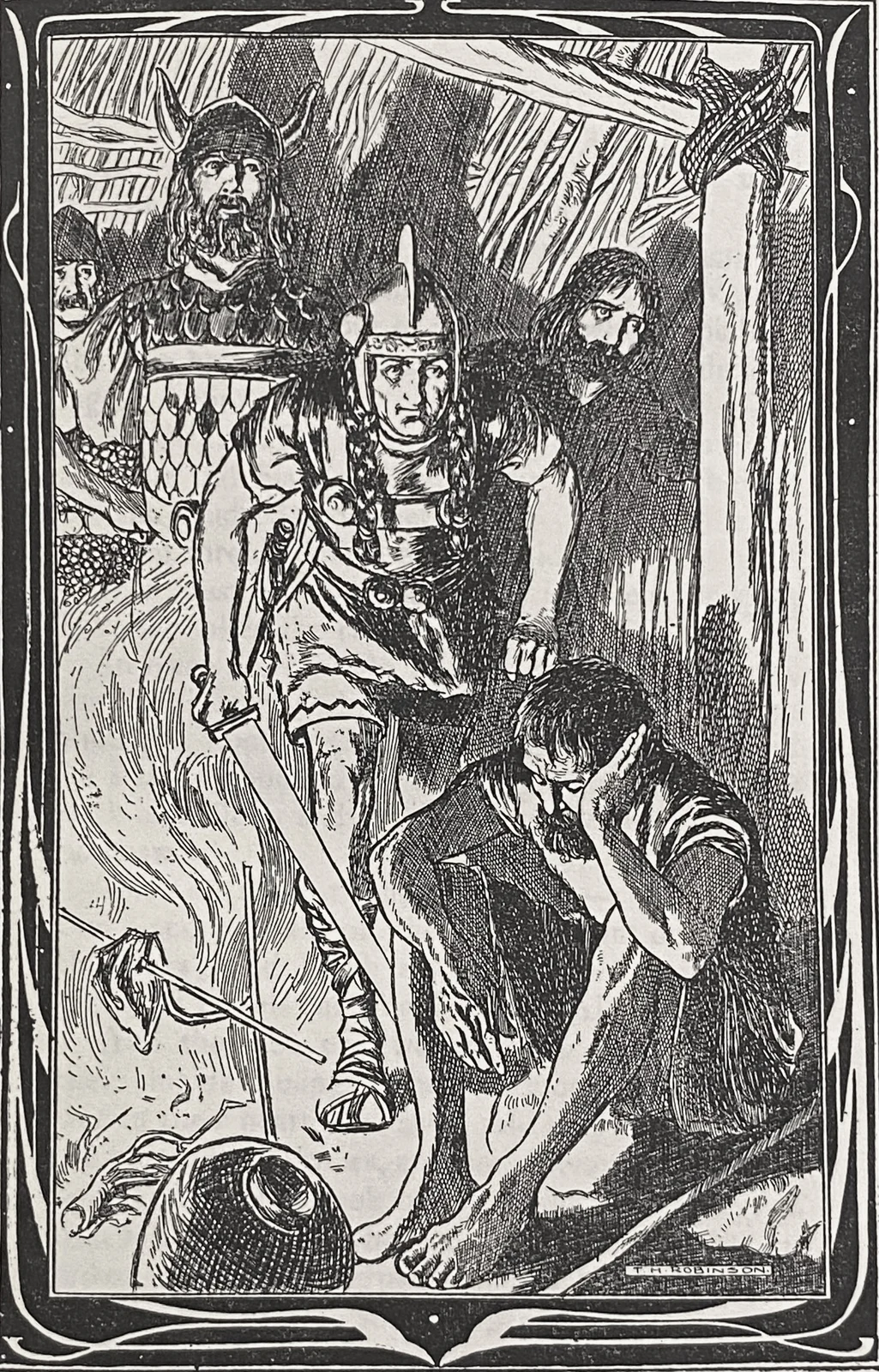
Völund sleeps by the fire as King Níðuðr’s men approach, Thomas Heath Robinson, 1903
The sleeping smith occupies the foreground while the king’s men enter his dwelling. This is Robinson’s illustration of Boult’s retelling of Völund’s capture; the men’s horned helmets and other clothing are artistic choices, not evidence of historical Norse armour.
Overview
The prose introduction to The Lay of Volund calls Völund one of three sons of a king of the Finns, hunting on snowshoes and settling at Ulfdal. The brothers find three flax-spinning women with swan plumages, identified in that introduction as Valkyriur. Völund lives with Hervor-Alvit; when the women depart, his brothers seek their partners, but he remains making rings and waiting. The prose says seven years together, while the verse distinguishes seven winters, longing in the eighth and separation in the ninth. The poem also calls him the Alfar’s companion and chief, language that coexists with rather than erases the introduction’s royal ancestry.
King Nidud’s men seize him after taking one of the seven hundred rings from a cord in his house. Völund first believes the missing ring means his partner has returned, then wakes fettered. The king takes his sword and gives the ring to Bodvild. Following the queen’s advice, his captors disable his legs and isolate him on Sævarstad, compelling him to manufacture jewellery. Craft skill therefore becomes the means of exploitation and revenge, rather than simply a list of admired treasures.
Völund kills the king’s two sons and secretly fashions gifts from their remains. Bodvild later brings the broken ring for repair; he gives her beer until she sleeps, and the final disclosure says that she is pregnant. Her own concluding words state that she could neither resist nor prevail against him. The episode therefore should not be retold as an uncomplicated romance despite Thorpe’s earlier lover terminology. Before explaining his revenge, Völund obtains the king’s promise not to kill the woman or the child.
The smith rises laughing into the air, out of reach of capture or arrows, while Nidud remains below in grief. This poem supplies flight but does not describe construction of feathered wings or a mechanical flying device. Its ending shifts to the king questioning Bodvild and her account of powerlessness. Völund’s supernatural association, captivity, violence and escape all remain in view; no universal bodily size or craft morality is inferred for elves as a whole.
Origins & earliest records
This profile follows Benjamin Thorpe’s English rendering of the selected Eddic poem, reproduced in the Norroena Society’s 1906 Elder and Younger Eddas. The edition’s title attributes the Elder Edda to Sæmund, but that publication attribution is not proof that he composed or collected this particular poem.
Records & interpretation
The Lay of Volund supplies a continuous named encounter in prose introduction and stanzas 1–39, pp. 121–127. The poem and its prose framing are distinguished from the translator’s numbered explanatory notes.
Selected bibliography
Documented works and useful reading. This is not a list of every appearance.
- 01
The Lay of Volund, prose introduction and stanzas 1–39, pp. 121–127
Complete poem and its printed framing and footnotes read. Translator interpretations are not silently promoted to facts of the verse.
Family & connections
A source-supported family tree or inspiration record has not yet been compiled for this profile. Related reading below indicates a connection in subject matter, not a proven lineage or creative influence.
References
Sources supporting this profile. Linked pages have their own scope and editorial standards.
- Primary poetic translationThorpe: The Lay of Volund in the 1906 editionResearch access: 2026-10-05
Image credits
Historical illustrationVölund sleeps by the fire as King Níðuðr’s men approach, Thomas Heath Robinson, 1903
The sleeping smith occupies the foreground while the king’s men enter his dwelling. This is Robinson’s illustration of Boult’s retelling of Völund’s capture; the men’s horned helmets and other clothing are artistic choices, not evidence of historical Norse armour.