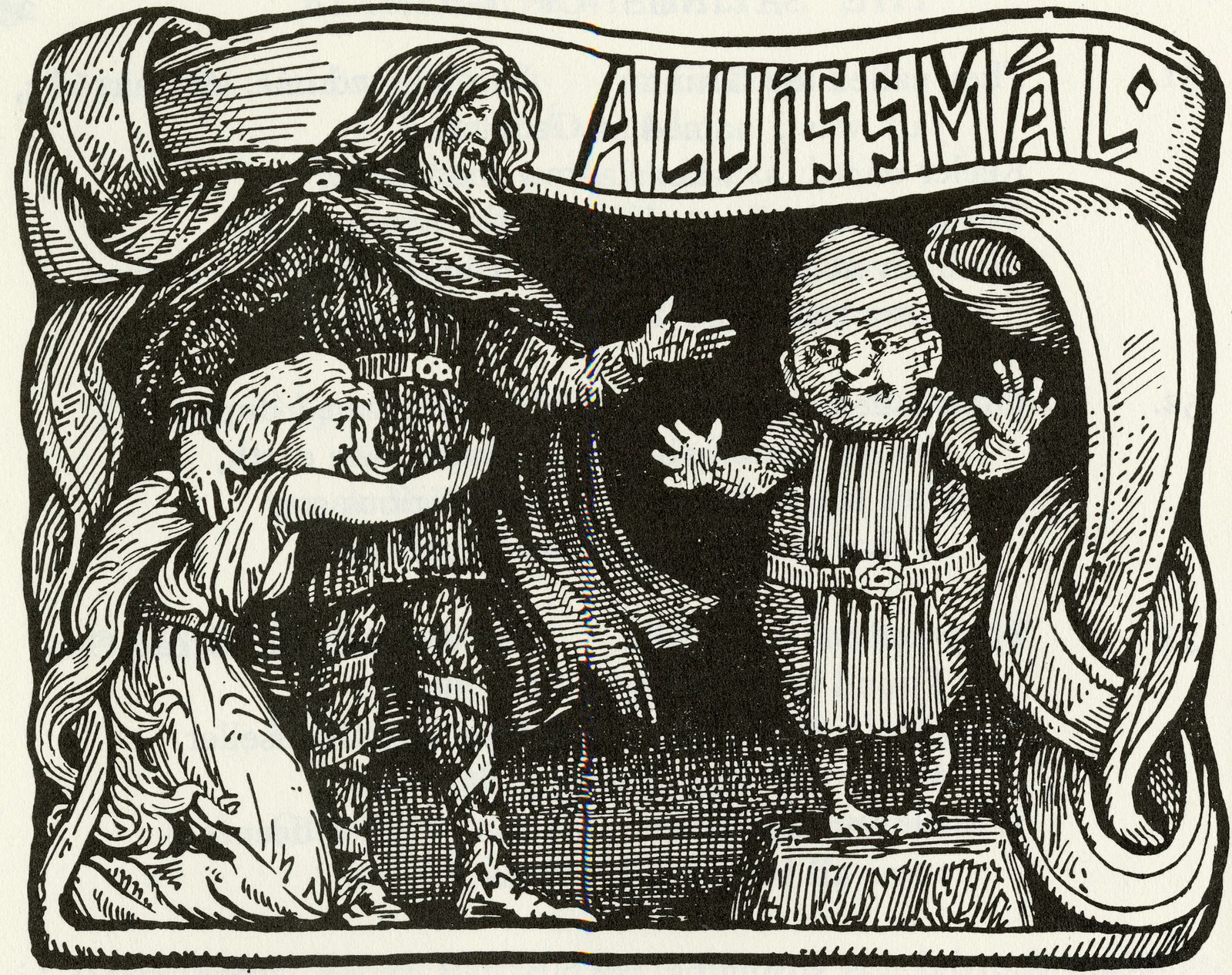
Alvíss answers Thor beside the suitor’s intended bride, W. G. Collingwood, 1908
Collingwood shows the small suitor on a rock, answering Thor while the maiden stands beside her father. His stature, dress and the figures’ arrangement are the illustrator’s choices for this knowledge contest.
Overview
The Lay of the Dwarf Alvis begins with preparations for a marriage that the suitor believes has been promised. Thor challenges his pallor and compares him to the Thursar; Alvíss identifies himself and says that he lives beneath the earth, under rock. Thor rejects the promise because it was given while he was absent and asserts his paternal authority over the maiden. Alvíss does not initially recognise his opponent, but continues seeking consent after Thor identifies himself. The poem’s daughter remains unnamed in the dialogue; Thorpe’s footnote identifies her as Thrud by reference to Skáldskaparmál, a separate textual connection.
Thor offers a test: the suitor must explain the names used for familiar things in every world. Alvíss claims to have travelled all nine worlds and answers successive questions about earth, heaven, moon, sun, clouds, wind, calm, sea, fire, forest, night, grain and ale. His answers distinguish vocabulary attributed to humans, gods, giants, elves, dwarfs and other powers. The knowledge is largely linguistic, so the scene is more than a contest of physical strength or a catalogue of magical objects.
In the final stanza Thor praises the abundance of ancient lore but reveals that he has deceived his guest: the dwarf is above ground at dawn and sunlight already shines in the hall. Thorpe’s rendered stanza stops at that disclosure; it does not narrate a body turning to stone. Petrification is a familiar interpretation illustrated elsewhere, but belongs to a separately identified witness rather than an additional action supplied to this verse.
Origins & earliest records
This profile follows Benjamin Thorpe’s English rendering of the selected Eddic poem, reproduced in the Norroena Society’s 1906 Elder and Younger Eddas. The edition’s title attributes the Elder Edda to Sæmund, but that publication attribution is not proof that he composed or collected this particular poem.
Records & interpretation
The Lay of the Dwarf Alvis supplies a continuous named encounter in stanzas 1–36, pp. 57–62. The poem and its prose framing are distinguished from the translator’s numbered explanatory notes.
Additional images
 View larger
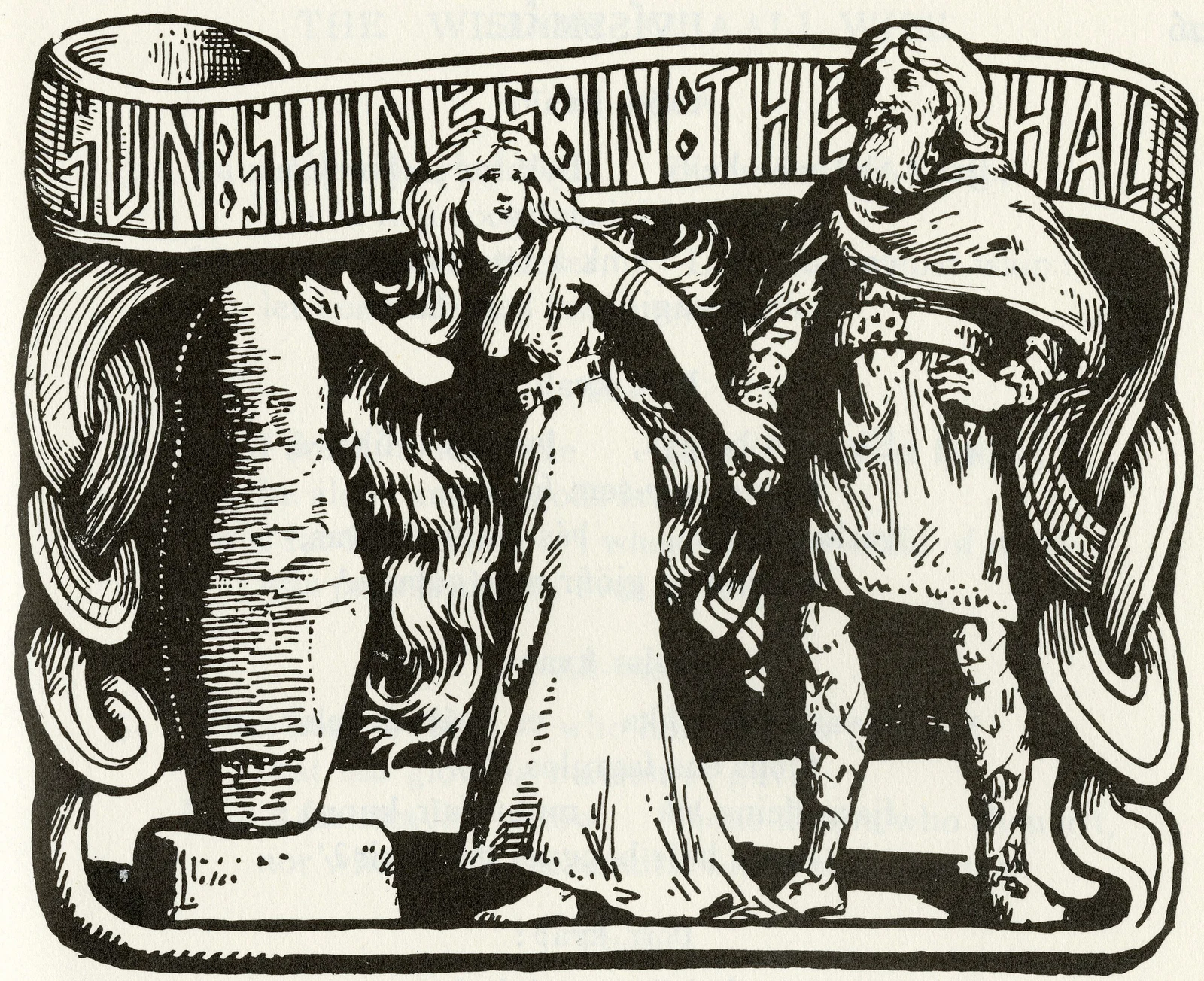
 A stone-shaped Alvíss stands before Thor and the maiden at sunrise, W. G. Collingwood, 1908
Collingwood interprets Alvíss’s exposure to daylight as petrification. The carved stone-like figure belongs to this 1908 illustration; Thorpe’s final stanza announces the dawn without explicitly narrating a transformation into stone.
Selected bibliography
Documented works and useful reading. This is not a list of every appearance.
- 01
The Lay of the Dwarf Alvis, stanzas 1–36, pp. 57–62
Complete poem and its printed framing and footnotes read. Translator interpretations are not silently promoted to facts of the verse.
Family & connections
A source-supported family tree or inspiration record has not yet been compiled for this profile. Related reading below indicates a connection in subject matter, not a proven lineage or creative influence.
References
Sources supporting this profile. Linked pages have their own scope and editorial standards.
- Primary poetic translationThorpe: The Lay of the Dwarf Alvis in the 1906 editionResearch access: 2026-10-05
Image credits
Historical illustrationAlvíss answers Thor beside the suitor’s intended bride, W. G. Collingwood, 1908
Collingwood shows the small suitor on a rock, answering Thor while the maiden stands beside her father. His stature, dress and the figures’ arrangement are the illustrator’s choices for this knowledge contest.
Further credits appear with each additional image.