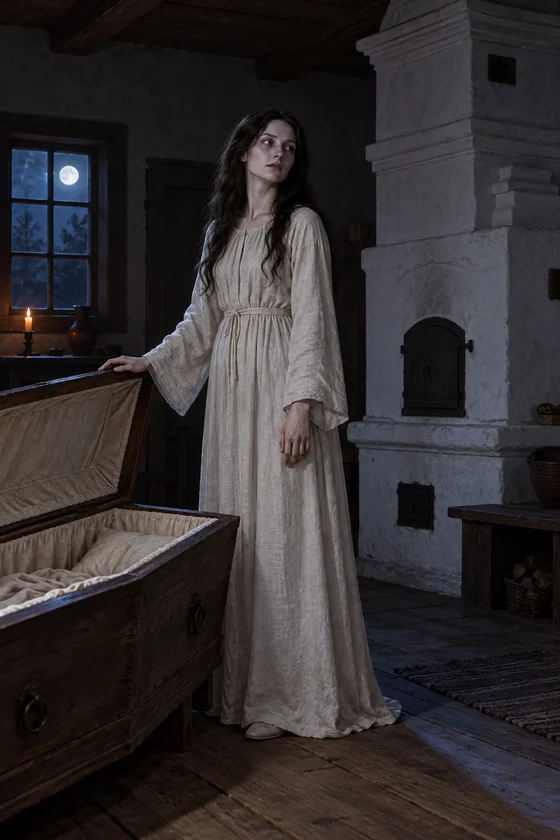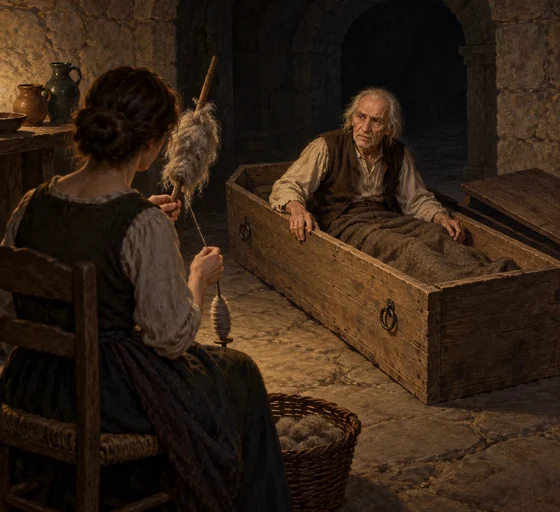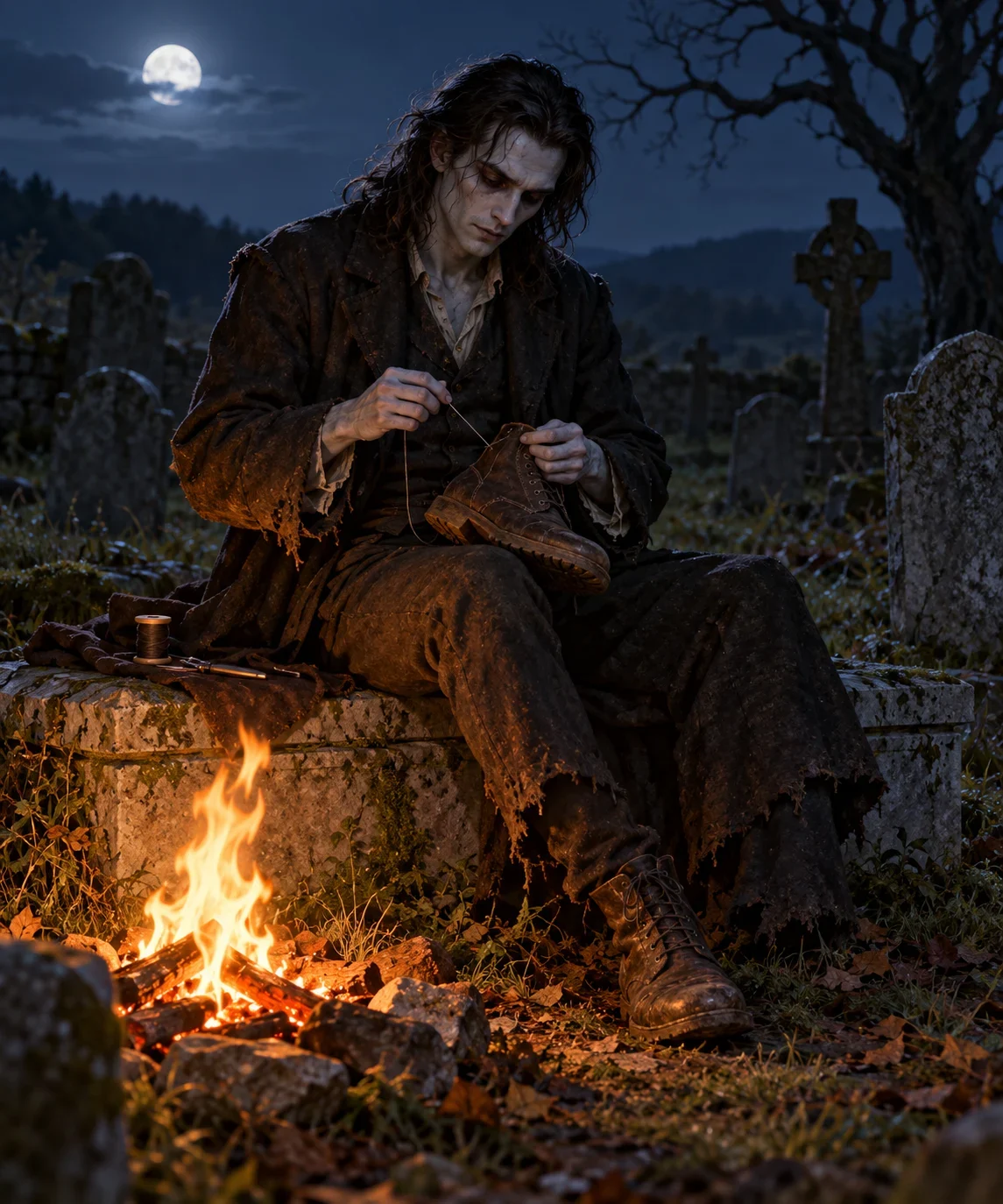
AI-generated interpretation of the warlock sewing boots by a graveyard fire before the wedding. Appearance, clothing, tools, grave and staging are imagined; no blood-taking or later pyre is depicted.
AI-generated interpretation of the warlock sewing boots by a graveyard fire before the wedding. Appearance, clothing, tools, grave and staging are imagined; no blood-taking or later pyre is depicted.
Overview
A soldier on furlough visits a miller near his native village. The miller warns that a dead warlock leaves his grave at night, but the soldier continues home. Passing the cemetery, he finds the revenant sewing boots beside a fire on a grave. Their first encounter is conversational rather than an immediate ambush: the warlock puts aside his work and invites him to a village wedding.
After drinking at the celebration, the warlock drives the other guests away and places the bride and bridegroom in a sleep. He pierces their hands with an awl and stores their blood in two phials. He tells the soldier that they will be found dead and that restoring their own blood through cuts in their heels will revive them. The bridegroom’s blood is in his right pocket and the bride’s in his left. This account therefore specifies instruments and separate stored blood; it does not say he bites with fangs or drinks directly from their throats.
On the return journey he boasts about his power and discloses another vulnerability. Burning him on a pyre of a hundred loads of aspen is insufficient unless every escaping creature is caught and burned too. Snakes, worms and other crawling creatures will emerge, while crows, magpies and jackdaws will arrive; even a surviving maggot could provide his escape. The warning makes complete containment part of the narrated destruction, rather than presenting one stake or a mere bonfire as a universal remedy.
At the grave the warlock attacks the soldier to prevent disclosure. The soldier fights with his sword and is nearly exhausted when cockcrow leaves the attacker motionless. Taking the phials, he returns home and later restores the newlyweds as instructed. He then gathers the villagers and the aspen wood. They burn the corpse and all the emerging or arriving creatures, after which the soldier scatters the ashes. The story ends with peace in the village, communal thanks and his eventual comfortable retirement after returning to service.
Ralston’s source note identifies Afanasief V, pp.144–147, from the Tambof Government. His ensuing general discussion of vampire belief is a separate comparative argument, not proof that every regional revenant has this warlock’s abilities. As historical vampire context, the tale can be contrasted with Tolkien’s separately documented bat-shaped creatures; it supplies no evidence for Tolkien consulting this episode and does not transfer boots, phials, bodily origin or destruction rules into Middle-earth.
Origins & earliest records
Complete The Soldier and the Vampire, pp.318–322, in the retained Hurst printing of Ralston’s Russian Fairy Tales. Source note412 gives Afanasief V,pp.144–147, Tambof Government; the original Russian publication was not collated.
Records & interpretation
Complete English narrative, immediate framing and note412 inspected. The tale attests a collected revenant narrative, not verified resurrection, blood medicine or evidence that historical deaths were supernatural. The account describes blood collection but not an explicit act of drinking.
Selected bibliography
Documented works and useful reading. This is not a list of every appearance.
- 01
Russian Fairy Tales, The Soldier and the Vampire, pp.318–322
Complete narrative; note412 cites Afanasief V,pp.144–147, Tambof Government. Adjacent generalization remains the compiler’s argument.
Family & connections
A source-supported family tree or inspiration record has not yet been compiled for this profile. Related reading below indicates a connection in subject matter, not a proven lineage or creative influence.
References
Sources supporting this profile. Linked pages have their own scope and editorial standards.
- Primary collected English translationRalston, Russian Fairy Tales, retained Hurst witnessResearch access: 2026-10-27
Image credits
AI-generated interpretation of the cited historical narrativeAI-generated interpretation of the warlock sewing boots by a graveyard fire before the wedding. Appearance, clothing, tools, grave and staging are imagined; no blood-taking or later pyre is depicted.
AI-generated interpretation of the warlock sewing boots by a graveyard fire before the wedding. Appearance, clothing, tools, grave and staging are imagined; no blood-taking or later pyre is depicted.