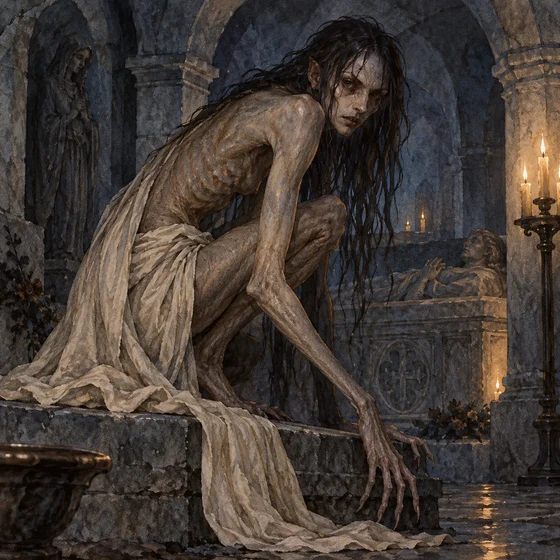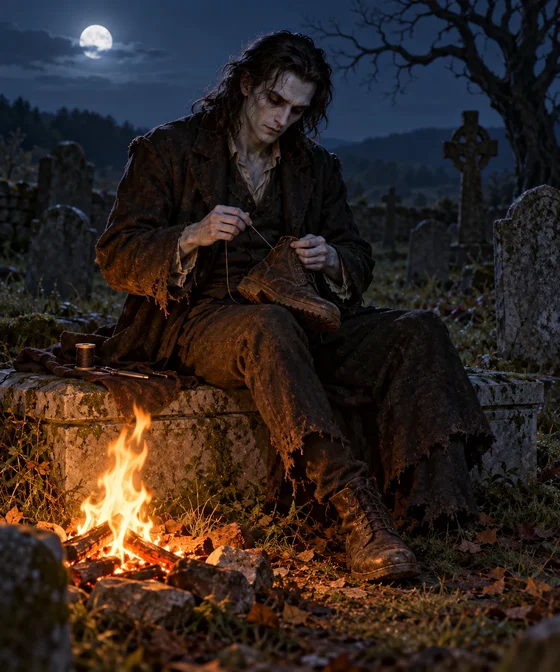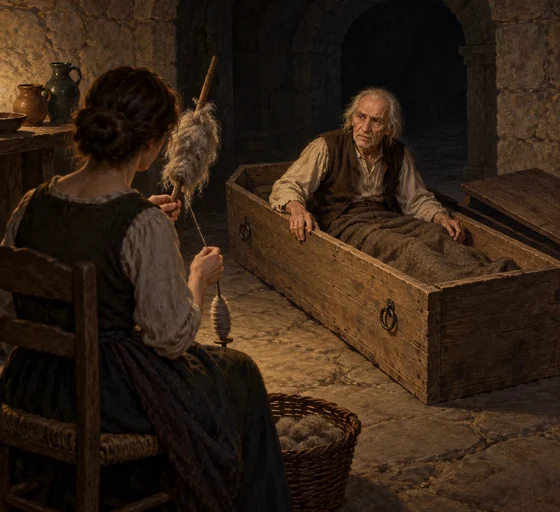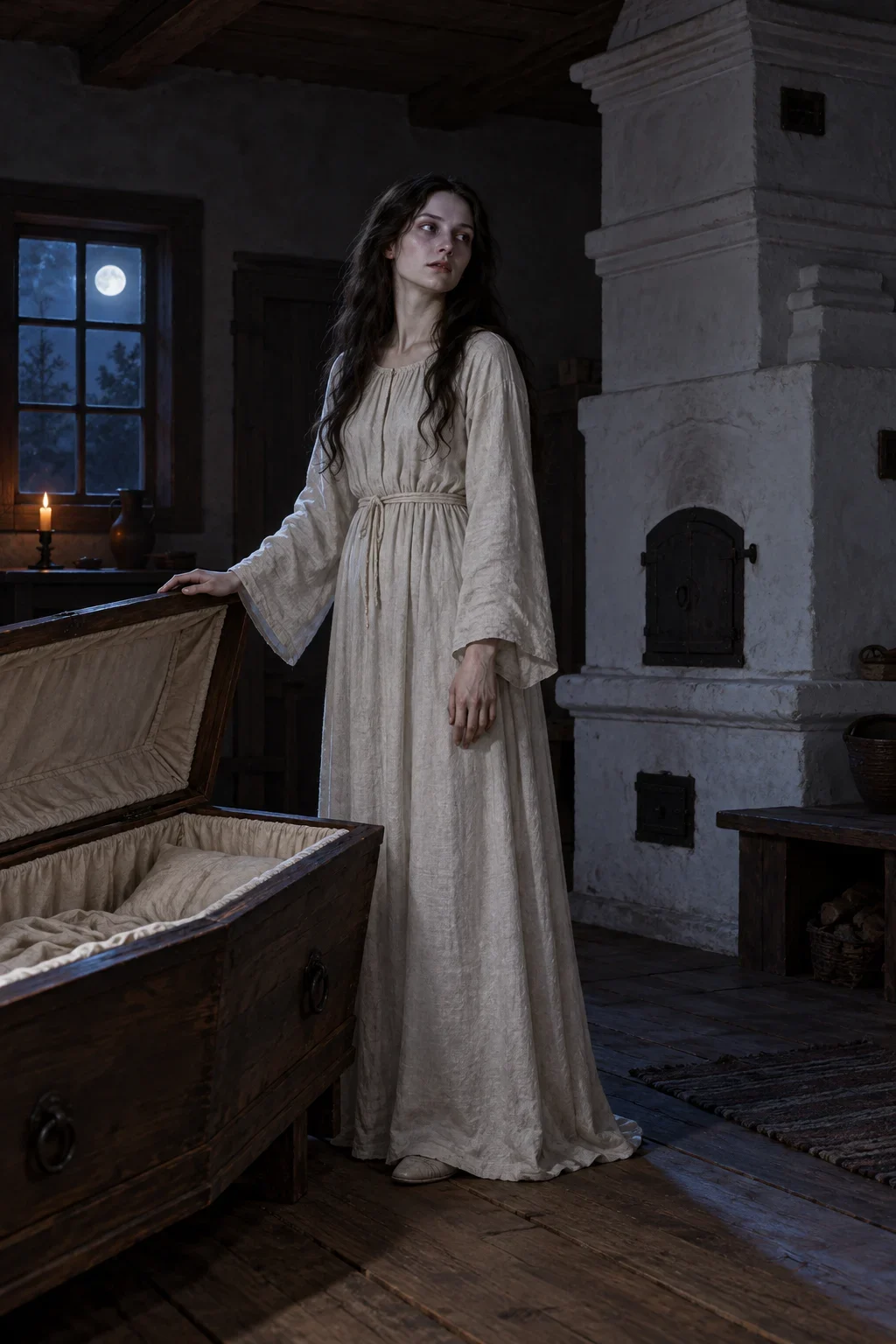
AI-generated interpretation of the first corpse-watch in Ralston’s collected tale. The woman’s appearance, clothing, coffin and stove design, pose and lighting are imagined; later watches and pursuit are not combined.
AI-generated interpretation of the first corpse-watch in Ralston’s collected tale. The woman’s appearance, clothing, coffin and stove design, pose and lighting are imagined; later watches and pursuit are not combined.
Overview
A soldier returning to his family near Kiev exchanges a joking challenge with a merchant’s daughter. His grandfather identifies her as a dangerous witch and explains a contest of commands: she can make the soldier her horse, but a quicker reply can turn her into a mare. The soldier follows the advice, bridles her and rides until he has beaten her to death. The story then continues through her corpse, rather than ending with that violent victory or describing a cure that restores an innocent captive.
Her father hires the soldier to read the psalter beside the coffin. The grandfather repeatedly advises him to drink only moderately and gives a different hiding place for each night. At midnight the coffin opens, the witch rises and crowds of devils search for him. On the first night he hides on the stove; on the second, inside it. Cockcrow ends each search, leaving her motionless so that he can return the body to its coffin and resume reading. These are successive watches, not alternative versions of one hiding place.
On the third night he sits on the stove-pipe beneath a large frying-pan. An old devil finally recognizes him and orders a fire lit with a candle-end that has not been blessed. The soldier nearly burns before cockcrow disperses the attackers. He again puts the corpse back and receives payment. The utensil is not an ordinary protective helmet: Ralston’s note explains the Russian skovoroda as a large, handleless stew-pan, while its use here belongs to the grandfather’s particular instructions.
The final task is burial. Three iron hoops surround the coffin; as each snaps, the danger approaches. After the third breaks, the soldier jumps through the wooden arch over the horse’s neck and runs backwards. The witch repeatedly follows the misleading footprints back to the horse. Cockcrow leaves her motionless again, and he buries her before returning for the last payment and a family feast. The ending supplies neither marriage nor permanent restoration to life, and does not explicitly prove that no further return could ever occur.
Ralston introduces this tale as coming from Little Russia and cites Afanasief VII, no.36c, without a separate original title. His following commentary distinguishes corpse-watch stories from blood-driven vampire stories; his comparison with Gogol is editorial framing. The account offers historical context beside The Witcher’s independently documented Striga encounter, but it does not establish that Sapkowski used this tale or that the merchant’s daughter shares Adda’s curse, royal identity or remedy.
Origins & earliest records
Complete selected narrative in Ralston’s Russian Fairy Tales, The Soldier’s Midnight Watch, pp.279–287; introductory framing and notes365–367. The Little-Russian attribution is the collector’s historical wording, not a new border or language claim.
Records & interpretation
The complete English narrative and attached source/utensil notes were inspected. Narrative acts are collected-story claims, not verified transformations or medical advice. The original Russian witness, individual storyteller and date of oral telling remain unverified.
Selected bibliography
Documented works and useful reading. This is not a list of every appearance.
- 01
Russian Fairy Tales, The Soldier’s Midnight Watch, pp.279–287
Afanasief VII,no.36c in note366; note367 explains the handleless skovoroda. Notes365 and following commentary belong to Ralston’s framing.
Family, evolution & connections
Striga (The Witcher)
Ralston’s soldier survives repeated watches over a woman who leaves her coffin at night; the Witcher Striga encounter also turns on resisting a nocturnal coffin-bound threat until dawn. The witch’s mare form, final burial and lack of human restoration remain distinct from Adda’s curable curse. No direct borrowing is established.
References
Sources supporting this profile. Linked pages have their own scope and editorial standards.
- Primary collected English translationRalston, Russian Fairy Tales, retained Hurst witnessResearch access: 2026-10-27
Image credits
AI-generated interpretation of the cited historical narrativeAI-generated interpretation of the first corpse-watch in Ralston’s collected tale. The woman’s appearance, clothing, coffin and stove design, pose and lighting are imagined; later watches and pursuit are not combined.
AI-generated interpretation of the first corpse-watch in Ralston’s collected tale. The woman’s appearance, clothing, coffin and stove design, pose and lighting are imagined; later watches and pursuit are not combined.