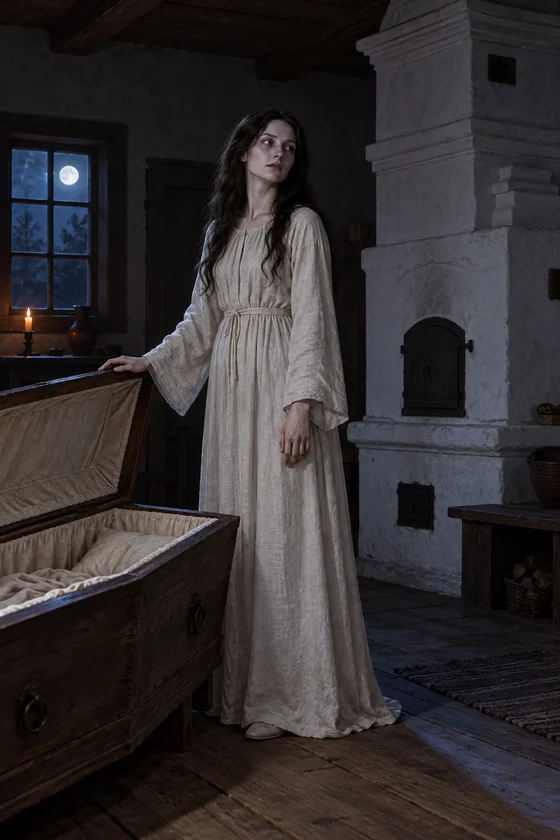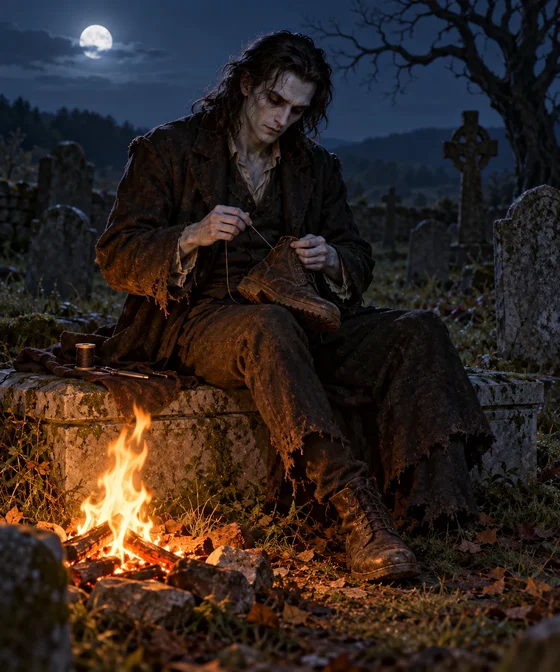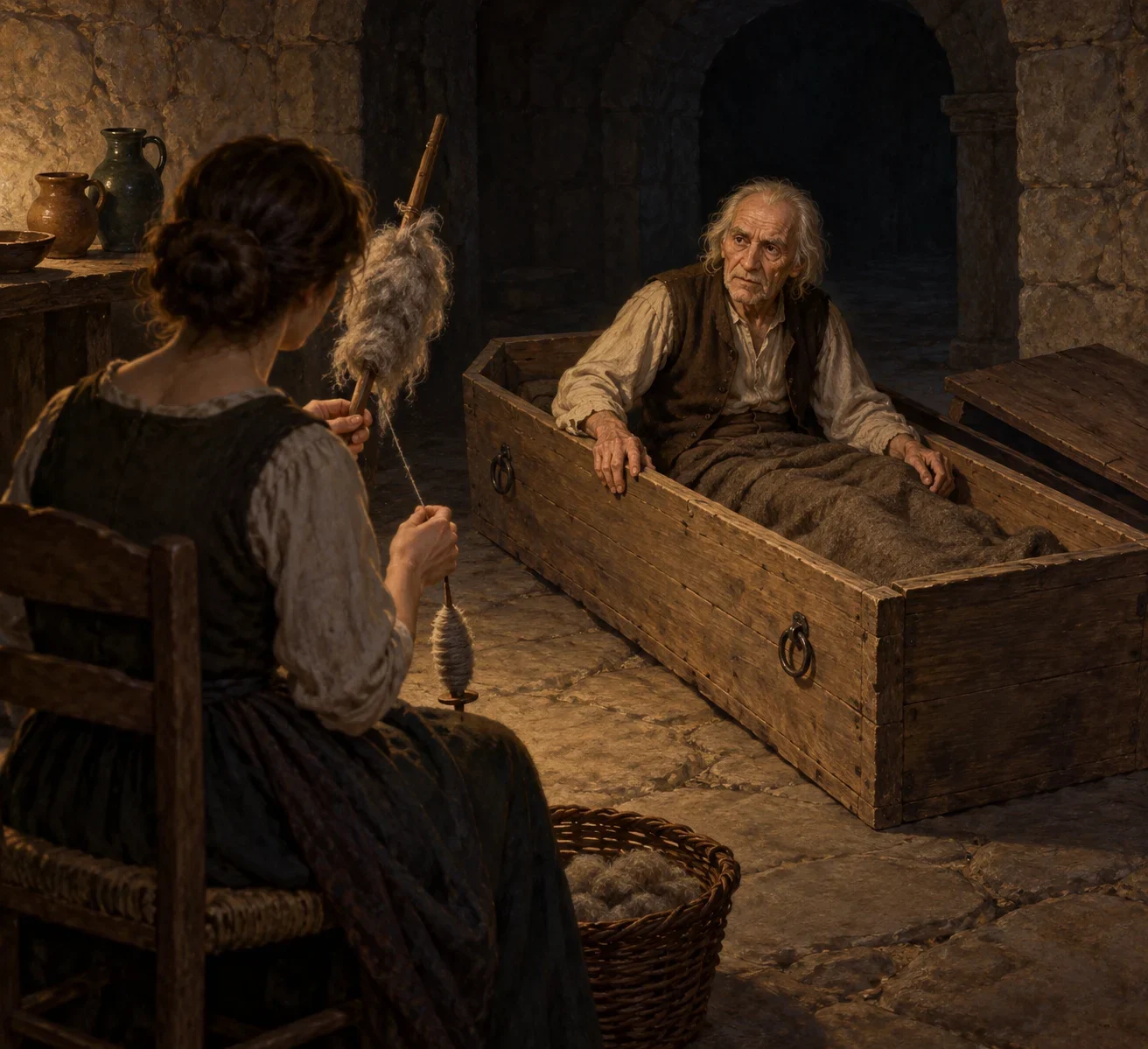
AI-generated interpretation of the coffin conversation before an attack; faces, clothes, stone chamber and furnishings are imagined.
AI-generated interpretation of the coffin conversation before an attack; faces, clothes, stone chamber and furnishings are imagined.
Overview
A long-lived villager, regarded as a koldun or wizard, has three married sons. Before dying he orders their wives to watch his body on three successive nights, one woman each night. His coffin is to stand in the outer chamber, and the watchers must spin grey wool for his caftan. He forbids a cross on his body and tells the women not to wear their own. These instructions establish a household ordeal involving his existing family, rather than a chance traveler hired to guard an unrelated corpse.
At midnight the dead man questions the first watcher about her presence, her seated work, the grey wool and the intended garment. He moves closer as the exchange is repeated. She shrinks into a corner but offers no prayer; he strangles her and returns to his coffin. His sons remove her body and send the next daughter-in-law to obey the same instructions. The second watcher suffers the same fate. The narrative does not describe either victim returning to life or becoming another supernatural being.
The third woman says that she has removed her cross but secretly keeps it. She spins while praying to herself and answers the repeated questions. Just as the warlock is about to rush at her, she lays the cross on him; he falls and dies. Looking into the coffin, she finds a large quantity of money. The narrator explains that he wanted to take it with him, or have it pass only to someone who could surpass him in cunning. The story ends at this discovery, without a further burial, wedding or distribution of the money.
Ralston cites Khudyakof no.104 from the Orel Government. His note explains the outer room as the cold izba, contrasted with the living room. Another note doubts the money episode and speculates that an earlier form might have turned the wizard into gold. That proposed reconstruction is not the event in the translated narrative: the woman finds money in the coffin after overcoming him. The following Highland comparison is likewise editorial comparison, not another episode in this family’s story.
Origins & earliest records
Complete The Warlock, pp.292–293, in Ralston’s Russian Fairy Tales; notes375–377. The Orel Government designation is a historical collector locator, not a modern country claim.
Records & interpretation
Complete retained English narrative and all three attached notes read through the money discovery; following p.294 comparison inspected separately. No original Russian collation or identified oral teller is claimed.
Selected bibliography
Documented works and useful reading. This is not a list of every appearance.
- 01
Russian Fairy Tales: The Warlock
Hurst title page undated; main pp.292–293 and notes375–377. Note377’s gold-transformation suggestion is commentary, not the main ending.
Family & connections
A source-supported family tree or inspiration record has not yet been compiled for this profile. Related reading below indicates a connection in subject matter, not a proven lineage or creative influence.
References
Sources supporting this profile. Linked pages have their own scope and editorial standards.
- Primary collected English translationRalston, Russian Fairy Tales, retained Hurst witnessResearch access: 2026-10-27
Image credits
AI-generated illustrationAI-generated interpretation of the coffin conversation before an attack; faces, clothes, stone chamber and furnishings are imagined.
AI-generated interpretation of the coffin conversation before an attack; faces, clothes, stone chamber and furnishings are imagined.