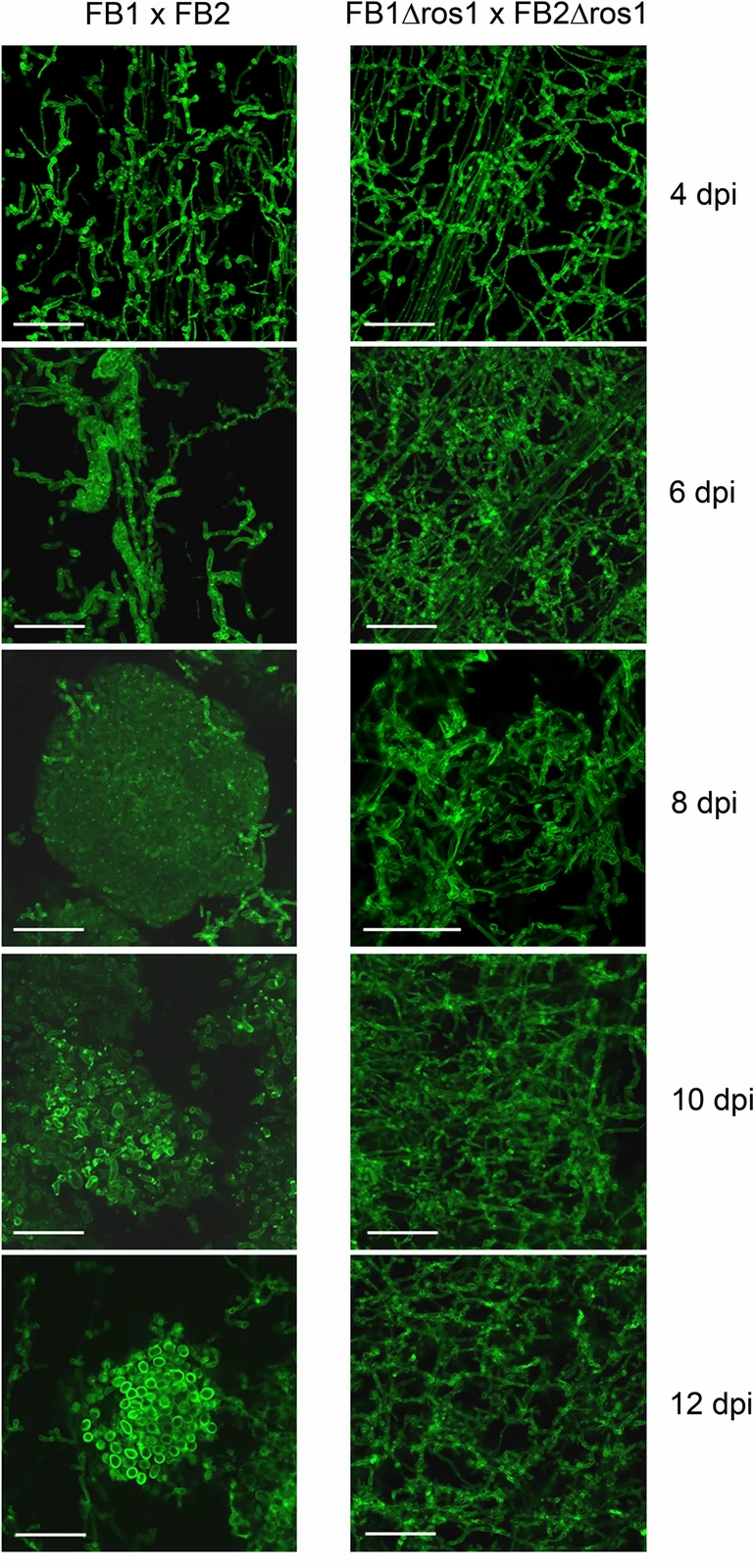
Confocal micrographs comparing wild-type Ustilago maydis with ros1-deletion strains in infected maize tissue, four to twelve days after inoculation, Tollot and colleagues’ 2016 figure 2
The left column shows wild-type strains FB1 and FB2 developing aggregates and spores in infected maize tissue; the right shows ros1-deletion strains remaining filamentous. Rows run from four to twelve days after inoculation. Green is fluorescence from a wheat-germ-agglutinin stain, not the fungus’s natural colour. The white scale bars represent fifty micrometres.
Overview
Ustilago maydis is a basidiomycete fungus that establishes a biotrophic infection in maize: it obtains resources while the colonized plant tissue remains alive. Infected tissues can develop tumours containing proliferating plant cells and fungal hyphae, with dark teliospores forming in affected structures. This host association differs from an infection strategy that simply kills tissue before feeding on it. The selected study examines one part of that relationship, the movement of sucrose across the fungal membrane, rather than providing an exhaustive description of the fungus’s life cycle.
Wahl and colleagues investigated the transporter Srt1 using the experimental strain SG200 and derived mutants. SG200 is a haploid, solopathogenic strain capable of infecting maize without a mating partner; its laboratory behaviour should not be taken as a description of every natural isolate. Deleting srt1 markedly reduced tumour symptoms in the tested maize infections. The mutant could still colonize plant tissue and grew normally on the tested artificial media. Restoring a functional copy of the gene restored disease development, strengthening the connection between transporter loss and the symptom phenotype.
Expression measurements and a fluorescent fusion protein showed that srt1 was strongly induced during growth inside the plant, with transcript expression peaking four to eight days after infection. The protein localized at the fungal cell surface. To test transport more directly, the researchers expressed it in selected Saccharomyces cerevisiae strains and measured uptake of labelled sugars. These heterologous experiments supported high-affinity, energy-dependent sucrose transport and unusually narrow substrate specificity. The yeast experiments establish a biochemical capability under controlled conditions, rather than directly measuring every carbon flux inside an infected maize plant.
A further replacement experiment used the Arabidopsis thaliana sucrose transporter AtSUC9. Under growth-chamber conditions it restored the virulence of the fungal deletion strain, supporting sucrose acquisition as an important function. The researchers cautioned that performance in a more competitive field environment could differ. They also proposed that direct sucrose uptake could reduce extracellular production of glucose signals associated with plant defence. That signal-avoidance explanation is distinct from the demonstrated uptake and complementation results. The experiments identify a contribution to pathogenic development without reducing the entire host–fungus interaction to one transporter or proving that its absence prevents every stage of infection.
Origins & earliest records
A living plant-associated fungus represented by SG200 and engineered derivatives in the selected study.
Evidence & interpretation
Gene deletion and restoration, infection symptoms, expression/localization and heterologous sugar-transport assays support complementary conclusions. Field performance and proposed signal avoidance remain less directly tested.
Selected bibliography
Documented works and useful reading. This is not a list of every appearance.
- 01
A Novel High-Affinity Sucrose Transporter Is Required for Virulence of the Plant Pathogen Ustilago maydis
PLOS Biology 8(2): e1000303, 9 February. Complete main report, Methods and main captions. Creative Commons Attribution licence; DOI 10.1371/journal.pbio.1000303.
Family, evolution & connections
Zea mays — maize
Wahl and colleagues study corn smut in living maize tissue. The fungus induces tumours and draws on host carbohydrates; its dependence on living tissue distinguishes this sampled interaction from feeding on an already dead plant. This is a host–pathogen relationship, not shared biological descent.
References
Sources supporting this profile. Linked pages have their own scope and editorial standards.
- ResearchSrt1 transport and maize infection experimentsResearch access: 2026-10-05
Image credits
Scientific fluorescence micrograph compositeConfocal micrographs comparing wild-type Ustilago maydis with ros1-deletion strains in infected maize tissue, four to twelve days after inoculation, Tollot and colleagues’ 2016 figure 2
The left column shows wild-type strains FB1 and FB2 developing aggregates and spores in infected maize tissue; the right shows ros1-deletion strains remaining filamentous. Rows run from four to twelve days after inoculation. Green is fluorescence from a wheat-germ-agglutinin stain, not the fungus’s natural colour. The white scale bars represent fifty micrometres.