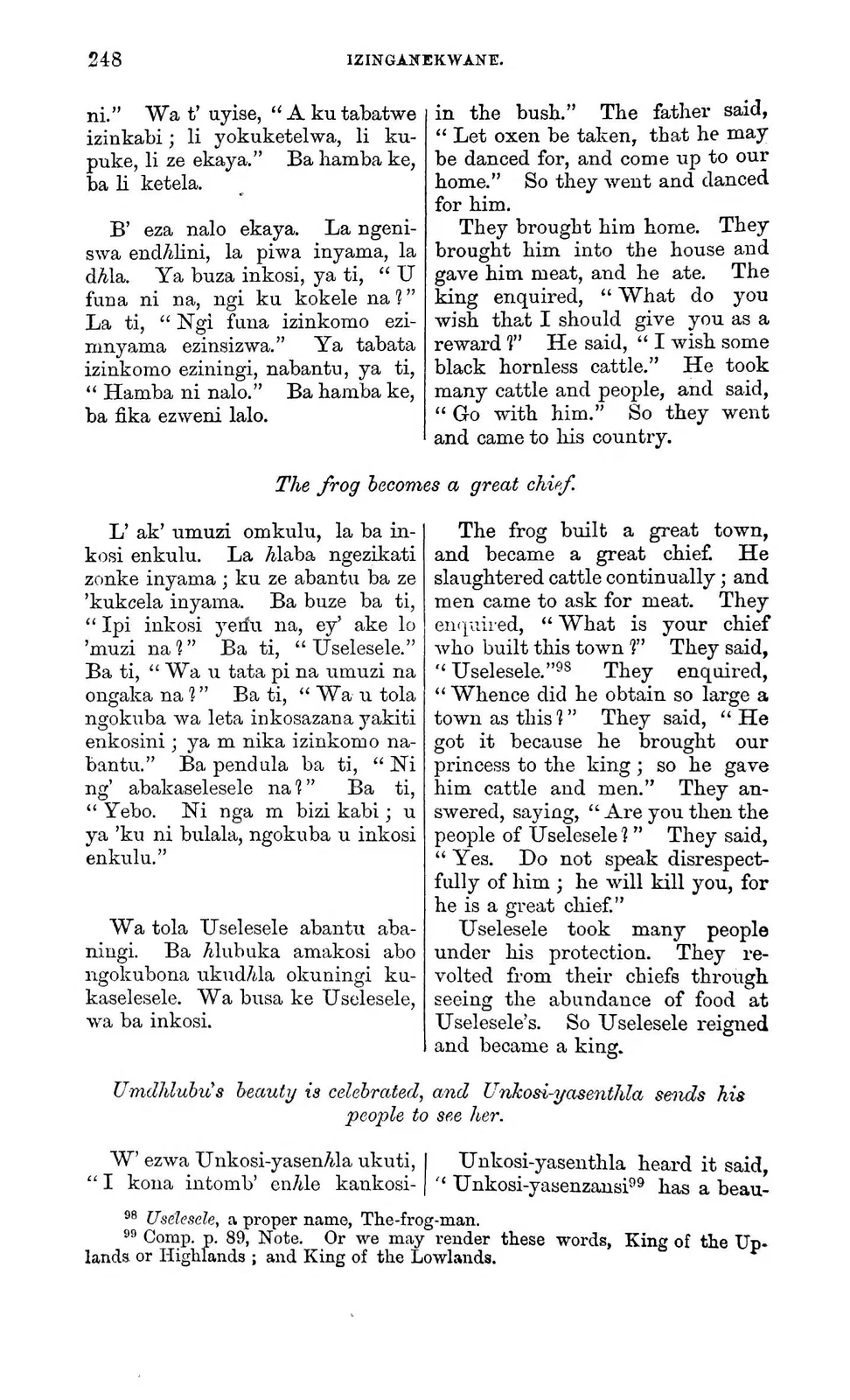
Uselesele, Umdhlubu’s Frog Rescuer: documentary text witness, Callaway 1868, printed page 248; documentary source-page facsimile
Frog rescuer becomes a chief; note 98 glosses Uselesele as the proper name Frog-man. Individually inspected original bilingual Zulu/English scanned page; documentary text, no creature illustration claimed. Physical edition 1868; translator/editor distinguished from traditional narrators. Public-domain publication and expired Callaway lifetime.
Overview
Umdhlubu, a princess lost as a child, is brought up by another queen beside that queen’s son. When they are pressed to marry she learns that she is a foundling, but continues to regard him as her brother. Crying beside a river, she encounters a very large frog that asks what troubles her. It tells her to collect her treasured ornaments and offers to take her to her own people. The frog swallows the possessions and then the princess, carrying both unharmed rather than consuming them as food.
Young men, older men and cattle-herding boys repeatedly threaten to kill it because of its size. It explains that it carries Umdhlubu home and must be spared. Her half-brother and her own brother hear the name and relent, moved by the memory of their lost sister. Near the family village it releases the girl and her belongings in a bush, cleanses and anoints her, and dresses her in her ornaments. She goes ahead to confront her mother, who at first takes her for a stranger and speaks of the daughter she believes dead.
Recognition brings public rejoicing but also dismay among rival queens who had hoped to secure their children’s supremacy. The messengers call Umdhlubu risen from death, while the narrative has already shown her living and growing up elsewhere. Her father celebrates with increasing cattle gifts, then asks how she came home. When she identifies the frog still waiting in the bush, he sends oxen and people to dance in its honour and bring it into his house.
The frog eats the meat offered and requests black hornless cattle as its reward. The king gives cattle and followers, who accompany it to its own country. It builds a great town and continually slaughters animals to feed visitors. The abundance attracts people who leave their former chiefs, and it becomes a ruler. Its followers warn newcomers not to speak disrespectfully of Uselesele, saying that the chief will kill them. Thus the grateful helper becomes a powerful political figure in the ending. Callaway’s note 98 glosses its name as the frog-man; no scene removes a skin or reveals a human prince.
Origins & earliest records
The complete account credits Mary (Umkampengula). Callaway translates it and compares other helpful frogs in notes; those other tales are not versions automatically attributed to Mary.
Records & interpretation
Umdhlubu and the Frog, complete pp. 237–253; helpful frog and safe swallowing pp. 240–241, repeated threatened encounters pp. 241–243, release p. 243, reward and rule pp. 247–248; closing credit p. 253.
In the literature
“The frog built a great town, and became a great chief.”
Umdhlubu and the Frog, printed p.248 · Henry Callaway
After rescuing the princess, the frog receives cattle and people, builds a town and becomes a ruler.
Selected bibliography
Documented works and useful reading. This is not a list of every appearance.
- 01
Nursery Tales, Traditions, and Histories of the Zulus, in Their Own Words, volume I
Umdhlubu and the Frog, complete pp. 237–253; Uselesele proper-name gloss note 98, p. 248.
- 02
Nursery Tales, Traditions, and Histories of the Zulus — Umdhlubu and the Frog
HenryCallaway, Nursery Tales, Traditions, and Histories of the Zulus, VolumeI, Springvale,Natal:JohnA.Blair1868; bilingual Princeton scan. Complete English UmdhlubuAndTheFrog237–253 read; original248/253 visually checked, including name gloss98 and Mary(Umkampengula) signature. Following Girl-King appendix not claimed as complete reading.
Family & connections
A source-supported family tree or inspiration record has not yet been compiled for this profile. Related reading below indicates a connection in subject matter, not a proven lineage or creative influence.
Located primary passages
Specific passages supporting details in this entry, grouped by their published witness.
Nursery Tales, Traditions, and Histories of the Zulus, in Their Own Words, volume I
HenryCallaway, Nursery Tales, Traditions, and Histories of the Zulus, VolumeI, Springvale,Natal:JohnA.Blair1868; bilingual Princeton scan. Complete English UmdhlubuAndTheFrog237–253 read; original248/253 visually checked, including name gloss98 and Mary(Umkampengula) signature. Following Girl-King appendix not claimed as complete reading.
- Rival wives arrange an outing during which a favoured child is forgotten. Another queen finds and nurses her alongside a son; the pair resist a proposed marriage because they regard each other as siblings. At the river a great speaking frog offers to restore the girl to her own people, swallows her belongings and the girl without killing her, survives encounters through explanation, and releases and prepares her near home. She is recognised and reunited with her parents. The father rewards the frog with black hornless cattle and people; he builds a town, attracts followers and becomes a king under the proper name Uselesele. The remaining tale marries Umdhlubu to another king and completes her town and diplomatic return.
Umdhlubu and the Frog, complete printed pp.237–253, especially241–248; gloss98/signature253
The foundling remained alive; characters’ resurrection language expresses their earlier assumption rather than a narrated actual death. No human transformation is stated for the frog, and Uselesele is a proper name glossed The-frog-man, not a generic species label. Foster siblinghood differs from biological brotherhood; no song or marriage prayer copied.
References
Sources supporting this profile. Linked pages have their own scope and editorial standards.
- Attributed primary narrative with translation; digitized bilingual editionCallaway bilingual edition — Umdhlubu and the Frog, pp. 237–253Research access: 2026-10-05
Image credits
Historical text facsimileUselesele, Umdhlubu’s Frog Rescuer: documentary text witness, Callaway 1868, printed page 248; documentary source-page facsimile
Frog rescuer becomes a chief; note 98 glosses Uselesele as the proper name Frog-man. Individually inspected original bilingual Zulu/English scanned page; documentary text, no creature illustration claimed. Physical edition 1868; translator/editor distinguished from traditional narrators. Public-domain publication and expired Callaway lifetime.