Ungaikyō
Image associated with the exact linked encyclopedia article; consult credited file description for its interpretation.
Overview
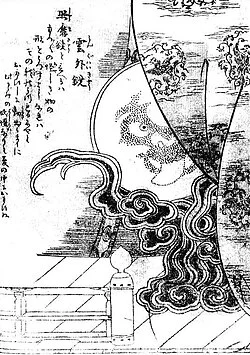
Ungaikyō is a mirror yōkai represented by Sekien in Hyakki Tsurezure Bukuro. A face occupies the reflective surface, while the stand suggests a body or limbs. The mirror's ordinary function already creates an image of a viewer; the transformation makes that image seem to possess an independent expression. The result is a distinctive object apparition whose visual identity is firmer than many expanded modern descriptions of its abilities.
Mirrors have wider religious and literary associations, but those histories do not mean that every sacred mirror is ungaikyō. Later commentary commonly groups the character with tsukumogami, and some accounts connect it with revealing or retaining supernatural appearances. This entry records the named plate and the face-bearing object while leaving specific magical operations to separately sourced accounts. It makes no claim that an actual reflective surface stores a living monster.
Origins & earliest records
Selected historical witness: Hyakki Tsurezure Bukuro (1784) by Toriyama Sekien. The linked library record identifies a surviving printed edition; it does not establish when the belief first arose.
Records & interpretation
The historical illustration and individual contextual reference support this profile. Named motifs, local narratives and later explanations are distinguished; image-to-plate matching still needs review.
Selected bibliography
Documented works and useful reading. This is not a list of every appearance.
- 01
Hyakki Tsurezure Bukuro
Selected historical witness; individual illustration now checked in the separately linked primary scan. This edition is not a claim of the earliest oral attestation.
Family & connections
A source-supported family tree or inspiration record has not yet been compiled for this profile. Related reading below indicates a connection in subject matter, not a proven lineage or creative influence.
Primary records and illustrations
Gazu Hyakki Tsurezure Bukuro
Volume 3; Smithsonian Libraries digitized copy. IIIF canvas index 5 (zero-based); HyakkitsurezureV3Tori_0006.jp2
Printed label 雲外鏡; a round mirror contains a monster face while cloudlike lines curl below it. Illustration directly inspected; no complete transcription of cursive explanatory text is claimed.
Encyclopedia background
An additional attributed reference, separate from the editorial profile above.
Read the open encyclopedia overview
The ungaikyō (雲外鏡、うんがいきょう; "mirror beyond the clouds") is a yōkai in Japanese folklore or fiction, a type of mirror monster.
The monster is depicted in the Gazu hyakki tsurezure bukuro (1784), a collection of yōkai paintings by the Edo period ukiyo-e artist Toriyama Sekien.
Modern commentary considers it an example of a tsukumogami or possessed object often depicted with faces, etc., and the ability to maneuver.
Text from Wikipedia contributors, “Ungaikyō”. CC BY-SA 4.0. Extracted introduction; formatting changed. Retrieved 5 October 2026. The source article may have changed since retrieval.
References
Sources supporting this profile. Linked pages have their own scope and editorial standards.
- Primary illustration / library recordHyakki Tsurezure Bukuro — historical library editionResearch access: 2026-10-05
- Secondary referenceUngaikyō — contextual overview and bibliographyResearch access: 2026-10-05
- Primary illustrated plate / institutional digitizationGazu Hyakki Tsurezure Bukuro — directly inspected IIIF canvas index 5 (zero-based); HyakkitsurezureV3Tori_0006.jp2Research access: 2026-10-05
Image credits
Historical illustrationUngaikyō
Image associated with the exact linked encyclopedia article; consult credited file description for its interpretation.