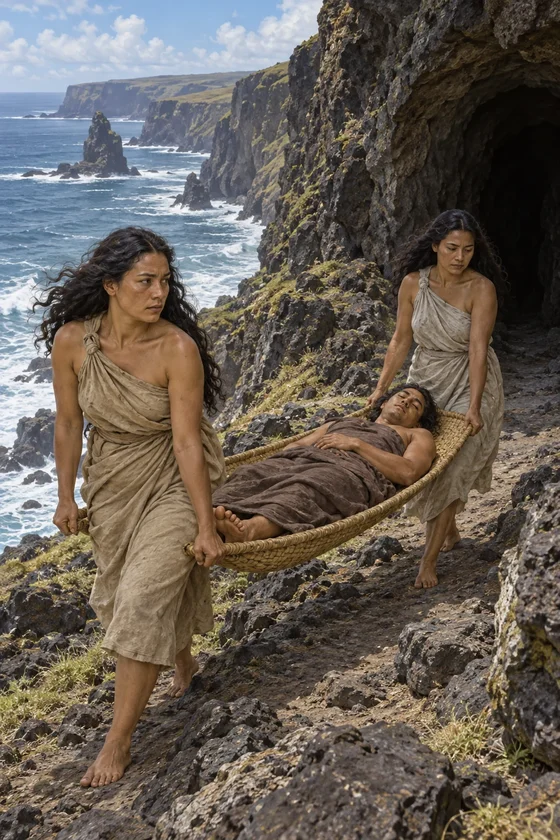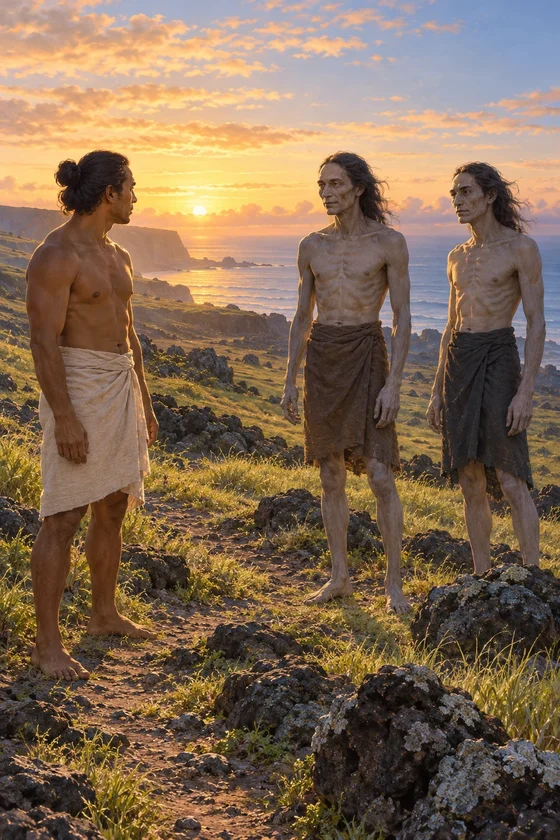
AI-generated interpretation of Uka-o-hoheru’s departure in Routledge’s recorded Rapa Nui account. Rain, headland and sea follow the story; the woman’s face, plain wrap, lighting, exact terrain and circling spray are imagined. The whirlwind is a narrative comparison, not a documented spirit anatomy or historic portrait.
AI-generated interpretation of Uka-o-hoheru’s departure in Routledge’s recorded Rapa Nui account. Rain, headland and sea follow the story; the woman’s face, plain wrap, lighting, exact terrain and circling spray are imagined. The whirlwind is a narrative comparison, not a documented spirit anatomy or historic portrait.
Overview
Uka-o-hoheru appears in Katherine Routledge’s account of Rapa Nui supernatural beings as a woman whose husband does not know that she is a tatane. The recorder also uses aku-aku for such beings and says that they could look indistinguishable from ordinary people. Uka-o-hoheru marries a young man of the Tupahotu and lives with him at Mahatua on the north coast. They have a child. These relationships locate the encounter within a particular household and place, rather than giving a biography shared by every spirit with the same label.
During heavy rain, she leaves the house to carry fresh fire to the cooking-place, where it has gone out. Her husband becomes angry when she returns without red paint on her face. She explains that the rain washed it off, but he ignores her explanation and takes a stick to beat her. The passage describes his threat and her flight; it does not describe a completed blow. He follows her until she sits at the edge of the eastern headland. Routledge reports that an ahu there was known by her name, a statement about the recorded account rather than a claim about a monument’s present condition.
When he reaches her, she tells him to return and look after their child. She then departs over the sea like a rushing whirlwind and is not seen again. The comparison supplies the manner of her departure without explaining a new bodily anatomy or a lasting transformation into weather. The narrative ends with her instruction concerning the child; it supplies no reunion, later punishment or return. This entry follows that complete short account and its surrounding discussion of spirit terminology, while leaving the anonymous tellers’ words mediated through Routledge’s hosted historical English witness, first published in1919 and including an April1920 second-edition preface.
Origins & earliest records
Selected Rapa Nui oral account mediated through Katherine Routledge’s expedition narrative, originally published1919. The actual hosted witness includes a second-edition preface datedApril1920. The printed passage does not identify its individual narrator; publication dates this witness, not the beginning of the tradition.
Records & interpretation
The complete located account, relevant framing and attached notes were read in Gutenberg’s hosted historical transcription, which includes an April1920 second-edition preface. No first/second-edition collation is claimed. This attests recorded narrative and collector interpretation, not a verified supernatural event or current community-wide belief.
Selected bibliography
Documented works and useful reading. This is not a list of every appearance.
- 01
The Mystery of Easter Island: The Story of an Expedition
Chapter XVI, pp236–237; Uka-o-hoheru story p237; notes49–51 contextual. Work first published1919; hosted text contains second-edition preface datedApril1920. No edition-body collation claimed.
Family & connections
A source-supported family tree or inspiration record has not yet been compiled for this profile. Related reading below indicates a connection in subject matter, not a proven lineage or creative influence.
References
Sources supporting this profile. Linked pages have their own scope and editorial standards.
- Primary historical collectionThe Mystery of Easter Island: The Story of an Expedition — Chapter XVI, pp236–237; Uka-o-hoheru story p237; notes49–51 contextual.Research access: 2026-10-27
Image credits
Modern AI interpretation of a historical accountAI-generated interpretation of Uka-o-hoheru’s departure in Routledge’s recorded Rapa Nui account. Rain, headland and sea follow the story; the woman’s face, plain wrap, lighting, exact terrain and circling spray are imagined. The whirlwind is a narrative comparison, not a documented spirit anatomy or historic portrait.
AI-generated interpretation of Uka-o-hoheru’s departure in Routledge’s recorded Rapa Nui account. Rain, headland and sea follow the story; the woman’s face, plain wrap, lighting, exact terrain and circling spray are imagined. The whirlwind is a narrative comparison, not a documented spirit anatomy or historic portrait.