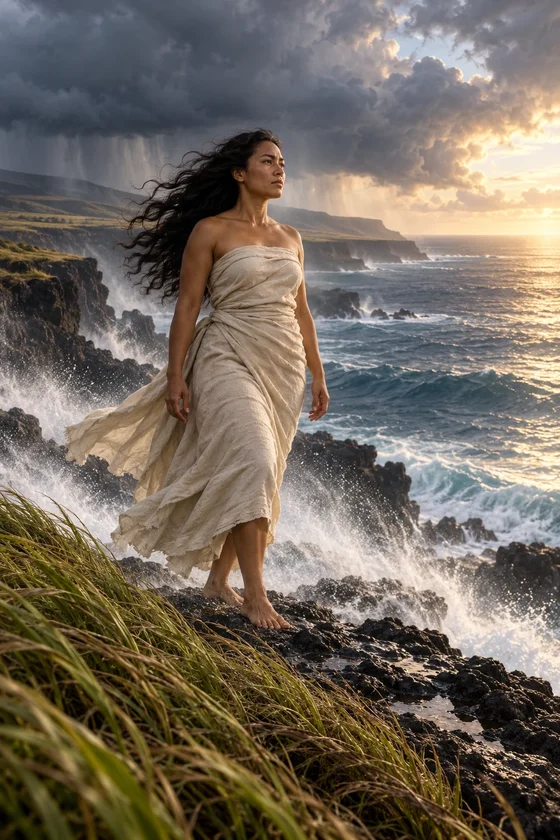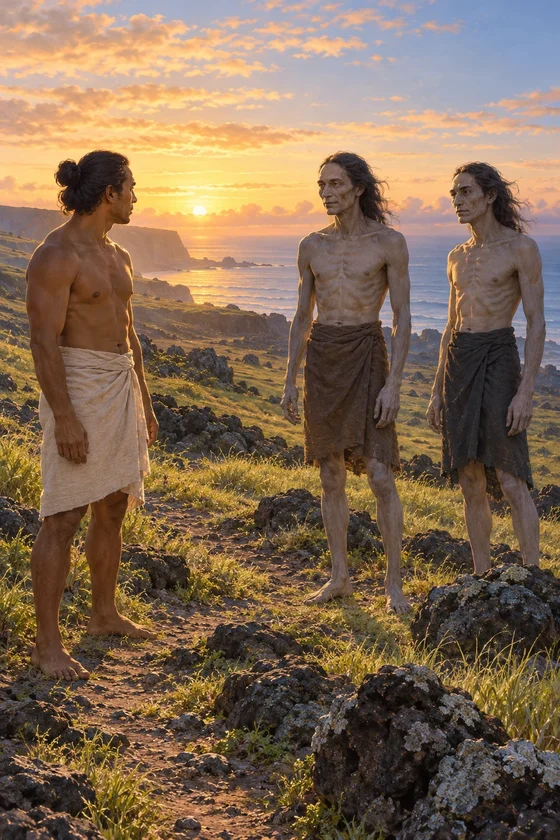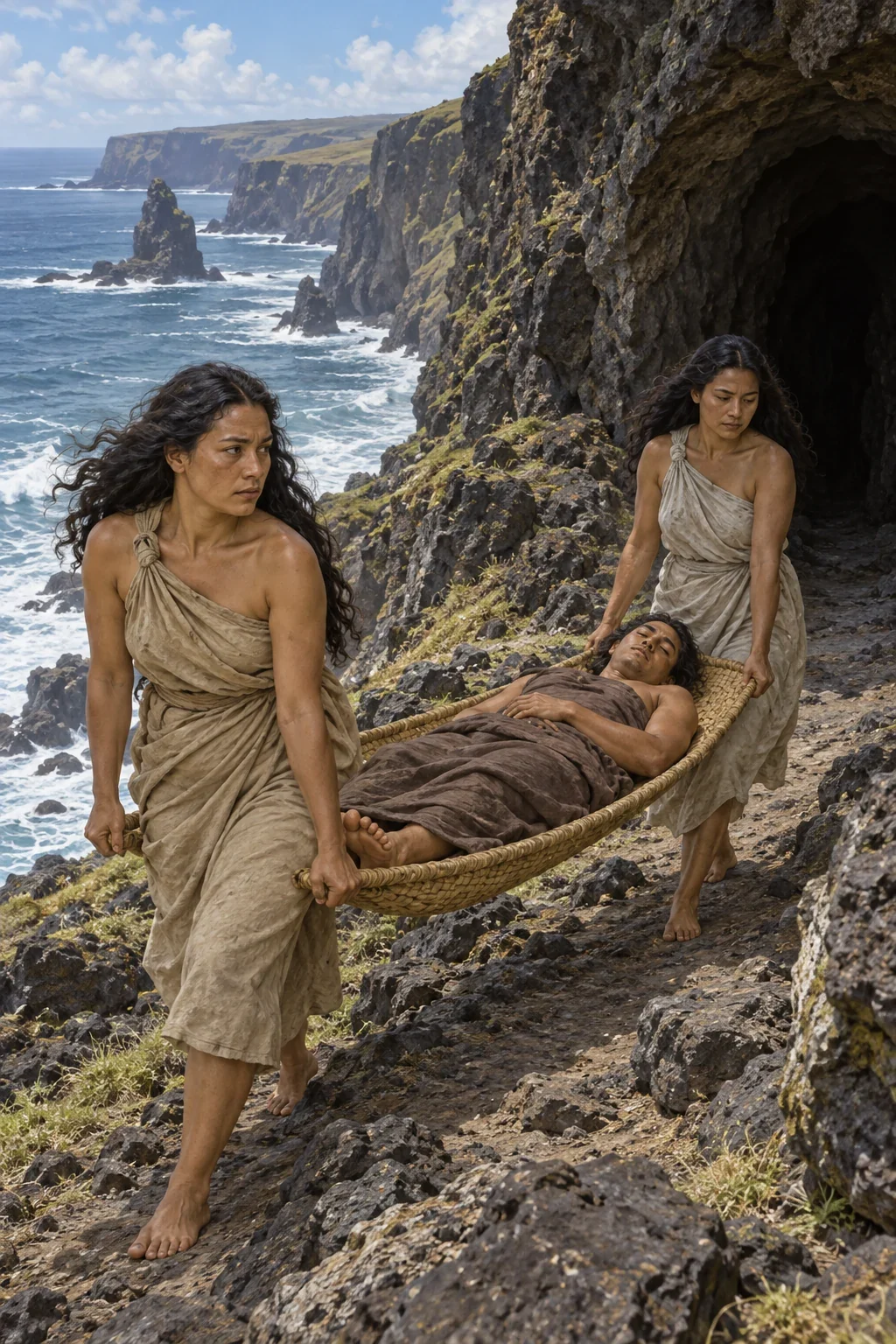
AI-generated interpretation of Kava-ara and Kava-tua carrying the sleeping Uré-a-hohové on his mat toward their cliff cave. The mat-carrying event follows the source; faces, clothing, mat construction, light and exact terrain are artistic choices, not an ethnographic reconstruction.
AI-generated interpretation of Kava-ara and Kava-tua carrying the sleeping Uré-a-hohové on his mat toward their cliff cave. The mat-carrying event follows the source; faces, clothing, mat construction, light and exact terrain are artistic choices, not an ethnographic reconstruction.
Overview
Kava-ara and Kava-tua are two female tatane who live together in a cave in the cliff-side of Paréhé. Routledge records their names within a discussion that also calls supernatural beings aku-aku. Hearing of the beauty of Uré-a-hohové, a young man living near Hanga Roa, they visit him, put him to sleep and carry him on his mat to the cave. The two captors form one acting pair in this complete account; the story does not provide separate careers or competing versions of their identities.
Before leaving the cave, they tell an old woman, herself an aku-aku, not to look inside. She does so and becomes the captive’s helper. She warns Uré to refuse the captors’ food and gives him chicken to eat instead. When Kava-ara and Kava-tua return, he pretends to accept what they offer while eating the chicken. The helper later tells him to kill cockroaches and flies if they come, but spare a crab. He follows the warning. The insects are other tatane, while the crab is the old woman; the passage does not identify those insects as Kava-ara or Kava-tua.
Uré’s father mourns his disappearance. Fishermen below the cliff hear a song and see him, but decline to attempt a rescue because the cave is so difficult to reach, even after his father gives them food. A woman finally volunteers, is lowered over the cliff in a net and brings Uré safely to the top. The story ends with his return home. Routledge’s comment that it does not say whether he married his deliverer is the recorder’s aside, not a missing marriage episode to supply. Her note50 locates Paréhé using the island’s eastern volcanic landscape and coastal erosion; it does not make this story evidence for a verified supernatural dwelling.
Origins & earliest records
Selected Rapa Nui oral account mediated through Katherine Routledge’s expedition narrative, originally published1919. The actual hosted witness includes a second-edition preface datedApril1920. The printed passage does not identify its individual narrator; publication dates this witness, not the beginning of the tradition.
Records & interpretation
The complete located account, relevant framing and attached notes were read in Gutenberg’s hosted historical transcription, which includes an April1920 second-edition preface. No first/second-edition collation is claimed. This attests recorded narrative and collector interpretation, not a verified supernatural event or current community-wide belief.
Selected bibliography
Documented works and useful reading. This is not a list of every appearance.
- 01
The Mystery of Easter Island: The Story of an Expedition
Chapter XVI, pp237–238; surrounding pp236–239; notes49–51, especially Paréhé note50. Work first published1919; hosted text contains second-edition preface datedApril1920. No edition-body collation claimed.
Family & connections
A source-supported family tree or inspiration record has not yet been compiled for this profile. Related reading below indicates a connection in subject matter, not a proven lineage or creative influence.
References
Sources supporting this profile. Linked pages have their own scope and editorial standards.
- Primary historical collectionThe Mystery of Easter Island: The Story of an Expedition — Chapter XVI, pp237–238; surrounding pp236–239; notes49–51, especially Paréhé note50.Research access: 2026-10-27
Image credits
Modern AI interpretation of a historical accountAI-generated interpretation of Kava-ara and Kava-tua carrying the sleeping Uré-a-hohové on his mat toward their cliff cave. The mat-carrying event follows the source; faces, clothing, mat construction, light and exact terrain are artistic choices, not an ethnographic reconstruction.
AI-generated interpretation of Kava-ara and Kava-tua carrying the sleeping Uré-a-hohové on his mat toward their cliff cave. The mat-carrying event follows the source; faces, clothing, mat construction, light and exact terrain are artistic choices, not an ethnographic reconstruction.