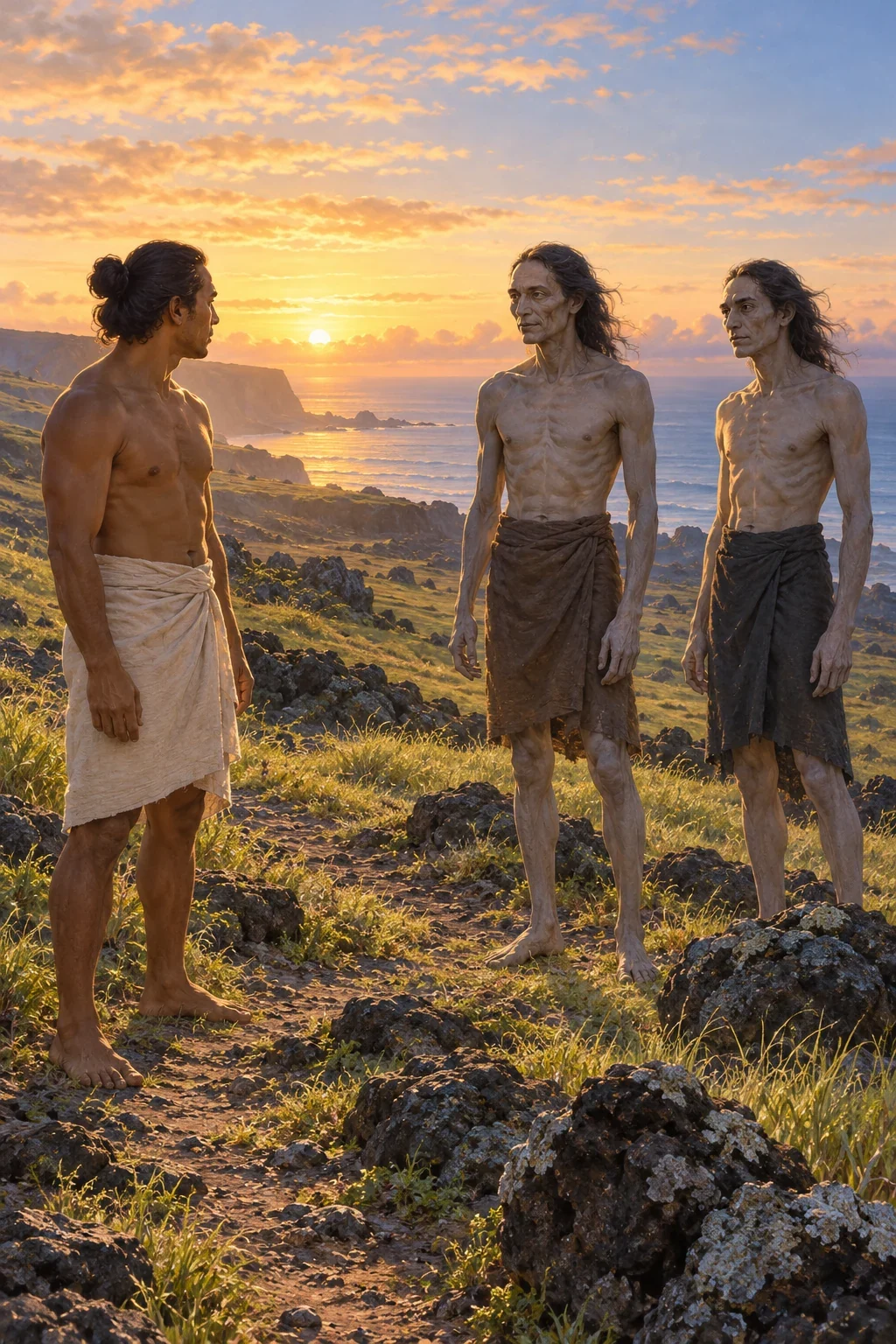
AI-generated interpretation of Tuukoihu meeting Ko Hitirau and Ko Nuku-te-mangoa at daybreak. Their conspicuous ribs follow the recorded encounter and its wooden-image context; faces, grey spirit colouring, garments and landscape are imagined. These story beings do not portray Rapa Nui ancestry or actual inhabitants.
AI-generated interpretation of Tuukoihu meeting Ko Hitirau and Ko Nuku-te-mangoa at daybreak. Their conspicuous ribs follow the recorded encounter and its wooden-image context; faces, grey spirit colouring, garments and landscape are imagined. These story beings do not portray Rapa Nui ancestry or actual inhabitants.
Overview
Ko Hitirau and Ko Nuku-te-mangoa are two male aku-aku encountered by Tuukoihu in Routledge’s collected account of wooden images. The recorder describes Tuukoihu as an ariki and skilled person with houses at Ahu Tepeu and Hanga Hahavé. The narrative begins before his meeting with the two males: female aku-aku named Papa Ahiro and Papa Akirani appear to him during sleep, and he makes two figures from toro-miro wood resembling them. The names belong to this recorded sequence; Routledge’s note67 compares the word papa with terms elsewhere in Polynesia, without establishing that these named figures are the same beings as a Hawaiian or other island’s Papa.
After fishing at Hanga Roa and sleeping there, Tuukoihu returns at daybreak by the quarry of the stone hats. Ko Hitirau and Ko Nuku-te-mangoa are sleeping along the way. Other aku-aku wake them and warn that an approaching man might notice their unusually conspicuous ribs. The pair ask whether Tuukoihu has seen anything. He replies that he has seen nothing, and they disappear; a further meeting produces the same question and answer. At home he carves two ribbed figures. After dark the spirits listen outside, intending to kill him if he speaks of the encounter, but he keeps silent.
The account continues with Tuukoihu making his male and female wooden images walk at his other home. When an image he has lent is caught in a house fire, he tells it to fly away, and it is later found unharmed. These actions complete the recorded wooden-image sequence rather than making the two male spirits creators of all island statues. Routledge separately reports the islanders rejecting the suggestion that prominent ribs portrayed starving first settlers. Her uncertainty about the figures’ original meanings and her speculative memorial-image explanation remain the recorder’s interpretation. This profile presents the named encounter and its ending without treating it as an archaeological demonstration or a portrait of Rapa Nui ancestry.
Origins & earliest records
Selected Rapa Nui oral account mediated through Katherine Routledge’s expedition narrative, originally published1919. The actual hosted witness includes a second-edition preface datedApril1920. The printed passage does not identify its individual narrator; publication dates this witness, not the beginning of the tradition.
Records & interpretation
The complete located account, relevant framing and attached notes were read in Gutenberg’s hosted historical transcription, which includes an April1920 second-edition preface. No first/second-edition collation is claimed. This attests recorded narrative and collector interpretation, not a verified supernatural event or current community-wide belief.
Selected bibliography
Documented works and useful reading. This is not a list of every appearance.
- 01
The Mystery of Easter Island: The Story of an Expedition
Chapter XVI, complete Wooden Carvings subsection pp269–271; Tuukoihu narrative pp270–271; notes65–67. Work first published1919; hosted text contains second-edition preface datedApril1920. No edition-body collation claimed.
Family & connections
A source-supported family tree or inspiration record has not yet been compiled for this profile. Related reading below indicates a connection in subject matter, not a proven lineage or creative influence.
References
Sources supporting this profile. Linked pages have their own scope and editorial standards.
- Primary historical collectionThe Mystery of Easter Island: The Story of an Expedition — Chapter XVI, complete Wooden Carvings subsection pp269–271; Tuukoihu narrative pp270–271; notes65–67.Research access: 2026-10-27
Image credits
Modern AI interpretation of a historical accountAI-generated interpretation of Tuukoihu meeting Ko Hitirau and Ko Nuku-te-mangoa at daybreak. Their conspicuous ribs follow the recorded encounter and its wooden-image context; faces, grey spirit colouring, garments and landscape are imagined. These story beings do not portray Rapa Nui ancestry or actual inhabitants.
AI-generated interpretation of Tuukoihu meeting Ko Hitirau and Ko Nuku-te-mangoa at daybreak. Their conspicuous ribs follow the recorded encounter and its wooden-image context; faces, grey spirit colouring, garments and landscape are imagined. These story beings do not portray Rapa Nui ancestry or actual inhabitants.