A sourced illustration has not yet been added. This gap is included in the coverage record.
Overview
Trentren lives on land in the Museo Chileno de Arte Precolombino's public account. When Caicai floods the earth, Trentren orders hills to grow higher and gives fleeing people a refuge. The opposition explains a transformed landscape within the story. It also gives this powerful serpent a protective role, making a generic classification as an attacking monster misleading.
In Antonio Rojas' Ancud narrative, Trentren hears a captive mother crying because her child will be taken from her. The serpent carries the infant away and shelters it in a mountain cave. Trauco cannot catch up, and Caicai's rage escalates into a flood with help from the Pillanes' rain. Trentren warns people to climb its hill and keeps raising it above the water. Finally a tail strike dislodges the rock Caicai is climbing, ending the pursuit and leaving a lagoon below.
The mother’s request determines the order of rescue in Rojas’s telling. Trentren first offers to take her to his hill, but she says her legs have become joined through prolonged confinement and asks him to save the baby first. When Trauco approaches carrying a crooked stick, Trentren starts to confront him; the woman recalls him to her daughter’s safety. She places the infant inside the serpent’s open mouth, and he carries her uphill beyond Trauco’s reach. The episode subsequently follows the baby and the flood; it does not separately narrate the promised rescue of the mother.
Trentren shelters the infant in a cave compared to a very deep well, entered from the hilltop. The struggle lasts many days and nights, with repeated increases in the hill’s height answering the rising sea. His final tail blow dislodges the rock that Caicay is using to climb toward the summit. The survivors return to their land when the waters fall. Their discovery of a lagoon supplies the tale’s concluding landscape explanation, while the later fate of the protected child remains unstated.
Origins & earliest records
A securely inspected written witness is Saunière's periodical series of 1916–1918, which attributes this episode to Antonio Rojas of Ancud. The museum's modern account provides a separate version centred on public refuge. The dates identify publications rather than the age of the transmitted tradition, and the story does not establish a measured prehistoric uplift event.
Records & interpretation
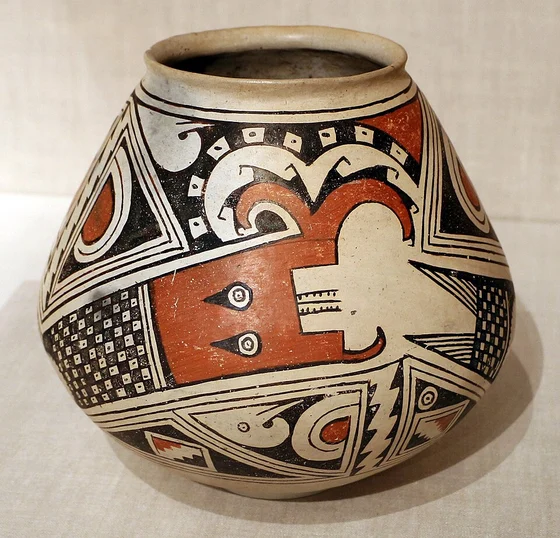
The two sources support the protective serpent and rising hills but give different starting conflicts and endings. Rojas' child rescue is not silently added to the museum's telling. Saunière could not identify the lagoon through her informant. The museum's archaeological object offers a possible visual comparison; its serpent-and-lizard decoration is not securely demonstrated to depict these beings. Complete five-part narrative,249–252, distinguishes the child’s narrated rescue from the mother’s promised but unreported removal; Caicay’s disappearance is not an explicit declaration of death.
Selected bibliography
Documented works and useful reading. This is not a list of every appearance.
- 01
Cuentos populares araucanos y chilenos recogidos de la tradición oral
Complete El Trentren y el Caicay-vilu, narrated by Antonio Rojas of Ancud; printed249–252, PDF52–55, including all five narrative sections and separately attributed editorial notes.
- 02
Caicai y Trentren
Public account accompanying mace head MChAP 0215; proposed iconographic connection remains a question.
Family & connections
A source-supported family tree or inspiration record has not yet been compiled for this profile. Related reading below indicates a connection in subject matter, not a proven lineage or creative influence.
References
Sources supporting this profile. Linked pages have their own scope and editorial standards.
- Primary textSaunière: Antonio Rojas' attributed serpent storyResearch access: 2026-10-05
- MuseumMuseo Chileno de Arte Precolombino: Caicai and TrentrenResearch access: 2026-10-05
Image credits
A sourced illustration has not yet been added. This gap is included in the coverage record.